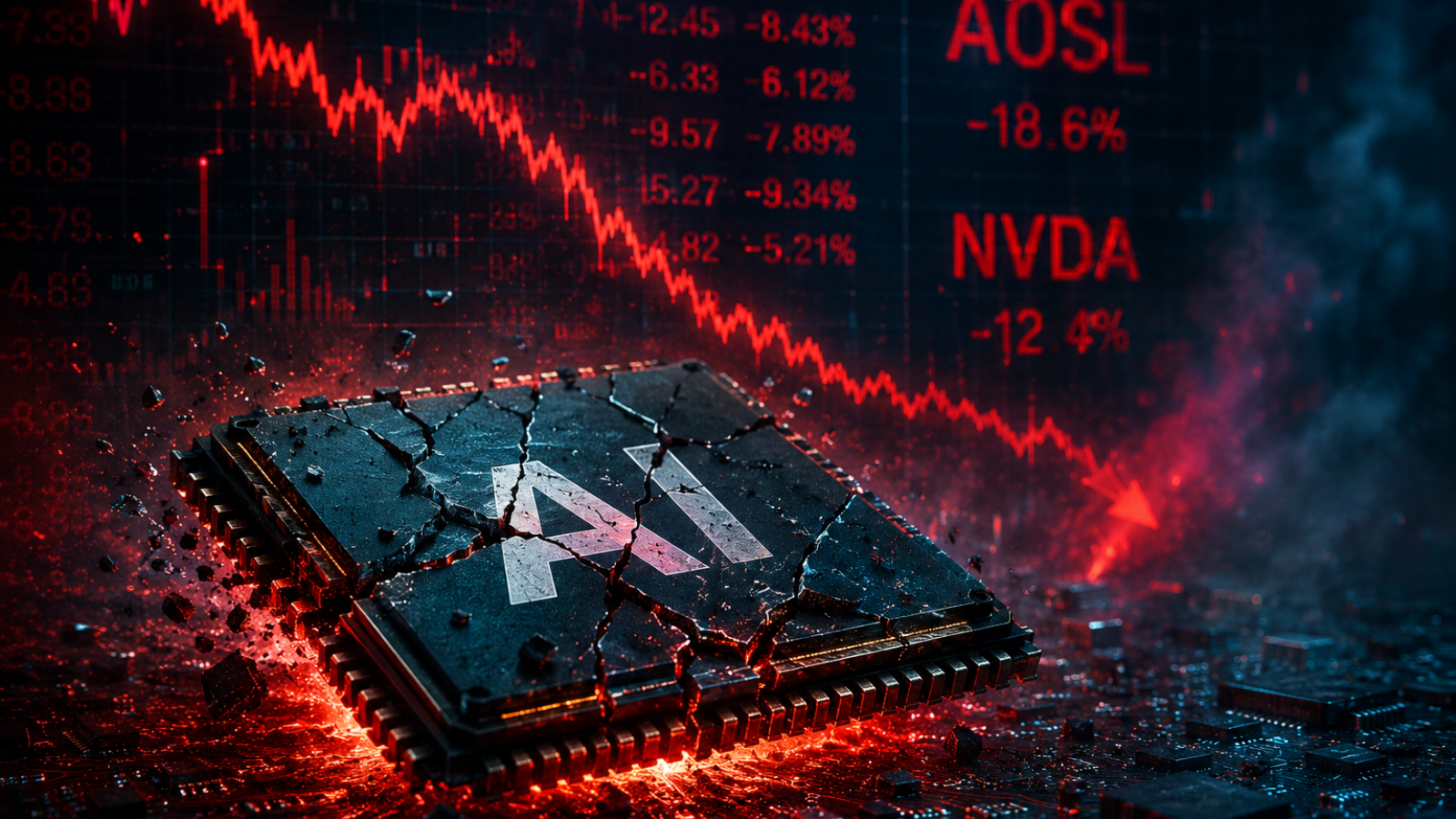
The artificial intelligence rally that dominated the stock market for over a year is facing a sharp reality check. While the long-term outlook for AI remains massive, several immediate pressures — from severe supply bottlenecks to fading market momentum — are forcing a correction in share prices.
If you are wondering why AI stocks are falling today, here is a breakdown of the three key factors currently reshaping the market.
The Memory Bottleneck and Rising Costs
A major reason for the recent slump is a critical supply-demand imbalance. Specialized memory, known as High Bandwidth Memory (HBM), is the lifeblood of AI chips, and right now, demand is significantly outpacing supply.
The industry is so desperate for these components that Nvidia recently finalized a massive $500 billion deal with SK Hynix to secure its HBM supply, with the first large-scale data centers expected to be online in 2027. Analysts at Bank of America warn that this scarcity will drive up prices for DRAM and NAND products, which could squeeze the profit margins of semiconductor firms and increase costs for the entire AI infrastructure buildout.
Fading Momentum: The Case of AOSL
After months of record-breaking gains, investor momentum is beginning to fade. Alpha and Omega Semiconductor (AOSL) serves as a perfect example of this trend. Despite a year-to-date gain of nearly 50%, the stock has dropped approximately 30% in just the last month.
It looks like the early excitement is cooling off, with investors taking a step back to rethink valuations while they wait for the next earnings season to confirm whether the story still holds up. Investors are increasingly concerned about cyclical electronics demand and the risk of margin pressure if competition in the power chip sector intensifies.
The $950 Billion Global Shift in AI Financing
The way AI infrastructure is financed is also changing, which can create short-term market uncertainty. A recent high-profile summit in San Francisco saw a landmark shift as South Korean industrial giants joined forces with U.S. tech leaders.
By the end of this gathering — which included figures like Jensen Huang and Sam Altman — roughly $950 billion in new AI agreements had been signed. This includes the $500 billion Nvidia deal and a separate $200 billion pact between Samsung and Broadcom. What’s notable here is that the list of major players buying into this trend has expanded well beyond tech giants to include foreign governments and large industrial conglomerates. While these massive investments prove the industry is still growing, the shift toward complex international partnerships and the sheer scale of the capital required are making some investors cautious.
Is This a Buying Opportunity?
Despite the recent slide, the underlying “AI power story” remains strong. Record-high revenues in AI and graphics computing suggest that the actual demand for power management solutions is still expanding. Memory supply constraints remain a genuine risk that could push costs higher, but demand for AI infrastructure is running at record levels — and that’s still keeping the long-term outlook for the sector intact.
Because of the recent sell-off, some analysts believe high-quality stocks are now significantly mispriced. For instance, AOSL is estimated to be roughly 34% undervalued, with a fair value target of $47.00 — well above its recent trading price of $30.85. For the patient investor, this pullback might represent a strategic entry point into the next phase of the AI race.
Editorial Note: This article was researched and drafted with AI assistance, then rigorously fact-checked, edited, and published by Miles. All content is strictly for informational and educational purposes only and does not constitute professional investment advice. Cryptocurrency and global financial markets experience severe volatility, sometimes swinging 50% or more in a single day. Invest only capital you can comfortably afford to lose, and always consult a certified financial advisor before committing funds. Read my full Disclaimer for more details.