Entering the digital asset market requires mastering several tools, but none is more fundamental than the crypto wallet. If you are buying digital currencies, collecting digital art, or interacting with decentralized protocols, understanding what a crypto wallet is is your first and most vital security step. Many newcomers assume that a wallet functions like a physical leather folder holding actual cash, but the reality is entirely cryptographic. This comprehensive guide builds your knowledge from the ground up, explaining how these devices protect your assets and how to choose the right option for your financial goals.
Table of Contents
Definition of a Crypto Wallet
A crypto wallet is a specialized device, physical medium, software application, or web service designed to manage the public and private cryptographic keys needed to execute cryptocurrency transactions. The fundamental characteristic of a crypto wallet is that it does not hold your digital assets directly. Instead, all digital coins and tokens reside on decentralized, public blockchains like Bitcoin, Ethereum, or Solana.
The wallet’s primary job is to protect and manage your cryptographic keys. These keys act as proof of ownership and provide the necessary credentials to authorize asset movements. Without these keys, your digital assets remain completely inaccessible. In addition to key storage, modern wallets allow you to encrypt and digitally sign information, enabling you to sign documents, verify your identity, or execute complex automated smart contracts on a blockchain network.
The History of Cryptocurrency Wallets
The origin of cryptocurrency wallets is deeply tied to the launch of Bitcoin in late 2008. Satoshi Nakamoto published the seminal paper, “Bitcoin: A Peer-to-Peer Electronic Cash System,” laying out a system based on cryptographic proof rather than trust. In January 2009, Satoshi released the very first wallet software, known simply as the Satoshi client or Bitcoin. This open-source software program executed the first-ever transaction on the network when Nakamoto sent 10 bitcoins to developer Hal Finney to prove the network’s technical feasibility.
As the software matured, the user interface toolkit transitioned from wxWidgets to Qt in version 0.5, leading to the name Bitcoin-Qt. By version 0.9, the developer community renamed the program Bitcoin Core to distinguish the client from the wider Bitcoin network. In the years that followed, open-source developers built forks of Bitcoin Core, such as Bitcoin XT, Bitcoin Unlimited, and Parity Bitcoin, introducing alternative rules and design structures. What started as a command-line tool has since evolved into a global ecosystem of multi-chain web, desktop, and physical devices.
How Crypto Wallets Work Under the Hood
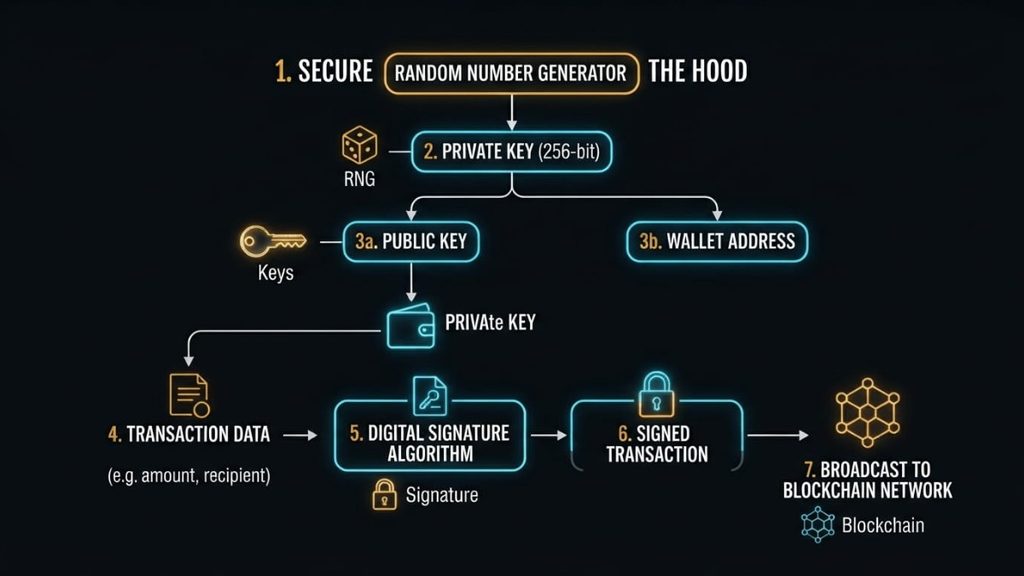
To understand how these systems operate, you must separate the user interface from the underlying blockchain ledger. Under the hood, a wallet utilizes advanced public-key cryptography to generate, manage, and sign transactions.
Key Generation and Cryptographic Math
When you set up a new wallet, the system uses a random number generator (RNG) to produce a highly secure, randomized number. This random number is mathematically converted into a private key according to the specific cryptographic criteria of that blockchain. From this private key, a corresponding public key is mathematically derived. Because the mathematics relies on one-way cryptographic functions, it is virtually impossible to reverse-engineer a private key from a public key.
The Role of Keys and Addresses
To understand daily operations, think of your keys through these standard banking analogies:
- Public Key and Wallet Address: Your public key is hashed to create your alphanumeric wallet address, which behaves like an email address or a bank routing number. This address can be shared openly with anyone who wants to send you digital assets.
- Private Key: Your private key acts as your secret digital signature and master password. It must remain confidential at all times. Anyone who gains access to your private key can authorize transactions and permanently drain your wallet.
Transaction Signing and Ledger Updates
When you send a transaction, your wallet uses your private key to generate a unique digital signature. This signature acts as cryptographic proof that you authorized the transfer, without revealing the private key itself to the internet. The signed transaction data is broadcast to the peer-to-peer blockchain network. Miners or validators verify the cryptographic signature against the public address to confirm its validity. Once confirmed, the transaction is permanently recorded on the immutable public ledger, and the updated balances are reflected in your wallet interface.
The Different Types of Crypto Wallets
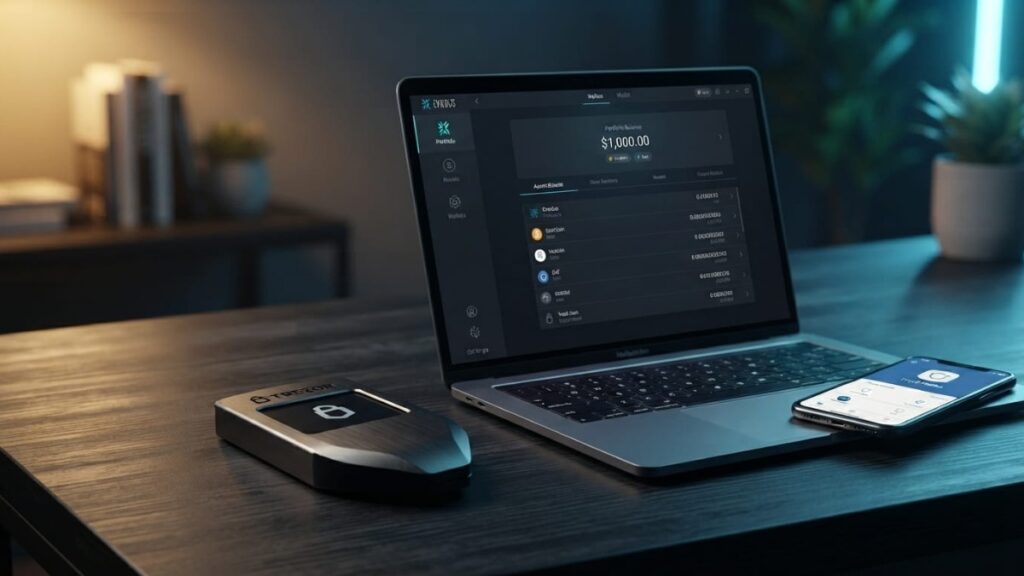
As the digital economy has expanded, developers have engineered a wide range of wallet types. These are categorized by how they connect to the internet (hot vs. cold) and their physical form.
Hot Wallets vs. Cold Wallets
- Hot Wallets: Any wallet that is continuously connected to the internet. These include mobile applications, web browsers, and desktop programs. They are convenient for day-to-day transactions, but their online connection exposes them to potential remote attacks.
- Cold Wallets: Offline storage media that are completely disconnected from the internet. Since the private keys never touch an online environment, cold wallets are highly resistant to remote hacking.
Software Wallets
Software wallets are applications installed directly on your computing devices. They operate in several modes, depending on their technical complexity:
- Full Clients: These applications verify transaction validity directly by downloading a full, local copy of the blockchain ledger. They provide maximum trustlessness but require significant storage, bandwidth, and computational power.
- Lightweight Clients (SPV): These programs consult external full nodes to send and receive transactions without storing the entire blockchain locally. This allows them to run efficiently on low-power devices like smartphones, though users must place some trust in external full nodes.
- Web and Browser Extension Wallets: Access Web3 applications and DeFi platforms directly through your internet browser without local software downloads. Non-custodial examples include MetaMask and Trust Wallet, while Binance Wallet offers a hybrid setup.
- Desktop Wallets: Applications run locally on your computer, generating an encrypted file called wallet.dat locally. Electrum is a classic, highly respected example of a desktop wallet.
- Mobile Wallets: Smartphone applications that let you manage digital assets on the go using QR codes for scanning and payments.
Hardware Wallets
A hardware wallet is a dedicated physical peripheral, similar to a secure USB drive, built with a tamper-resistant secure chip. Devices like the Ledger Stax, Ledger Flex, Ledger Nano X, or Trezor Model T generate and store your private keys entirely offline. Transactions are processed and signed internally within the isolated hardware environment, meaning your private keys are never exposed to the host computer. This ensures complete security even if you connect the hardware device to a computer infected with viruses or keylogging malware.
Paper Wallets
An early method of cold storage, a paper wallet, is a physical piece of paper containing your public address and private key printed as text and QR codes. They are immune to digital hacking but are vulnerable to physical destruction, water damage, fire, or theft. Furthermore, paper wallets carry severe procedural risks. For instance, if you spend a portion of a paper wallet’s balance, the blockchain network may send the remaining change to a newly generated “change address” that you do not physically control, leading to the permanent loss of your funds. Consequently, their use is now widely discouraged.
Custodial vs. Non-Custodial Custody Models
When selecting a wallet, the most critical architectural decision is deciding who holds and controls the private keys. This defines the difference between custodial and non-custodial custody.
Custodial Wallets (Hosted Accounts)
In a custodial framework, a third-party intermediary—such as a centralized cryptocurrency exchange or institutional custodian—manages the private keys and secures the funds on your behalf.
- The Trade-off: This model prioritizes convenience. If you forget your password, you can restore access through standard customer support channels, identity verification, or email resets.
- The Risk: You do not have true ownership of your assets. Your funds are subject to the custodian’s withdrawal limits, operational uptime, and regulatory compliance. If the exchange experiences a severe security breach, regulatory freeze, or bankruptcy (such as the historic Mt. Gox collapse in 2011), your funds may be lost permanently.
Non-Custodial Wallets (Self-Custody)
A non-custodial wallet grants you total, exclusive control over your private keys and seed phrase. This model represents the foundational Web3 philosophy: “not your keys, not your coins”.
- The Trade-off: You gain complete financial sovereignty. No bank, government, or exchange can freeze, seize, or block your funds, enabling direct peer-to-peer global payments.
- The Risk: The entire burden of security falls squarely on your shoulders. If you lose your seed phrase or private key, there is no “forgot password” button. Your digital assets will be locked in the blockchain forever, with zero options for recovery.
Key Derivation Standards: Sequential, Hierarchical, and Non-Deterministic
As wallet technology has matured, the methods used to derive and organize cryptographic keys have evolved through several standard improvement proposals.
Non-Deterministic Wallets
An early wallet design where every private key is generated completely independently using a separate random number. This means there is no mathematical relationship between your addresses. To secure this type of wallet, you must back up the entire wallet file every single time you generate a new address, making backups cumbersome and prone to human error.
Sequential Deterministic Wallets
To simplify backups, developers introduced deterministic wallets. A sequential deterministic wallet uses a single master starting string or “seed”. It then applies a cryptographic hash function, such as SHA-256, in a simple formula: SHA-256(seed + n), where n is an ASCII number that starts at 1 and increments sequentially as new keys are needed. This allows a user to back up a single starting string and regenerate subsequent keys in the exact same order.
Hierarchical Deterministic (HD) Wallets (BIP32)
Standardized in Bitcoin Improvement Proposal 32 (BIP32), Hierarchical Deterministic (HD) wallets represent the modern industry standard. Instead of deriving a single sequential chain of keys, an HD wallet uses a master root seed to generate an entire, stratified “tree” of independent keypair chains. This enables a single backup phrase to manage multiple accounts, diverse cryptocurrencies, and infinite addresses across different networks, organized in clean, nested structural branches.
The Core Benefits of Using a Crypto Wallet
Utilizing a dedicated, self-custody wallet provides several key advantages that traditional banking systems cannot match.
- True Asset Ownership: By directly holding your private keys, you hold absolute, legal proof of ownership over your funds. You are not a creditor to a bank or an exchange; you are your own sovereign financial institution.
- Global, Intermediary-Free Payments: Send and receive digital currencies 24/7, across international borders, without relying on central clearinghouses, banking holidays, or manual approvals. Transactions are processed peer-to-peer at high speeds and low costs.
- Unrivaled Interoperability: Modern multi-chain wallets support thousands of assets across diverse Layer 1 and Layer 2 networks, such as Ethereum, Solana, Avalanche, and Cronos, all within a single unified user interface.
- Financial Inclusion for the Unbanked: Anyone with an internet connection can set up a wallet instantly without credit checks or physical documentation, opening up global decentralized financial services to underbanked populations worldwide.
- Advanced Web3 and DeFi Integration: A non-custodial wallet serves as your digital passport to the decentralized web. It allows you to trade on decentralized exchanges, lend assets to earn yield, stake tokens directly to secure blockchain consensus networks, and purchase or display unique digital collectibles (NFTs).
Risks, Vulnerabilities, and Real-World Threats
While crypto wallets offer immense power, managing your own security comes with notable risks. Understanding these vectors is crucial for keeping your assets safe.
Phishing and Social Engineering
Phishing remains the most common threat to wallet security. Attackers construct fraudulent websites, replicate legitimate wallet extensions, or send fake support emails designed to trick you into typing in your seed phrase or signing a malicious smart contract transaction. Once they obtain your phrase, they will instantly drain all associated funds.
Malware and Device Exploits
Keyloggers and copy-paste clipboard hijackers run silently on compromised computers or mobile devices. A clipboard hijacker detects when you copy a wallet address and silently swaps it in your clipboard for an attacker’s address, causing you to accidentally send funds to the wrong destination.
Smart Contract and Blind Signing Vulnerabilities
Interacting with unverified decentralized applications (dApps) can lead to devastating smart contract exploits. If you “blind sign” a transaction—approving a contract’s request without fully reading or understanding the parameters—you may grant a malicious script permanent permission to drain your entire wallet’s balance.
Physical Supply Chain and Software Bugs
Even offline cold wallets are not completely immune to technical exploits. Physical devices purchased from unauthorized third-party resellers may be tampered with before arrival. Additionally, software and firmware bugs can introduce severe security holes.
For example, in late July 2026, the cold wallet manufacturer Coinkite disclosed a critical software bug affecting its devices. This software bug allowed attackers to access supposedly secure cold wallets under specific conditions, resulting in catastrophic losses of approximately $130 million (with some industry estimates reaching $140 million) by early August 2026. This real-world incident highlights that no storage method is entirely infallible, and continuous vigilance is required.
Getting Started: How to Set Up Your First Wallet
Setting up your first crypto wallet is a straightforward process, but it requires strict attention to detail to ensure your setup is secure.
Step 1: Research and Select a Trusted Provider
Analyze your personal goals. If you trade actively in small amounts, a mobile software wallet like Trust Wallet or MetaMask is highly practical. For holding large portfolios long-term, invest in a hardware signer from an official manufacturer. Always verify the official website’s URL to avoid landing on fake, malicious phishing clones.
Step 2: Install and Launch the Application
Download the application from verified app stores or the official site. For hardware devices, connect the physical unit to your computer via cable or Bluetooth, install the official companion software, and perform any necessary firmware updates.
Step 3: Generate a New Wallet and Secure Your Seed Phrase
Select the option to “Create a New Wallet”. The system will generate your public address and a randomized 12-to-24-word seed phrase (under the BIP-39 standard). Write this phrase down physically on paper or engrave it on metal. Never take a digital screenshot, save it in a text file, or store it in cloud services, as these are highly vulnerable to hacking. Confirm the phrase by entering the words in the exact sequential order requested by the setup interface.
Step 4: Fund Your Wallet and Manage Network Selection
To execute on-chain activities, you must fund your wallet with the native cryptocurrency of that specific blockchain to cover transaction fees, commonly referred to as gas fees. For example, you must hold Ethereum (ETH) to pay fees on the Ethereum network, Solana (SOL) to execute trades on Solana, or BNB to transact on the BNB Chain.
When transferring funds from a custodial exchange account (like Binance) to your self-custody wallet, you must copy your public address and select the exact matching blockchain network (e.g., ERC20 for Ethereum, BEP20 for BNB Chain, SPL for Solana). Sending assets over the wrong network can result in the permanent loss of your funds. If you are transferring a large balance, always send a small, low-value test amount first to confirm the transaction lands safely before sending the remaining funds.
Best Practices for Securing Your Digital Assets
To protect your digital assets from evolving security threats, you should implement these strict, industry-standard security protocols:
- Keep Your Seed Phrase Completely Offline: Never store your seed phrase digitally. Use physical media like fireproof steel plates or paper notebooks locked in a secure safe or safety deposit box.
- Opt for Clear Signing over Blind Signing: Never sign a transaction unless you can read and verify the exact parameters on your screen. Clear signing provides complete, human-readable details of what assets are entering or leaving your wallet before you press approve.
- Utilize Advanced Transaction Simulations: Choose modern wallets and browser extensions that actively simulate transaction outcomes before you sign them, showing you exactly what permissions and assets you are granting to a smart contract.
- Implement Strong Authentication Measures: Secure all custodial exchange accounts with multi-factor authentication (2FA), set up unique anti-phishing codes, and establish a whitelist of authorized withdrawal addresses.
- Purchase Directly from Manufacturers: Never buy hardware wallets from third-party marketplaces like eBay or unauthorized Amazon listings. Only purchase directly from the official manufacturer, and carefully inspect the packaging’s security seals upon arrival to ensure they have not been tampered with.
- Regularly Revoke Smart Contract Allowances: Use reliable blockchain explorer tools to periodically audit and revoke token approvals and spending limits granted to old or unused decentralized applications, minimizing your active attack surface.
The Future of Crypto Wallets and Web3 Integration

As decentralized technology advances, the classic crypto wallet is undergoing an evolutionary shift, moving from a simple key storage app to an intelligent, user-friendly Web3 control panel.
Smart Accounts and Account Abstraction (ERC-4337)
The development of Smart Accounts (ERC-4337) is transforming wallet usability. Instead of relying on a simple private key that is easily lost, account abstraction allows wallets to operate as programmable smart contracts. This enables advanced, consumer-friendly features such as multi-signature security, automatic recovery options (social recovery), transaction batching, and gasless transactions where decentralized applications can sponsor network fees for users.
Secure Cross-Chain Interoperability
Historically, moving assets across multiple isolated blockchains required using highly vulnerable third-party token bridges. Today, protocols like the Chainlink Cross-Chain Interoperability Protocol (CCIP) are establishing a secure global standard for cross-chain data and value transfer. By integrating CCIP directly, future Web3 wallets will behave as a universal, seamless interface across a multi-chain world, allowing you to execute cross-chain transfers and trigger smart contracts across different networks with a single click.
Oracle-Driven Portfolios and Automation
Wallets increasingly rely on decentralized oracle infrastructure like Chainlink Data Feeds to deliver accurate, real-time fiat valuations for diverse tokens directly inside user dashboards. Additionally, integrations with Chainlink Automation enable programmable wallet features, allowing users to automatically execute limit orders, top up collateralized loans when balances run low, or automate recurring investment strategies directly from their secure self-custody wallets.
Sovereignty and National Frameworks
Beyond financial transactions, next-generation wallets are being designed to support national digital identities. A prime example is the European Union’s development of an eIDAS-compliant eID wallet under the European Self-Sovereign Identity Framework (ESSIF), operating on the European Blockchain Services Infrastructure (EBSI). The EBSI wallet is built to securely store verified academic credentials, professional diplomas, and official state identities, allowing citizens to digitally sign legal documents and securely verify their identity across member states.
Conclusion
Understanding the mechanics of a crypto wallet is the absolute foundation of participating in the decentralized digital economy. Far from being a simple folder that stores digital coins, a wallet serves as your personal cryptographic command center and digital passport to Web3. Choosing between the fast convenience of an online hot wallet and the fortress-like security of an offline hardware device depends entirely on your trading patterns, portfolio size, and risk appetite. By keeping your seed phrase strictly offline, clearing every transaction, and choosing trusted partners, you can safely navigate the blockchain ecosystem and maintain full control over your financial destiny.
Resources
- Wikipedia: Cryptocurrency Wallet Technical Specifications.
- Binance Academy: Step-by-Step Crypto Wallet Setup and Security Guide.
- Chainlink: The Role of Decentralized Oracles in Web3 Wallets.
- Ledger: Self-Custody Best Practices and Offline Seed Storage.
- Trust Wallet: Beginner’s Guide to Multi-Currency Web3 Interfaces.
- Fidelity: Navigating Digital Asset Custody Models.
Frequently Asked Questions(FAQ)
What is a crypto wallet?
A crypto wallet is a digital program, physical hardware device, or online service that generates and stores the cryptographic keys (public and private) required to access, manage, and sign transactions for digital assets. The wallet does not hold actual coins; instead, your funds remain on the blockchain, and the wallet provides the security credentials to control them.
What is the difference between a custodial and a non-custodial wallet?
A custodial wallet is managed by an exchange or third party that holds and controls your private keys on your behalf, offering convenience and account recovery at the expense of true ownership. A non-custodial wallet gives you absolute control over your private keys and recovery phrase, ensuring complete ownership but placing the full responsibility for security on you.
Is a hardware wallet safer than a software wallet?
Yes, hardware wallets are significantly safer because they generate and store your private keys completely offline in an environment isolated from internet-connected devices, protecting them from remote hackers, malware, and phishing attacks. Software wallets run on devices continuously connected to the internet, exposing them to more cyber vulnerabilities.
What happens if I lose my hardware wallet?
If you lose your physical hardware wallet, your digital assets are still safe on the blockchain. As long as you have your written 12-to-24-word seed phrase, you can input it into any new, compatible hardware or software wallet to completely restore your accounts, keys, and assets. However, if you lose both the device and your seed phrase, your funds are lost permanently.
What are gas fees, and why do I need native tokens to pay them?
Gas fees are the standard network transaction fees paid directly to miners or validators to process and record your transactions on the blockchain public ledger. Because these fees are network-specific, you must hold the native token of that particular blockchain (such as ETH for Ethereum, SOL for Solana, or BNB for BNB Chain) in your wallet to authorize any token transfers, swaps, or smart contract interactions.
Can two people generate the exact same private key?
While mathematically possible (referred to as a key collision), the probability of two people generating the exact same private key is so extremely low that it is considered practically impossible. The mathematical space of possible 256-bit private keys is so astronomically vast that duplicate key generation has never occurred on any major network, making duplicate keys inconceivable.
Editorial Note: This article was researched and drafted with AI assistance, then rigorously fact-checked, edited, and published by Miles. All content is strictly for informational and educational purposes only and does not constitute professional investment advice. Cryptocurrency and global financial markets experience severe volatility, sometimes swinging 50% or more in a single day. Invest only capital you can comfortably afford to lose, and always consult a certified financial advisor before committing funds. Read my full Disclaimer for more details.