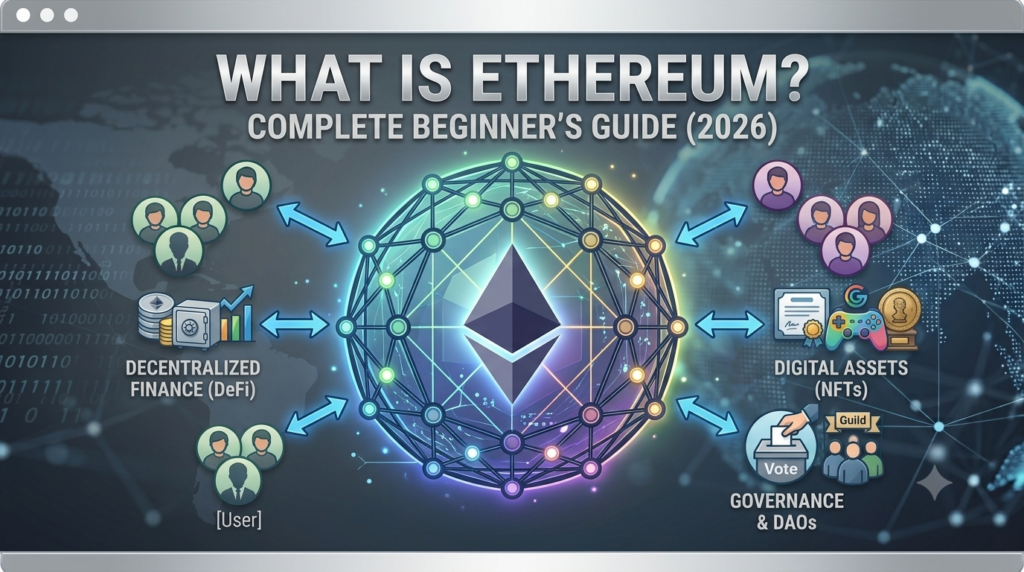
What Is Bitcoin? The Fundamental Definition
Bitcoin represents something unprecedented in financial history: a currency system that operates without banks, governments, or central administrators. At its core, Bitcoin is a decentralized digital money protocol that enables direct value transfer between participants across the globe without requiring intermediaries.
📈 Track real-time charts and professional market indicators with the world's leading charting platform.
Open Free TradingView Account →Disclaimer: We may earn a commission if you sign up through our link at no extra cost to you.
To understand what Bitcoin is, imagine a global ledger that nobody controls, but everyone can verify. Every transaction is recorded transparently, yet no single entity can manipulate it. This combination—transparency without central authority—distinguishes Bitcoin from every financial system that preceded it.
Unlike dollars stored in bank accounts or gold sitting in vaults, Bitcoin exists as pure information. It is a series of cryptographic codes stored on thousands of computers worldwide. Yet despite its digital nature, Bitcoin functions as sound money with fixed supply, divisibility, and portability that make it viable for storing and exchanging value.
If you are completely new to digital assets, we recommend starting with our comprehensive guide on What Is Cryptocurrency? to understand the broader ecosystem before diving deep into Bitcoin.
Table of Contents
The Origins: Why Bitcoin Was Invented
Understanding what Bitcoin is requires knowing the historical moment of its creation.
In 2008, the world financial system fractured. Lehman Brothers collapsed, banks required government bailouts, and trust in financial institutions evaporated. Ordinary people watched their retirement savings disappear while executives faced no consequences. Central banks printed trillions in new currency to prevent systemic collapse, a response that troubled many observers.
Against this backdrop, on October 31, 2008, an anonymous figure or group calling themselves Satoshi Nakamoto published a nine-page document titled “Bitcoin: A Peer-to-Peer Electronic Cash System.” The white paper described a technical system for money transfers that required no trusted intermediary.
On January 3, 2009, Nakamoto activated the Bitcoin network by mining the first block, called the Genesis Block. Embedded within that block was a message: the headline from The Times newspaper reading “Chancellor on Brink of Second Bank Bailout.” This wasn’t random. Nakamoto was signaling that Bitcoin represented a response to institutional financial failure.
For the first few years, Bitcoin remained obscure. Programmers and cryptography enthusiasts mined coins on their laptops. But the core vision persisted: create a form of money that no government could devalue, no bank could freeze, and no authority could control.
How Bitcoin Actually Works: The Technology Explained Simply
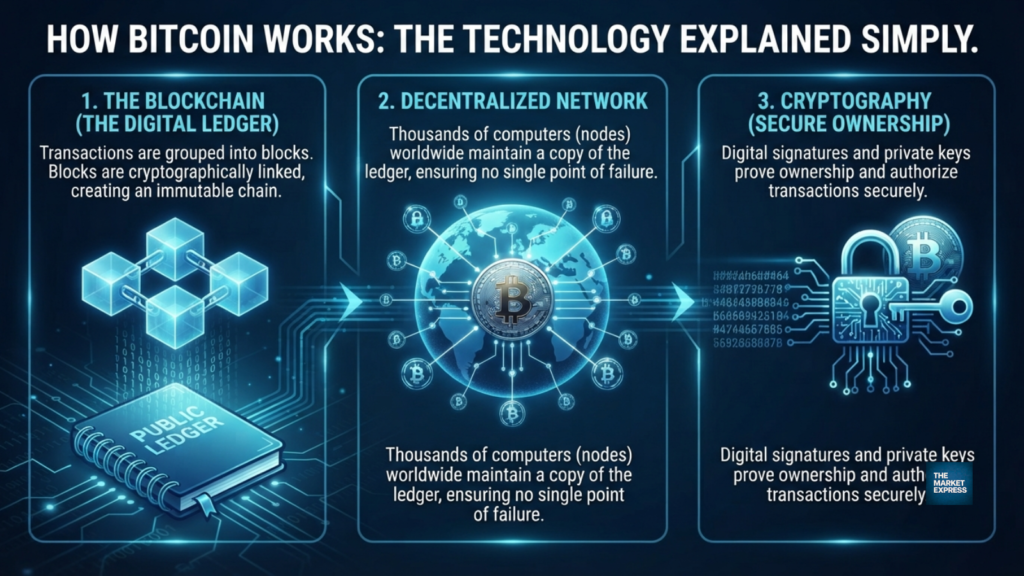
What makes Bitcoin possible involves several interconnected technologies working together.
The Blockchain: Bitcoin’s Fundamental Innovation
The blockchain is Bitcoin’s greatest innovation, yet it’s fundamentally simple. Imagine a notebook that records every transaction ever made. This notebook exists not on one server but simultaneously on thousands of computers worldwide. Everyone can read every page. New entries are added constantly, but old entries cannot be changed.
This ledger is arranged in blocks. Each block contains transaction records from a specific period. These blocks link together in a chain using mathematics. Block number 2 references Block 1 using a unique cryptographic fingerprint. Block 3 references Block 2. If someone attempted to alter a transaction in Block 1, its fingerprint would change, which would break Block 2, which would break Block 3, and so on.
To successfully tamper with Bitcoin’s history, an attacker would need to redo all the mathematical work for every block after the one they wanted to change. With thousands of miners constantly working to add new blocks, this becomes computationally impossible. The further back an attempted change occurred, the more impossible it becomes.
This system creates immutability without requiring anyone to trust anyone else.
Decentralization: No Single Point of Failure
Traditional money depends on institutions. Your bank holds your account information. The Federal Reserve manages the money supply. The SEC oversees markets. If these institutions fail or act maliciously, you have limited recourse.
Bitcoin eliminates this dependency by distributing the ledger across thousands of independent nodes—computers running Bitcoin software that maintain their own copy of the complete blockchain. These nodes are operated by enthusiasts, miners, businesses, and institutions worldwide.
When someone initiates a Bitcoin transaction, these nodes verify it independently. If the transaction violates Bitcoin’s rules—for example, if someone tried to spend the same Bitcoin twice—the nodes reject it. No single authority makes this decision. The rule is embedded in the software itself.
This decentralization means no government can shut down Bitcoin by closing its headquarters. No bank can freeze your Bitcoin by accessing a central database. Bitcoin’s security comes from its distribution, not from trusting an institution.
Cryptography: How You Prove Ownership
Bitcoin uses public-key cryptography, a mathematical system that enables secure digital signatures.
Every Bitcoin user generates two related keys: a public key and a private key. The public key is like an email address or bank account number. You share it freely so others can send you Bitcoin. The private key is like your password, but far more powerful. You keep it secret.
When you initiate a Bitcoin transaction, you use your private key to digitally sign it. This signature proves you authorized the transaction without revealing your private key. Recipients can verify the signature using your public key, confirming you genuinely sent the Bitcoin.
This system is so secure that no amount of computational power can forge a signature without the private key. A hacker cannot access your Bitcoin by stealing your public key. They would need your private key, which exists only where you store it.
Critically, if you lose your private key, your Bitcoin becomes permanently inaccessible. Unlike a bank account where you can reset a forgotten password, Bitcoin has no recovery mechanism. This creates personal responsibility for securing your own wealth.
Bitcoin Mining: The Engine Behind the Network
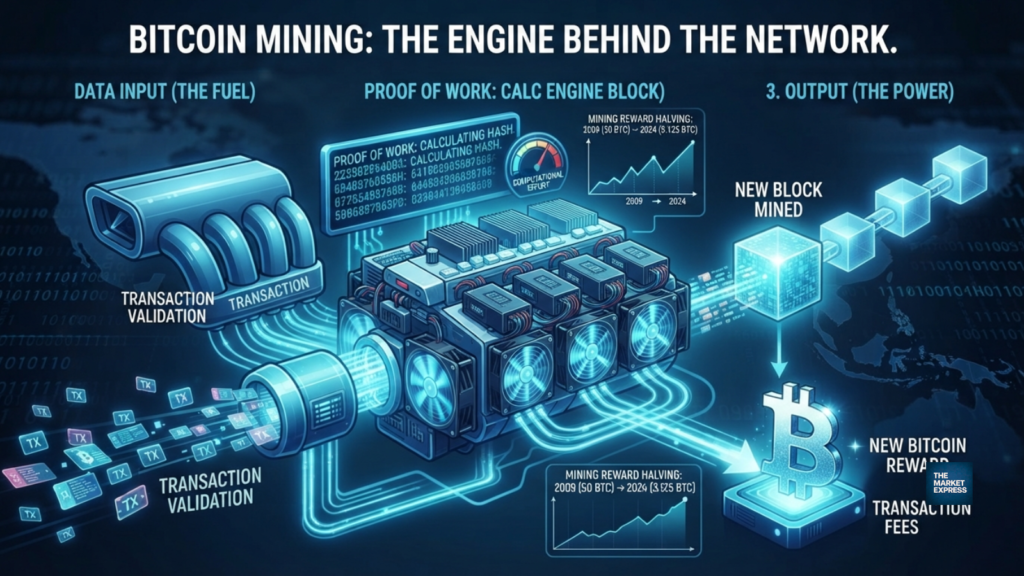
How does Bitcoin mining operate, and why is it so critical? Mining is both a technical process and an economic incentive system.
Bitcoin mining serves two functions. First, it processes transactions. Miners collect pending Bitcoin transactions, verify they follow the rules, and bundle them into new blocks. This validation prevents double-spending—the problem where someone spends the same Bitcoin twice.
Second, mining creates new Bitcoin. When a miner successfully solves a complex mathematical puzzle, they earn newly created Bitcoin plus transaction fees from the block they mined. This reward incentivizes people to operate mining hardware and secure the network.
The puzzle miners solve is called Proof of Work. It requires enormous computational effort but minimal effort to verify. This asymmetry ensures that attacking the network is economically irrational. An attacker would need more computing power than the entire honest network combined, costing billions of dollars.
Over time, Bitcoin’s mining rewards decrease. Originally, miners received 50 Bitcoin per block. Every 210,000 blocks (roughly four years), this reward halves. Today, miners earn 3.125 Bitcoin per block. Eventually, around the year 2140, the reward will shrink to zero.
When mining rewards diminish, transaction fees will become mining’s primary incentive. Users who want faster confirmations can pay higher fees, creating a market for block space.
The 21 Million Bitcoin Cap: Why Scarcity Matters
A fundamental characteristic of Bitcoin is its fixed supply. There will never be more than 21 million Bitcoins.
This scarcity is intentional and mathematical. The supply schedule was determined when Nakamoto coded Bitcoin. The protocol checks this limit automatically. No developer can change it. No miner can create extra Bitcoin. No government can print more.
Compare this to traditional currencies. Central banks control the money supply. When economic crises occur, central banks print currency, diluting the value of existing money. This process, called inflation, benefits those holding new currency first but eventually erodes purchasing power for everyone else.
Bitcoin’s fixed supply eliminates this problem. Its inflation rate decreases predictably over time and reaches zero permanently. Someone holding Bitcoin in 2080 knows exactly how many Bitcoins will ever exist.
This scarcity is why many investors call Bitcoin “digital gold.” Gold’s value partly derives from its rarity. More gold cannot be manufactured easily. Similarly, more Bitcoin cannot be manufactured at all.
Why Bitcoin Has Value: The Economics of Trust
Why does anything have value? Throughout history, humans have used various items as money: shells, salt, beads, precious metals, and government-issued paper. Each worked because communities agreed to accept them.
Bitcoin’s value follows the same principle. It has value because people accept it as payment and a store of value. But what drives this acceptance?
Decentralization creates censorship resistance. No authority can freeze your Bitcoin or prevent you from sending it. This matters tremendously for people in countries with capital controls or unstable currencies. A Venezuelan citizen can preserve wealth in Bitcoin despite their government’s currency collapse.
Scarcity protects purchasing power. As governments devalue their currencies through inflation, Bitcoin’s fixed supply maintains its relative value. This characteristic appeals especially to people experiencing high inflation or currency crises.
Divisibility enables small transactions. You don’t need to own a full Bitcoin. The smallest unit is 0.00000001 Bitcoin, called a Satoshi. This divisibility allows Bitcoin to function for both massive transactions and tiny payments.
Portability exceeds other assets. You can carry millions in Bitcoin value on a small hardware device or even memorize it as a recovery phrase. Moving gold or large cash quantities across borders is dangerous and regulated. Bitcoin moves instantly across the globe.
Cryptographic security prevents theft. With traditional assets, theft is possible. Bitcoin’s cryptographic foundation makes theft impossible if you secure your keys properly.
These characteristics combine to create value. Bitcoin’s price fluctuates based on supply and demand, but its underlying characteristics remain constant.
Bitcoin in the Modern Financial System: Recent Developments
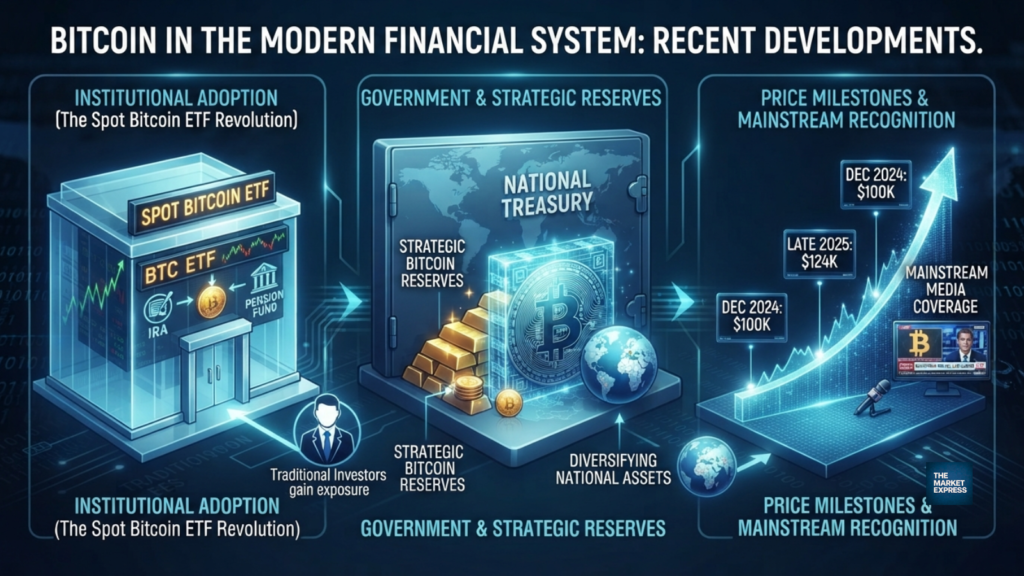
For over a decade, Bitcoin remained relegated to fringe status. Large institutions ignored it. Mainstream finance dismissed it. This changed dramatically in 2024.
The Spot Bitcoin ETF Revolution
In January 2024, the U.S. Securities and Exchange Commission approved the first spot Bitcoin Exchange-Traded Funds. This seemingly technical development had enormous implications.
Spot Bitcoin ETFs allow traditional investors to gain Bitcoin exposure through their regular brokerage accounts. Someone with an IRA can now own Bitcoin through an ETF rather than managing digital wallets and private keys. Major financial institutions like BlackRock, Fidelity, and VanEck launched Bitcoin ETFs almost immediately.
This development legitimized Bitcoin as an institutional asset. Pension funds, university endowments, and insurance companies—entities that previously avoided cryptocurrency—began allocating to Bitcoin through ETFs.
Strategic Bitcoin Reserves: Governments Enter the Game
Perhaps more significant than institutional adoption was government adoption. In March 2025, the U.S. President signed an executive order establishing a Strategic Bitcoin Reserve. The federal government began purchasing Bitcoin, treating it similarly to how it reserves gold.
Following this precedent, states including Texas and New Hampshire announced their own Bitcoin reserve programs. Why would governments accumulate Bitcoin?
One reason involves diversifying reserves. Historically, governments held gold as a store of value. Bitcoin’s fixed supply and decentralized nature provide similar characteristics. A Bitcoin reserve cannot be diluted by monetary policy.
Another reason involves recognizing Bitcoin’s evolving role in global finance. As more institutions and countries adopt Bitcoin, its network effects strengthen. Early adoption by governments could position nations advantageously in a future where Bitcoin plays a larger monetary role.
Price Milestones and Market Recognition
Bitcoin’s price has historically moved in cycles, but the recent trajectory reflects mainstream acceptance.
In December 2024, Bitcoin crossed $100,000 for the first time. This psychological milestone received significant media coverage. By late 2025, Bitcoin had reached over $124,000. While the cryptocurrency remains volatile—capable of 10% swings in single days—its general trajectory affirms growing institutional and governmental confidence.
The Practical Reality: Advantages and Limitations
Understanding what Bitcoin is requires acknowledging both its genuine advantages and real limitations.
Genuine Advantages
Financial sovereignty becomes possible. With Bitcoin, you truly own your money. No institution can freeze your account, seize your assets, or refuse your transactions. This matters for people in countries with capital controls, political instability, or failed banking systems.
Cross-border transfers become cheaper and faster. International wire transfers through banks take days and incur substantial fees. Bitcoin transfers settle in minutes and cost nearly nothing, regardless of borders.
Inflation protection works automatically. As central banks print currency, Bitcoin’s fixed supply means your Bitcoin percentage of total Bitcoin remains constant. Your wealth doesn’t suffer from currency devaluation.
Privacy can be enhanced. While Bitcoin transactions are public, they’re pseudonymous. You can receive Bitcoin without revealing your identity, unlike traditional banking.
Transparency enables verification. Anyone can verify Bitcoin’s supply, audit the blockchain, or trace transaction history. This transparency prevents secret monetary manipulation.
Real Limitations
Price volatility creates risk. Bitcoin regularly experiences 10-30% price swings. This volatility makes Bitcoin unsuitable as stable savings for short-term needs. Most financial advisors recommend keeping only discretionary funds in Bitcoin.
Transactions are permanent. If you send Bitcoin to the wrong address, it’s gone forever. The Bitcoin protocol has no refund mechanism. This differs from credit cards or banks, where errors can be reversed.
Regulatory uncertainty persists. Different countries treat Bitcoin differently. Some embrace it. Others restrict or ban it. Regulatory changes in major economies could impact Bitcoin’s value.
Environmental concerns remain valid. Bitcoin mining consumes substantial electricity. While increasingly powered by renewable energy, its energy usage remains significant. Some environmentalists argue this cost outweighs Bitcoin’s benefits.
User error is common and costly. Bitcoin requires personal responsibility. Losing your private key means permanent fund loss. Phishing attacks successfully target Bitcoin users. Poor security practices lead to theft. Most users lack the technical expertise to protect themselves completely.
How to Acquire and Store Bitcoin Safely
Buying Bitcoin: Where to Start
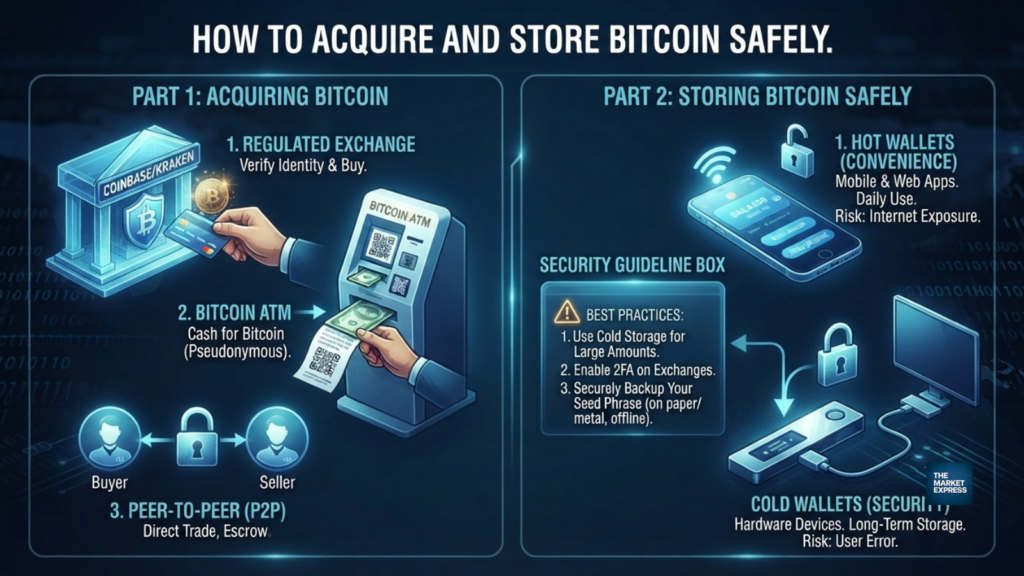
The most straightforward way to purchase Bitcoin involves using a regulated cryptocurrency exchange. Platforms like Coinbase, Kraken, and Gemini allow users to create accounts, verify identity (complying with financial regulations), and trade fiat currency for Bitcoin.
These exchanges connect your bank account or payment method to Bitcoin markets. You place an order, and the exchange delivers Bitcoin to your account. Fees vary by exchange and payment method but typically range from 0.5% to 2%.
Bitcoin ATMs represent an alternative for cash purchases. Over 36,000 Bitcoin ATMs operate globally, allowing cash deposits in exchange for Bitcoin. These ATMs provide pseudonymity, as they require minimal identity verification.
For larger purchases, some services offer peer-to-peer trading, escrow services, or direct purchases from institutional dealers. These options suit people buying significant amounts of Bitcoin.
Storing Bitcoin: Wallets Explained
Technically, Bitcoin doesn’t “store” anywhere. The blockchain contains the record of ownership. What you actually secure is your private key—the cryptographic secret proving you own Bitcoin.
Bitcoin wallets are software or hardware systems for managing private keys securely.
Hot wallets connect to the internet, making them convenient for regular spending. Mobile apps and web-based platforms function as hot wallets. The trade-off is a security risk. Internet-connected devices face hacking exposure.
Cold wallets remain offline, typically implemented as hardware devices (like Ledger or Trezor) or even paper records of private keys. These devices cannot be hacked remotely because they don’t connect to the internet. Cold wallets represent the gold standard for securing significant Bitcoin holdings.
For modest amounts, hot wallets offer sufficient security and superior convenience. For large amounts, cold storage is essential. The general guideline holds: keep only spending money in hot wallets and reserve long-term holdings for cold storage.
Technical Evolution: How Bitcoin Continues Improving
Bitcoin isn’t static. The network has undergone significant upgrades while maintaining backward compatibility.
SegWit (2017) improved how transactions are structured, increasing blockchain capacity and reducing fees. More importantly, SegWit enabled the Lightning Network—a protocol allowing near-instant Bitcoin transactions with minimal fees.
Taproot (2021) represented Bitcoin’s most significant upgrade in years. This upgrade improved privacy by making complex transactions appear identical to simple ones on-chain. It also enabled smart contracts, allowing Bitcoin to host more sophisticated applications.
Ordinals (2023) introduced the ability to inscribe data directly onto Bitcoin, effectively creating Bitcoin NFTs. While controversial regarding blockchain bloat, Ordinals opened new use cases for Bitcoin’s immutable ledger.
Each upgrade occurred through consensus among network participants. Bitcoin’s decentralized governance means no central authority forces changes. The community must agree that upgrades are worthwhile.
Common Misconceptions About Bitcoin
Misconception: Bitcoin exists only for criminal activity.
Reality: Early Bitcoin adoption did include criminal use due to pseudonymity. However, the vast majority of Bitcoin activity today is legitimate investment. Law enforcement has successfully traced Bitcoin transactions and prosecuted criminals. Cash remains superior for hiding illegal activity compared to Bitcoin’s publicly auditable ledger.
Misconception: Bitcoin is a Ponzi scheme.
Reality: Ponzi schemes require a central operator who pays early investors with new investor funds. Bitcoin has no central operator. It’s open-source software with no leader. Its value derives from supply and demand, not from recruited participants.
Misconception: Bitcoin will be replaced by newer cryptocurrencies.
Reality: While newer cryptocurrencies exist, none has matched Bitcoin’s network effects, security, or institutional adoption. Bitcoin’s first-mover advantage, established security, and network size create powerful barriers to replacement.
Misconception: Bitcoin uses outdated technology.
Reality: Bitcoin intentionally prioritizes security and decentralization over speed and features. Newer cryptocurrencies optimize for speed but sacrifice decentralization or security. Bitcoin’s deliberate conservatism is a feature, not a bug.
The Future of Bitcoin: What Comes Next
Predicting Bitcoin’s future is inherently uncertain, but several plausible scenarios exist.
Mainstream currency adoption would occur if Bitcoin’s volatility decreased and adoption reached critical mass. At present, Bitcoin remains too volatile for everyday use, but continued adoption could stabilize it.
Digital gold as a store of value represents another likely scenario. Bitcoin functions excellently as a store of wealth across time and space. Many investors treat it similarly to how previous generations treated gold—a hedge against currency devaluation.
An Institutional settlement layer could emerge as institutions increasingly use Bitcoin for large transfers between entities. The speed and security improvements versus traditional wire transfers make this plausible.
Regulatory integration will likely occur as governments develop frameworks for Bitcoin. Rather than prohibition or unrestricted freedom, most likely outcomes involve regulation comparable to gold or foreign currency.
Key Takeaways: Understanding Bitcoin
What is Bitcoin? It’s a revolutionary financial technology that enables value transfer without institutions, protects against inflation through fixed supply, and creates genuine financial sovereignty for its users.
Bitcoin isn’t perfect. It consumes electricity, requires technical security expertise, and is subject to price volatility. These limitations matter.
But Bitcoin’s fundamental innovation—creating trust through mathematics rather than institutions—has proven durable and increasingly valuable.
Whether Bitcoin becomes a global currency, digital gold, or something else entirely remains uncertain. What’s certain is that Bitcoin has fundamentally altered how we think about money, value, and institutional trust.
Frequently Asked Questions About Bitcoin
Is Bitcoin legal?
In the U.S. and many other Western countries, yes. However, it is restricted or banned in countries like China, Egypt, and Iraq.
Can I turn Bitcoin back into cash?
Yes. You can sell your Bitcoin on an exchange and withdraw the money to your bank account, or use a Bitcoin ATM to get physical cash.
Who is Satoshi Nakamoto?
We still don’t know. While figures like Hal Finney and Nick Szabo are often mentioned, the creator’s identity remains the greatest mystery of the digital age.
What is the Genesis Block?
It is the very first block of transactions in the Bitcoin blockchain, mined by Satoshi on January 3, 2009.
How many Bitcoins exist right now?
Approximately 21 million Bitcoins will ever exist. As of July 2026, roughly 21 million are either already mined or scheduled to be mined by 2140. The exact number fluctuates as mining continues.
Can Bitcoin be hacked?
The Bitcoin protocol itself is considered unhackable due to its cryptographic foundation. However, individual users can lose Bitcoin through poor security, phishing, or operational errors. Security depends on how users protect their private keys.
Ready to Learn More?
Understanding what Bitcoin is represents just the beginning. The cryptocurrency ecosystem encompasses thousands of projects, each with different philosophies and use cases. As you explore further, remember the fundamentals: Bitcoin’s value derives from its decentralization, scarcity, and security. These characteristics distinguish it from previous monetary systems and account for its growing adoption.
Next Steps:
- Explore our Bitcoin price tracker tool to monitor real-time market data.
- Read our guide on cryptocurrency investing fundamentals.
- Check our comparison of Bitcoin storage options.
- Visit our crypto category for the latest Bitcoin news and analysis.
Bitcoin’s story is still being written. Understanding its foundations positions you to navigate this evolving financial landscape intelligently.
Editorial Note: This article was researched and drafted with AI assistance, then rigorously fact-checked, edited, and published by Miles. All content is strictly for informational and educational purposes only and does not constitute professional investment advice. Cryptocurrency and global financial markets experience severe volatility, sometimes swinging 50% or more in a single day. Invest only capital you can comfortably afford to lose, and always consult a certified financial advisor before committing funds. Read my full Disclaimer for more details.
Ready to Start Trading Cryptocurrency?
Open your account at a trusted exchange and begin trading today:
Sponsored & Disclosure: This box contains affiliate links. We earn a commission when you sign up through these links at no extra cost to you.