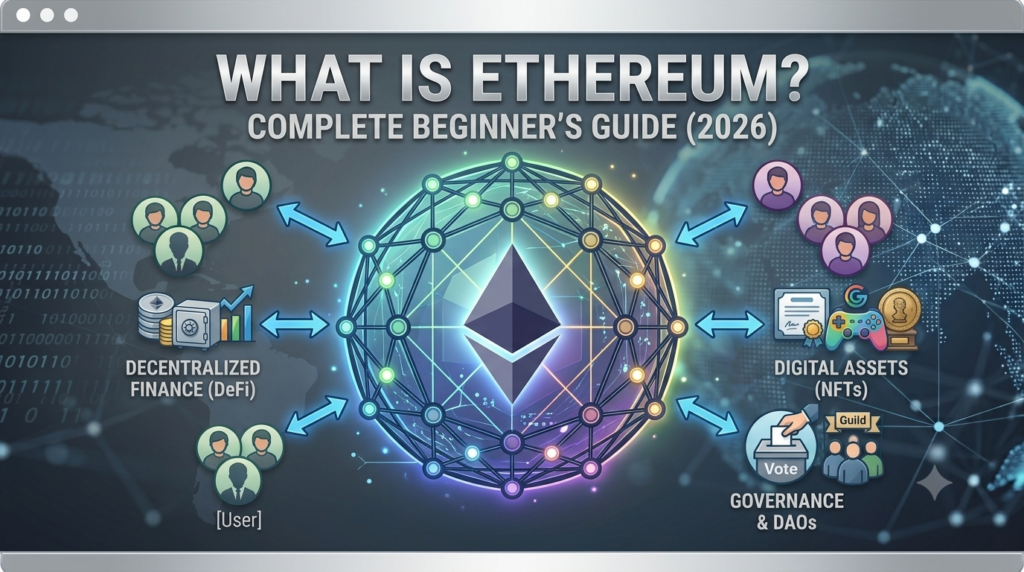
Table of Contents
- Introduction: Why Everyone Keeps Talking About Ethereum
- What is Ethereum? (The Core Concept Explained Simply)
- How Ethereum Works: Under the Hood Without the Headaches
- Why Ethereum Matters: Real-World Applications
- Ether (ETH) vs. Ethereum: What is the Difference?
- Pros and Cons: An Honest Assessment
- Ethereum for Beginners: How to Safely Get Started
- Frequently Asked Questions (FAQ)
- Conclusion & Next Steps
Introduction: Why Everyone Keeps Talking About Ethereum
If you have spent any time reading tech news, scrolling through finance forums, or listening to podcasts over the last few years, you have almost certainly bumped into the word “Ethereum.”
📈 Track real-time charts and professional market indicators with the world's leading charting platform.
Open Free TradingView Account →Disclaimer: We may earn a commission if you sign up through our link at no extra cost to you.
Usually, it gets lumped together with Bitcoin. People talk about them as if they are twin brothers competing for the same spot in your digital wallet. But here is the thing: treating Ethereum as “just another cryptocurrency” is like calling a smartphone “just another digital clock.” Sure, it tells the time, but that completely misses the point of what the device actually does.
When I first started diving into crypto years ago, I fell into the same trap. I assumed Ethereum was created simply to be digital money. It wasn’t until I sat down and read through the original concept that the lightbulb went off: Ethereum wasn’t built to be a digital currency; it was built to be a global, decentralized computer.
Whether you are looking to understand the tech, curious about how digital assets function, or just trying to figure out what your tech-savvy friend won’t stop talking about, this guide is designed for you. No technical jargon, no elitist buzzwords—just a clear, practical, and honest breakdown for absolute beginners.
What is Ethereum? (The Core Concept Explained Simply)
To answer the core question—what is Ethereum?—let’s use an analogy that most people interact with every single day: The App Store.
Think about your smartphone. Apple or Google built an operating system (iOS or Android). On top of that system, independent developers from around the world can build apps—everything from banking tools and ride-sharing platforms to games and social networks.
However, there is a catch. Apple and Google control those platforms completely. They set the rules, take a percentage of sales, can remove apps whenever they choose, and hold all user data on their centralized servers. If their servers go down or if they decide to close your account, you lose access.
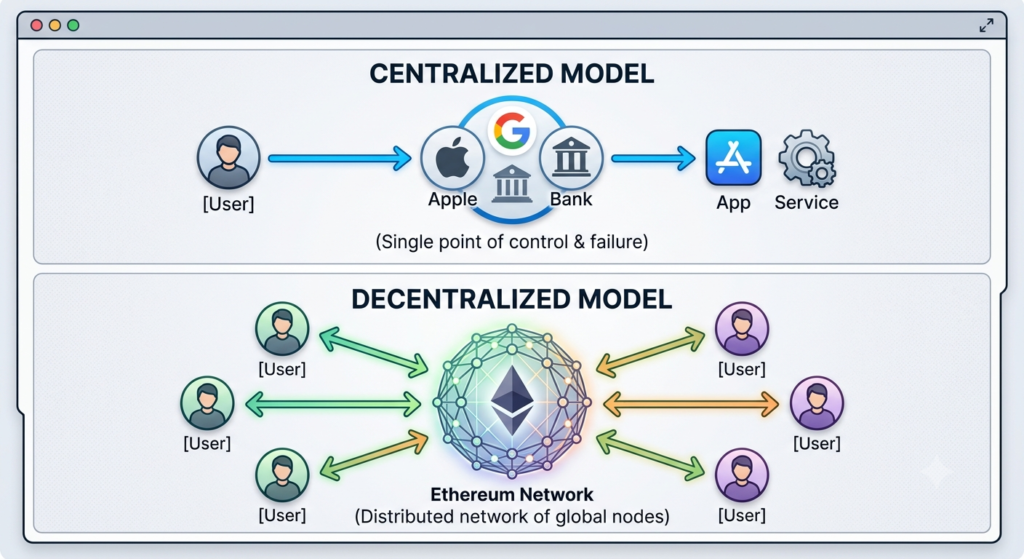
Ethereum is like a global, open-source smartphone operating system, but without Apple or Google running it.
Instead of sitting on servers owned by a single corporation, Ethereum runs on thousands of computers scattered across the globe. Anyone, anywhere, can write software programs—known as decentralized applications (dApps)—and deploy them onto the network. Once deployed, these programs run exactly as coded without any middleman, censorship, or downtime.
Where Did It Come From?
Ethereum was proposed in late 2013 by a young programmer named Vitalik Buterin. Vitalik realized that while Bitcoin was brilliant at doing one specific thing—moving digital money from Person A to Person B without a bank—it was intentionally limited in scope.
Vitalik asked a fundamental question: What if, instead of using blockchain technology just for a payment system, we used it to run software code?
Along with a co-founding team (including prominent figures like Gavin Wood and Charles Hoskinson), Ethereum was officially launched in July 2015. Since then, it has grown into the foundation for thousands of applications handling billions of dollars in daily activity.
How Ethereum Works: Under the Hood Without the Headaches
You don’t need a degree in computer science to understand how Ethereum works. Let’s break the complex mechanics into four digestible pieces.
The Blockchain as a Shared Ledger
At its foundation, Ethereum uses a blockchain. Imagine a physical ledger book shared among millions of people. Every time a transaction occurs—whether transferring funds or interacting with an app—it is recorded in this book.
Instead of keeping the ledger in a bank vault, every computer participating in the network (called a node) keeps an exact, identical copy of this ledger. When a new batch of transactions (a “block”) is added, every single copy updates at the same time. This makes altering records virtually impossible; to cheat the system, you would have to hack thousands of computers simultaneously, which is practically impossible.
Nodes and Validation: How the Network Agrees
How do thousands of independent computers agree on which transactions are valid? They use a mechanism called Proof-of-Stake (PoS).
In simple terms:
- Individuals who wish to help validate transactions lock up a certain amount of Ether (ETH) as collateral. These participants are called validators.
- The system randomly selects validators to propose and confirm new blocks of transactions.
- If a validator acts honestly and verifies valid transactions, they earn a small reward.
- If a validator tries to cheat or manipulate the system, they lose a portion of their locked collateral.
This setup ensures that acting honestly is always in every participant’s financial best interest.
Smart Contracts: Self-Executing Agreements
If blockchain is the engine of Ethereum, smart contracts are the magic spark. A smart contract is simply a computer program stored on the blockchain that executes automatically when predetermined conditions are met.
Think of a traditional vending machine:
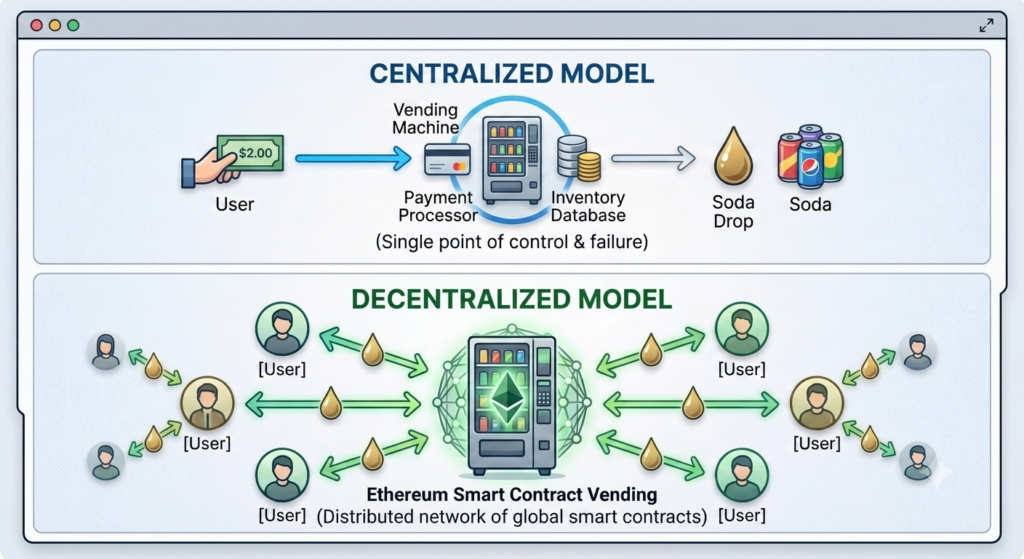
You put in $2.00, press the button for a soda, and the internal mechanism automatically checks that you provided enough money and drops the drink. You don’t need a cashier, a lawyer, or a middleman to verify the deal. The rules are pre-programmed directly into the machine.
A smart contract works the same way, but for digital agreements:
- IF Buyer transfers $10,000 in digital currency to the contract, THEN the digital title of the property is automatically transferred to the Buyer.
- IF a flight is delayed by more than two hours, THEN the insurance contract automatically sends a refund to the passenger’s digital wallet.
Because smart contracts run on a decentralized network, no single party can alter the code once it is live.
Gas Fees: The Fuel of the Ethereum Network
Whenever you act on Ethereum—sending funds, swapping tokens, or interacting with a smart contract—you are asking thousands of global computers to run computations for you.
To pay for this computational labor, users pay a transaction fee known as gas.
- Gas Price: Measured in tiny fractions of Ether called Gwei (1 Gwei = 0.000000001 ETH).
- Why Fees Vary: Gas prices rise and fall based on network demand. If millions of people try to use Ethereum at the same moment, gas fees increase as users bid for priority execution.
Think of gas like real fuel in a car: a simple trip (sending a transfer) requires very little fuel, whereas hauling heavy furniture up a mountain (running a complex smart contract) uses significantly more.
Why Ethereum Matters: Real-World Applications
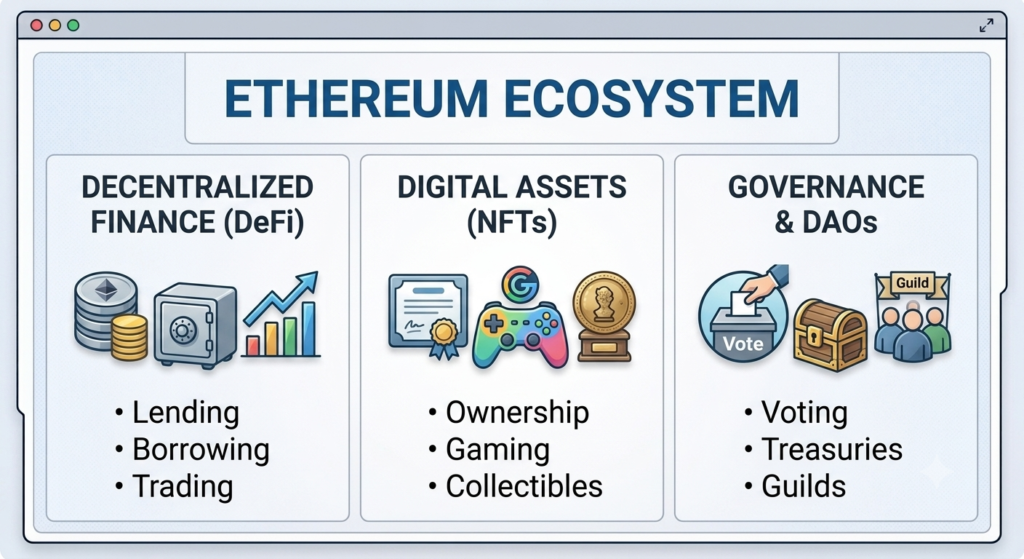
Understanding the mechanics is helpful, but seeing how people actually use the network is where understanding Ethereum really clicks. Here are three core areas powered by the network today.
Decentralized Finance (DeFi)
Traditional finance relies heavily on intermediaries: banks, brokers, credit agencies, and clearinghouses. Each intermediary takes a fee and introduces a potential point of failure or restriction.
DeFi replaces these traditional intermediaries with smart contracts. Through Ethereum-based DeFi protocols, users can:
- Lend and Borrow: Lend out digital assets to earn yield, or borrow funds directly using collateral, without needing credit approval from a bank.
- Decentralized Exchanges (DEXs): Swap digital assets directly with other users via automated liquidity pools like Uniswap.
- Stablecoins: Access digital currencies pegged 1:1 to traditional fiat currencies like the US Dollar (e.g., USDC or USDT), enabling fast, low-cost international settlements.
Non-Fungible Tokens (NFTs) & Digital Ownership
Before smart contracts, digital files (images, music, software) could be copied and pasted infinitely with zero difference between the original and the copy.
NFTs changed this paradigm by creating verifiable digital scarcity. An NFT is a unique digital certificate recorded on the Ethereum blockchain proving ownership of a specific item—whether that’s digital artwork, virtual real estate in gaming worlds, or event tickets.
Decentralized Autonomous Organizations (DAOs)
Imagine an organization or club run entirely by software code rather than a board of directors. That is a DAO.
In a DAO, members hold governance tokens that allow them to vote on proposals, treasury spending, and operational changes. All rules, voting processes, and treasury funds are managed transparently via smart contracts on Ethereum, ensuring complete transparency for participants.
Ether (ETH) vs. Ethereum: What is the Difference?
One of the most common points of confusion for newcomers is mixing up Ethereum and Ether. While often used interchangeably in casual conversation, they represent two distinct things.
| Feature | Ethereum | Ether (ETH) |
| What is it? | The decentralized blockchain network and platform. | The native cryptocurrency/token of the network. |
| Primary Function | Executes smart contracts and hosts applications. | Used as fuel (gas fees) and a store of digital value. |
| Analogy | The underlying highway system. | The fuel required to drive vehicles on the highway. |
Put simply: Ethereum is the network; Ether (ETH) is the currency that powers it. You use Ether to pay for transactions, secure the network via staking, or hold it as an asset within the ecosystem.
Pros and Cons: An Honest Assessment
No technology is perfect. To maintain a balanced perspective, let me break down both the strengths and weaknesses of Ethereum today.
The Advantages (Pros)
- First-Mover Advantage & Network Effects: Ethereum has the largest ecosystem of developers, applications, and security history among smart contract platforms.
- Unmatched Security: Thousands of active decentralized nodes secure the ledger, making it extraordinarily resilient to attacks.
- Continuous Innovation: A global community of researchers and engineers constantly updates the underlying protocols to enhance efficiency and scalability.
- True Interoperability: Applications built on Ethereum seamlessly interact with one another (often described as “money Legos”).
The Disadvantages (Cons)
- Transaction Costs (Gas Fees): During peak periods, gas fees on the main network can become prohibitively high for small, everyday micro-transactions.
- Scalability Bottlenecks: The primary network handles roughly 15 to 30 transactions per second natively, though secondary layers (Layer 2s) help address this.
- User Experience Complexity: Navigating wallet keys, network fees, and smart contract approvals requires caution; mistakes like sending funds to the wrong address cannot be reversed by a support team.
Ethereum for Beginners: How to Safely Get Started
If you are interested in exploring Ethereum for beginners, here is a practical, security-focused path forward.
Step 1: Education First
Before spending any real funds, learn the basics of digital security. Understand that in a decentralized system, you are your own bank—there is no password reset button if you lose access to your credentials. Learn key concepts by reviewing educational resources from public organizations like the Ethereum Foundation.
Step 2: Set Up a Self-Custody Wallet
To store tokens or interact with applications, you need a crypto wallet.
- Software Wallets (Hot Wallets): Apps like MetaMask or Coinbase Wallet run on your phone or web browser. They are convenient for daily transactions.
- Hardware Wallets (Cold Storage): Physical devices like Ledger or Trezor store your private keys offline, away from internet-connected threats.
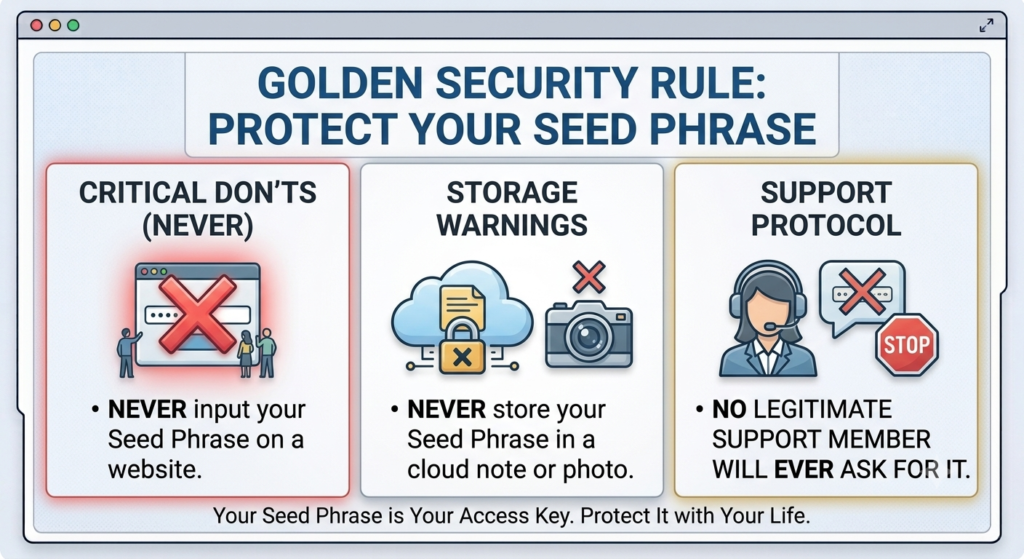
Crucial Rule: When setting up a wallet, you will receive a 12-to-24-word recovery phrase (Seed Phrase). Write this phrase down on physical paper and store it securely offline. Never share it with anyone, under any circumstances.
Step 3: Explore Layer 2 Solutions
To avoid high network fees while learning, explore Layer 2 (L2) networks built on top of Ethereum (such as Arbitrum, Optimism, or Base). These L2 networks bundle transactions off-chain, delivering significantly lower fees and faster speeds while maintaining Ethereum’s underlying security.
Conclusion & Next Steps
Ethereum fundamentally changed our understanding of what blockchain technology can achieve. By expanding blockchain capabilities from simple monetary transfers to programmable, self-executing contracts, it introduced a new paradigm for building open, transparent, and global financial and digital services.
Whether Ethereum ultimately powers everyday consumer applications or serves as a foundational settlement layer for global finance, its core principles remain constant: decentralization, transparency, and permissionless access for anyone with an internet connection.
Ready to Continue Your Journey?
- Read official documentation: Visit Ethereum.org to explore beginner guides and documentation.
- Practice safely: Set up a software wallet and explore testnet environments where you can experiment with dApps using zero real money.
- Stay cautious: Always verify links, double-check addresses, and prioritize security over speed.
Frequently Asked Questions (FAQ)
Is Ethereum safe to use?
The Ethereum network itself is protected by cryptography and a vast, global network of nodes. However, user safety depends largely on individual practices: protecting seed phrases, verifying smart contract permissions, and avoiding phishing attempts.
Can Ethereum replace Bitcoin?
They serve different primary goals. Bitcoin aims to function as a scarce, decentralized digital store of value (often referred to as “digital gold”). Ethereum serves as a programmable platform for decentralized software and finance. Rather than replacing one another, they occupy distinct niches in the broader digital asset landscape.
What is “Staking” in Ethereum?
Staking involves locking up Ether (ETH) to help validate transactions and secure the network under the Proof-of-Stake system. In return for performing these validation duties, stakers earn rewards paid out in ETH.
What happens if I lose my wallet seed phrase?
Your seed phrase is the master recovery key to your wallet on the blockchain. If you lose both your wallet access and your seed phrase, your assets are permanently inaccessible. No company, developer, or support team can recover them for you.
Whether you are exploring dApps or interested in investing, keeping an eye on the Ethereum Price will help you make informed decisions in the market.
Editorial Note: This article was researched and drafted with AI assistance, then rigorously fact-checked, edited, and published by Miles. All content is strictly for informational and educational purposes only and does not constitute professional investment advice. Cryptocurrency and global financial markets experience severe volatility, sometimes swinging 50% or more in a single day. Invest only capital you can comfortably afford to lose, and always consult a certified financial advisor before committing funds. Read my full Disclaimer for more details.
Ready to Start Trading Cryptocurrency?
Open your account at a trusted exchange and begin trading today:
Sponsored & Disclosure: This box contains affiliate links. We earn a commission when you sign up through these links at no extra cost to you.