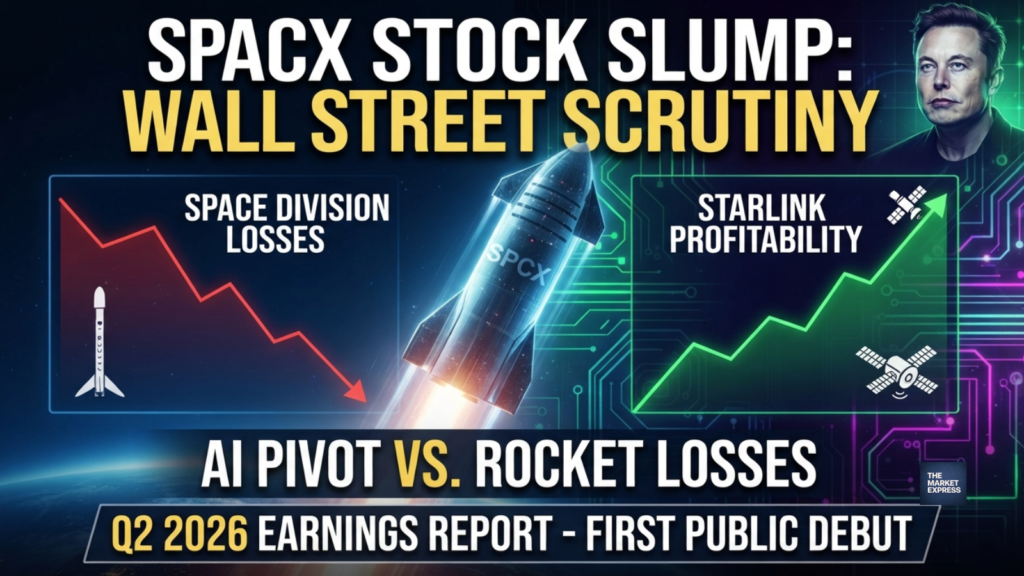
SpaceX reports its fiscal second-quarter 2026 earnings on Tuesday, marking the first time the reusable rocket maker has faced Wall Street as a public company. The report comes at a critical juncture for the Elon Musk-led corporation, which saw its market capitalization plummet by $500 billion following a record-breaking initial public offering (IPO) in June. Investors are seeking clarity on the company’s path to profitability as it balances high-burn research and development with an aggressive pivot into artificial intelligence infrastructure. The company is expected to report its results after the bell, with a conference call scheduled for 4:30 p.m. ET.
📈 Track real-time charts and professional market indicators with the world's leading charting platform.
Open Free TradingView Account →Disclaimer: We may earn a commission if you sign up through our link at no extra cost to you.
Market Impact: SPCX Stock Volatility and Trader Sentiment
SpaceX shares surged nearly 10% in afternoon trading on Tuesday, reaching a temporary plateau after weeks of sustained losses. Since its market debut at $150 per share on June 12, the stock has declined by approximately 24% and now trades below its IPO price. This volatility has triggered a surge in options activity, with traders purchasing nearly 90,000 call options at a $330 strike price on Monday alone. While these “out-of-the-money” calls suggest some bullish sentiment, the implied volatility for SpaceX remains at 133, surpassing almost every company in the S&P 500. Market participants are particularly concerned about the upcoming expiration of “lockup” shares, which could flood the market with new supply.
Key Details: Revenue Targets and Segment Performance
According to London Stock Exchange Group (LSEG) data, analysts are forecasting quarterly revenue of $6.93 billion. The consensus estimate suggests a loss of 26 cents per share for the quarter. Financial performance is expected to be bifurcated across the company’s three primary business pillars: Space, Connectivity, and AI.
The Connectivity arm, dominated by the Starlink satellite internet service, remains the company’s only profitable segment. Analysts project Starlink will contribute $3.83 billion in revenue for the quarter. In contrast, the Space segment, which includes the Falcon 9 and Starship launch programs, is expected to report $835 million in revenue while continuing to record significant operational losses. The AI division, which incorporates the recently merged xAI and the social media platform X, is forecasted to generate $2.18 billion in revenue.
Why This Matters: The $119 Billion AI Infrastructure Pivot
The SpaceX earnings report will provide the first detailed look at the company’s massive capital commitment to artificial intelligence. In the first quarter of 2026, SpaceX reported $10.1 billion in capital expenditures, with $7.7 billion—over 76% of the total—dedicated to AI-related expenses. A central component of this strategy is “Terafab,” a projected $119 billion AI chip manufacturing facility planned for East Texas.
SpaceX has stated that this vertical integration is necessary to alleviate future chip shortages and optimize compute performance for its planned orbital data centers. To monetize this infrastructure, SpaceX has already secured major cloud agreements, including a $920 million monthly deal with Google and capacity agreements with startups like Anthropic and Reflection AI. However, these investments have strained the balance sheet, with total liabilities reaching $60.5 billion at the end of the first quarter.
Expert Analysis: Diverging Views on Valuation and Growth
Wall Street remains divided on SpaceX’s long-term valuation, with some analysts issuing rare “Sell” ratings. Analysts at Phillip Capital set a price target of $75, citing the company’s projected negative cash flows through at least 2030. They noted that while the company’s cash pile swelled past $90 billion following the IPO, the current rate of spending on AI and Starship development will likely return the group to a net debt position by fiscal 2030.
Conversely, analysts at Bank of America suggest that progress on Starship is the most critical metric for investors. They argue that the path to full rocket reusability is the “key enabler” for the company’s entire growth strategy, including commercial space tourism and the deployment of a second-generation AI satellite constellation. New Street Research analysts emphasized that while orbital data centers represent a “huge opportunity,” the realization of this revenue stream is likely a decade away.
Related Information: The Lockup Expiration and Short Seller Profits
A significant catalyst for the stock’s recent decline has been the impending expiration of share lockup restrictions. On Thursday, 912 million shares held by employees and insiders will become eligible for public trading. This volume represents more than double the current floating supply of SPCX stock. Short sellers have already capitalized on this downward pressure, accumulating approximately $8.3 billion in paper profits as of early August.
Elon Musk has publicly criticized these market participants, suggesting that firms maintaining significant short positions in SpaceX face low long-term survival probabilities. The broader Musk “ecosystem” is also under pressure; Tesla shares have fallen 20% since the SpaceX IPO, contributing to a decline in Musk’s personal net worth from over $1 trillion to approximately $750 billion.
Looking Ahead
The upcoming SpaceX earnings report will determine if the company can justify its $2 trillion valuation amid heavy losses and ambitious infrastructure projects. While Starlink continues to show robust subscriber growth, surpassing 12 million users, the massive capital requirements for Terafab and Starship development remain a point of contention for value-oriented investors. The primary takeaway for the market will be whether the AI pivot can generate sustainable cloud revenue fast enough to offset the cash burn from rocket science. SpaceX must prove it is more than a launch provider; it must demonstrate it is a viable AI and connectivity powerhouse.
Editorial Note: This article was researched and drafted with AI assistance, then rigorously fact-checked, edited, and published by Miles. All content is strictly for informational and educational purposes only and does not constitute professional investment advice. Cryptocurrency and global financial markets experience severe volatility, sometimes swinging 50% or more in a single day. Invest only capital you can comfortably afford to lose, and always consult a certified financial advisor before committing funds. Read my full Disclaimer for more details.
Ready to Start Trading Cryptocurrency?
Open your account at a trusted exchange and begin trading today:
Sponsored & Disclosure: This box contains affiliate links. We earn a commission when you sign up through these links at no extra cost to you.