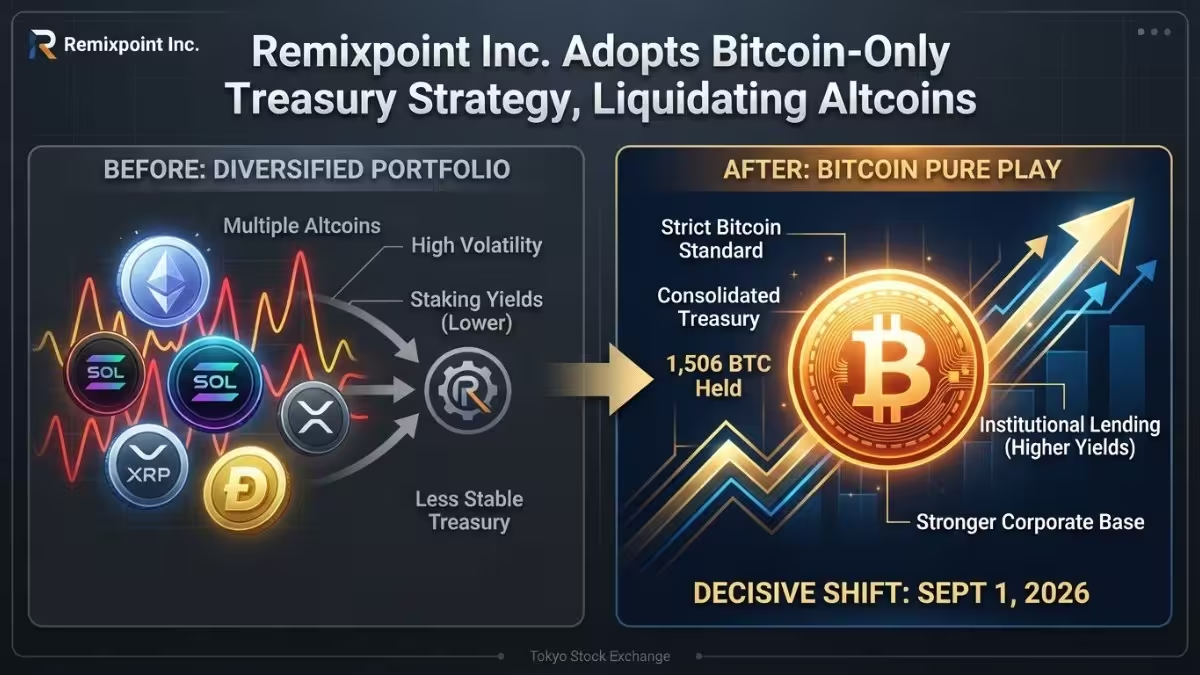
The Japanese public market has witnessed a decisive capital shift as Tokyo-listed Remixpoint Inc. completed its transition to a strict Remixpoint Bitcoin strategy, liquidating its entire altcoin portfolio in a single day to consolidate its corporate treasury. The firm executed the high-stakes transaction on September 1, 2026, offloading millions of dollars in Ethereum, Solana, XRP, and Dogecoin. This sweeping liquidation generated a total transaction value of JPY 878.81 million, equivalent to approximately $5.5 million. Against a book value of JPY 761.04 million at the start of the period, the strategic divestment secured a net profit of JPY 117.77 million, or roughly $736,800, for the corporate balance sheet. By abandoning high-volatility alternative tokens, the energy and digital asset conglomerate has established a pure Bitcoin standard, holding approximately 1,506 BTC as its sole cryptocurrency asset.
The financial results across individual digital assets varied widely during the summer exit. Ethereum emerged as the most profitable segment of the liquidation. Remixpoint divested 901.44672542 ETH for JPY 353.43 million against a book value of JPY 293.22 million, securing a JPY 60.20 million net gain. Solana followed closely with a JPY 49.30 million realized profit as the firm unloaded 13,920.07255868 SOL for JPY 227.89 million. The company also exited its long-held position of 1.191 million XRP, bringing in JPY 260.43 million and locking in an ¥11.52 million profit. Dogecoin proved to be the sole detractor in the portfolio. The liquidation of 2.802 million DOGE for JPY 37.08 million against a book value of JPY 40.34 million triggered a JPY 3.26 million loss.
“The portfolio change would concentrate its crypto holdings and establish Bitcoin as the main asset under its holding and operational strategy,” said Yoshihiko Takahashi, Chief Executive Officer at Remixpoint, in the firm’s regulatory disclosure to the Tokyo Stock Exchange. The executive’s decision highlights a pragmatic calculation of risk and reward in the volatile digital asset markets. Beyond the immediate capital gains from the sales, alternative assets had provided some operational utility through staking. Between July 16, 2025, and August 31, 2026, the company gathered JPY 10.93 million in staking rewards from its Ethereum holdings. Staking rewards from Solana yielded another JPY 18.94 million. The combined staking income reached JPY 29.87 million, which the firm received entirely in fiat yen.
However, the passive income generated by alternative assets paled in comparison to the yields produced by the leading cryptocurrency. Remixpoint has successfully leveraged its massive Bitcoin reserves through institutional lending programs to generate recurring, non-dilutive capital. Between February 24 and August 31, 2026, the company’s lending initiatives generated 14.92055902 BTC in interest payments. This accumulated yield added JPY 164.22 million to corporate coffers without requiring the sale of any underlying core assets. The efficacy of this model accelerated significantly as the summer concluded. In August 2026 alone, monthly lending income reached 2.48356398 BTC, injecting JPY 31.15 million in high-margin revenue.
“This move formalizes a Bitcoin-only policy, reflecting a broader trend of companies adopting Bitcoin as a primary reserve asset,” said analysts at Crypto Briefing in a Tokyo market report. The shift marks a dramatic evolution from the diversified strategy that Remixpoint pursued over the previous two years. In November 2024, the company maintained a wide basket of digital assets. This initial trial included Bitcoin, Ethereum, Solana, Avalanche, Dogecoin, and XRP, with the company holding just 215.76 BTC at the time. While Solana represented the firm’s second-largest asset by value, the balance sheet was heavily exposed to individual altcoin price swings.
The corporate transition toward a single-asset treasury model accelerated through 2025. By December 2024, the company expanded its Bitcoin position to 282.87 BTC through a JPY 200 million acquisition. The overall acquisition cost across all digital assets reached JPY 4.00 billion. In May 2025, the board approved an additional JPY 1.00 billion allocation specifically for Bitcoin purchases, pushing its total cryptocurrency budget to JPY 12.00 billion. Remixpoint solidified its institutional commitment to the asset class in July 2025. The company announced a major financing structure intended to raise $215 million to scale its Bitcoin exposure, pushing its holdings to 1,051 BTC. Takahashi further cemented this corporate alignment by electing to receive his entire executive salary directly in Bitcoin. This made Remixpoint the first publicly listed corporation in Japan to implement such a compensation structure.
Despite this momentum, Remixpoint briefly deviated from its Bitcoin-only trajectory in June 2026. Facing intense macro pressures from a rapidly depreciating Japanese yen, the treasury department expanded its altcoin allocation to hedge capital. The firm acquired approximately 1.2 million XRP, alongside new tranches of Solana and Dogecoin. Internal financial projections estimated that the total cryptocurrency segment could generate up to JPY 12.44 billion in annual revenue. However, the summer proved highly challenging for altcoin liquidity. Management’s assessment of market risks and the extreme volatility of non-Bitcoin assets prompted an immediate strategic reversal. On-chain trading signals indicated a rapidly deteriorating risk-to-return profile for altcoins, making a diversified strategy untenable.
Faced with these signals, management implemented a “selection and concentration” strategy to mitigate systemic risk. The entire altcoin portfolio was liquidated in a single day, permanently closing the chapter on the firm’s multi-token experiments. The realized JPY 117.00 million profit will be booked directly as business segment revenue in the second quarter of the fiscal year ending March 2027. The company has announced that the capital raised from these sales will be deployed to expand its industrial assets. Specifically, the funds will buy grid-scale battery storage systems to scale up its core energy division and strengthen its corporate financial base.
This strategy mirrors a larger wave of institutional Bitcoin adoption taking hold across corporate Japan. Other Tokyo-listed enterprises have implemented aggressive accumulation models to shield shareholder value from domestic monetary debasement. Metaplanet Inc. remains a prominent leader in this regional shift. The firm held a staggering 43,000 BTC after adding 2,823 BTC to its balance sheet in the second quarter of 2026. Metaplanet reported an overall average acquisition price of JPY 15.30 million per Bitcoin, even as revenue from its specialized Bitcoin Income Generation business fell 41% quarter-over-quarter to JPY 1.747 billion.
“The company reported an overall average acquisition price of ¥15.3 million per Bitcoin,” said management at Metaplanet in its corporate report. To support its massive treasury operations, Metaplanet has moved aggressively into advanced financial products. The firm completed a JPY 2.10 billion acquisition of Siiibo Securities in July, paving the way for the launch of Metaplanet Securities. This regulated subsidiary is designed specifically to issue Bitcoin-backed corporate bonds and digital credit structures. For both Remixpoint and Metaplanet, the decision to hold Bitcoin as a primary reserve asset is no longer an experimental hedge. It represents a highly structured, yield-generating corporate strategy that is redefining the parameters of institutional capital preservation in Asia.
Editorial Note: This article was researched and drafted with AI assistance, then rigorously fact-checked, edited, and published by Miles. All content is strictly for informational and educational purposes only and does not constitute professional investment advice. Cryptocurrency and global financial markets experience severe volatility, sometimes swinging 50% or more in a single day. Invest only capital you can comfortably afford to lose, and always consult a certified financial advisor before committing funds. Read my full Disclaimer for more details.