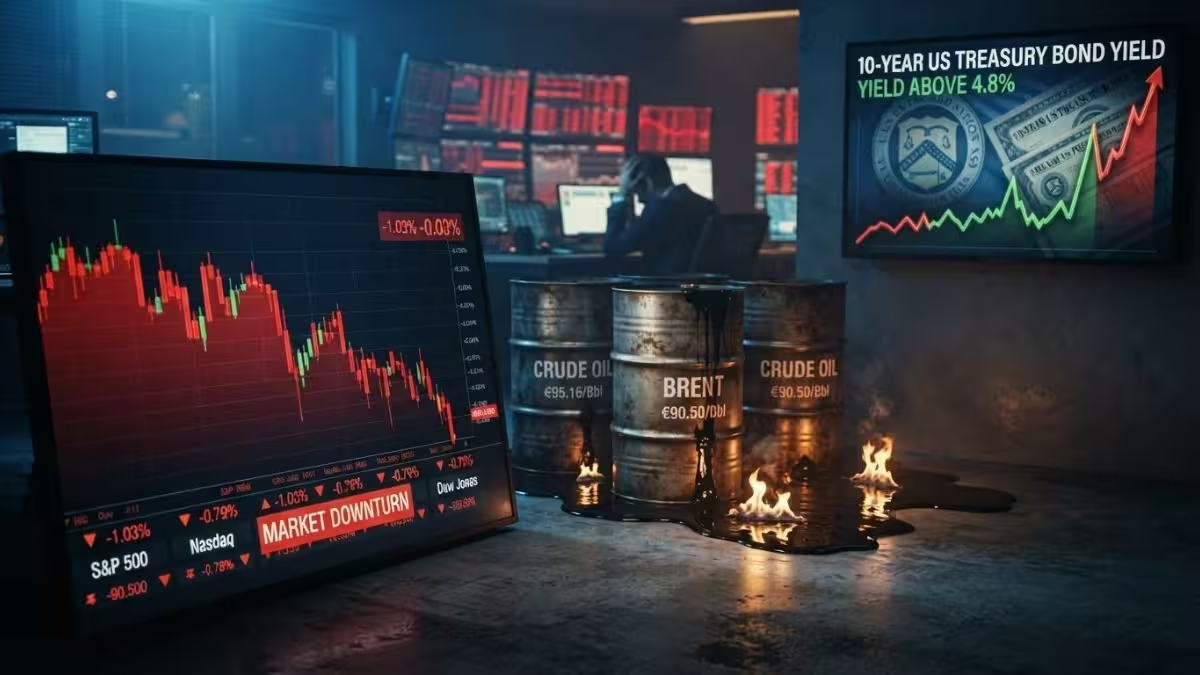
Wall Street faces intense selling pressure on Wednesday as Nasdaq futures slip roughly 0.2% during early premarket trading, reacting to a dramatic surge in crude oil prices and escalating geopolitical tensions that have pushed risk-free bond yields to multi-year highs. Equity markets are absorbing a punishing wave of global selling after the Nasdaq Composite dropped 1.03% to close at 26,099.77 points during Tuesday’s turbulent cash session. Concurrently, the benchmark S&P 500 index lost 0.71% to settle at 7,631.47, while the Dow Jones Industrial Average plummeted 419.02 points, or 0.79%, to end at 52,766.88. This collective retreat marks three consecutive trading days of declines for all three major United States stock indexes. Investors find little incentive to purchase equities during what has historically proven to be the most challenging month of the year for financial markets.
The primary catalyst for this market retreat stems directly from a sharp military escalation in the Middle East, which has rapidly revived global inflation anxieties. Fresh United States military strikes targeted Iranian positions, drawing immediate missile and drone retaliatory strikes against American bases. Concurrently, strikes on commercial tankers have severely disrupted maritime traffic and deepened fears over an outright closure of the highly critical Strait of Hormuz shipping lane. These developments pushed Brent Crude futures up by 0.54% to $95.16 a barrel Wednesday morning, after approaching $96 in previous sessions, while West Texas Intermediate crude rose 0.31% to settle at $90.50 a barrel. In total, global oil benchmarks have surged roughly 8% in just two trading sessions. This rapid energy price appreciation threatens to reverse recent progress on consumer price pressures, placing monetary policymakers in a difficult position.
The surge in crude oil prices has acted as a direct rate-hike catalyst, sending shockwaves through the sovereign debt markets and driving the yield on the benchmark 10-year United States Treasury note above 4.81%. This spike represents the highest yield recorded for the 10-year Treasury note since November 2023. Elevated risk-free yields systematically undermine equity valuations by significantly increasing borrowing costs for corporations and making conservative government bonds highly competitive with riskier equities. “We could see a sharp rise in geopolitical tensions over the next few weeks, as Tehran currently holds its strongest strategic bargaining position ahead of the upcoming midterm elections,” noted Ryan Isherwood, founder and CEO of Significance Capital. The sudden military escalation has disrupted the uneasy calm that characterized markets over the preceding weeks, forcing traders to rapidly re-evaluate their portfolios.
The technology sector has borne the brunt of this bond market rally, as higher yields heavily discount the present value of long-term corporate earnings. Mega-cap growth companies are particularly vulnerable to this mathematical discounting model. During recent sessions, chip giant Nvidia fell 1.51% to close at $217.44, while Advanced Micro Devices dropped 2.4%. Retail and cloud computing giant Amazon extended its retreat, falling 1.87% to close at $254.92. Other technology majors also suffered notable losses, with electric vehicle manufacturer Tesla sliding 3.22% to $356.09 and software powerhouse Microsoft declining 1.24% to close at $501.02. The underlying market breadth of the Nasdaq was remarkably weak, with 128 individual stocks hitting fresh 52-week lows, compared to a mere 19 stocks securing new highs.
This deterioration in equity values has spread rapidly across international financial capitals, confirming the global nature of the current valuation squeeze. Asia-Pacific equity markets bore the next wave of intense selling. South Korea’s chip-heavy OSI index plunged more than 3%, while Japan’s Nikkei 225 index dropped 2.6%. In Tokyo, Japanese five-year government bond yields surged to a record 2.295%, demonstrating that the intense pressure on sovereign debt and corporate valuations has expanded far beyond the borders of Wall Street. Concurrently, the US dollar index climbed toward 99.80, while gold futures slid below their 200-day moving average, declining 0.96% to settle at $4,354.39 per ounce as investors sought shelter in cash over precious metals.
The shifting economic landscape has directly complicated the near-term interest rate outlook for the Federal Reserve. Market participants have aggressively adjusted their terminal rate expectations. Traders are now pricing in a 67% probability of an additional quarter-point interest rate increase at the central bank’s September policy meeting, a substantial rise from the 40% probability priced in just one week prior. This hawkish shift followed hawkish commentary from key policy officials. “Taming price pressures is the central bank’s chief focus,” said Kevin Warsh, Chair of the Federal Reserve. This uncompromising focus on inflation has left investors grappling with the prospect of prolonged restrictive monetary policy.
Reflecting on the central bank’s situation, Isherwood mentioned that while interest rate expectations have been fluctuating back and forth like a game of ping-pong, an actual rate hike immediately before the election remains improbable given the complex political and economic currents. The Federal Reserve remains in a significant policy bind. While rising geopolitical tensions and escalating energy costs typically demand higher interest rates to curb core inflation, those same rising costs can simultaneously suppress consumer demand and drag down overall economic growth.
Still, select technology giants have managed to deliver strong corporate results amidst the macroeconomic gloom. Server manufacturer Dell Technologies surged 9.65% in premarket trading after posting record-breaking quarterly revenue of $47 billion and adjusted earnings of $7.04 per share, easily outpacing consensus Wall Street expectations. Dell management aggressively raised its annual revenue guidance to $192 billion, representing a substantial $25 billion upward adjustment, fueled by robust enterprise artificial intelligence demand. The company’s AI-server bookings exceeded $130 billion over the past year, confirming that corporate infrastructure spending on next-generation computing remains highly resilient. Investors are now looking to Broadcom, which is scheduled to report its quarterly earnings after Wednesday’s closing bell. Consensus estimates Broadcom will deliver revenue of approximately $29.2 billion alongside adjusted earnings of $3.23 per share.
Despite these isolated corporate triumphs, broader equity markets must contend with severe seasonal headwinds throughout the remainder of the month. September holds a well-documented reputation as the worst-performing calendar month for global equities. “September has arrived with its historical reputation intact,” noted market analysts at TradingView, pointing to long-term performance trends. Historical market data compiled over a century confirms that these seasonal dynamics are deeply entrenched. “Since 1926, the benchmark S&P 500 has lost 0.7% on average in September, making it the weakest month for stocks and the only one with a negative average return,” said analysts at Fisher Investments, citing data from Fine.
Looking ahead, financial markets face a series of critical macroeconomic tests that will determine the trajectory of equities and sovereign bonds. Investors are closely monitoring Wednesday’s release of the ADP private employment data, factory orders, and the Federal Reserve’s Beige Book for signs of labor market softening or economic cooling. These indicators will serve as critical inputs ahead of Friday’s highly anticipated nonfarm payrolls report. If the upcoming employment data reveals persistent wage growth and labor market tightness alongside surging oil prices, the Federal Reserve may feel compelled to act decisively, cementing the market’s worst fears of a September interest rate hike and keeping risk assets under intense pressure.
Editorial Note: This article was researched and drafted with AI assistance, then rigorously fact-checked, edited, and published by Miles. All content is strictly for informational and educational purposes only and does not constitute professional investment advice. Cryptocurrency and global financial markets experience severe volatility, sometimes swinging 50% or more in a single day. Invest only capital you can comfortably afford to lose, and always consult a certified financial advisor before committing funds. Read my full Disclaimer for more details.