
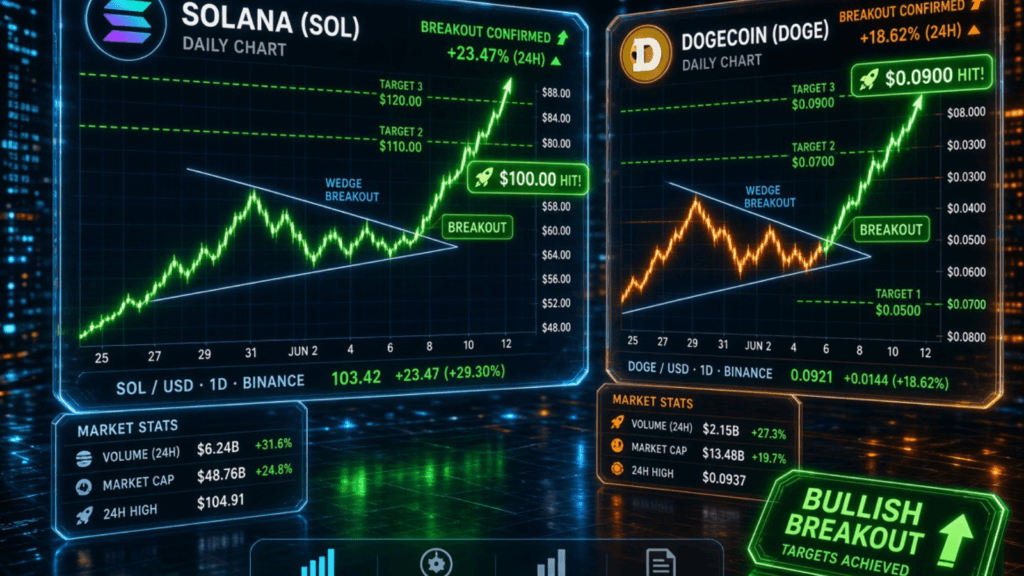
NEW YORK — Digital asset markets are entering a period of extreme compression as investors finalize Solana and Dogecoin trading strategies ahead of a projected autumn breakout. Technical indicators suggest Bitcoin is carving out a “generational” bottom near its 200-week moving average, providing a stable foundation for high-conviction altcoin plays. While Bitcoin remains the primary market barometer, institutional attention is shifting toward high-utility networks like Solana and speculative leaders like Dogecoin.
Traders are currently navigating a “calm before the storm” environment, characterized by low volatility and high accumulation. The market’s focus has intensified on technical entry points and long-term valuation gaps, particularly as the U.S. Senate prepares for a pivotal procedural vote on the Clarity Act on September 15. This regulatory milestone, combined with massive institutional inflows, is forcing a reevaluation of traditional crypto valuation models.
Market Impact: The Bitcoin Compression and Short Squeeze Potential
Bitcoin’s current price action mirrors the late 2022 accumulation phase, with the asset trading in “deep value” territory below its 200-week moving average. Historically, Bitcoin stays in this zone only 8% of the time, often preceding significant moves toward the upside. Analysts report that the market is preparing for a major short squeeze as shorts reach exhaustive levels and spot demand continues to rise.
Institutional data reinforces this bullish outlook. BlackRock’s IBIT ETF recently lowered its Bitcoin-to-ETF conversion threshold from $25 million to $1 million, allowing a broader range of holders to seek institutional custody without incurring capital gains taxes. Between August 3 and August 9, ETFs purchased eight times more Bitcoin than Michael Saylor’s MicroStrategy sold, indicating that institutional demand is effectively absorbing retail or corporate sell pressure.
The broader market impact is visible in the Ethereum and Solana pairs. While Ethereum has shown short-term weakness, hitting support at its 200-day moving average, it remains a “Table Stakes” asset for Wall Street. However, the real volatility is expected in the altcoin sector, where specific technical setups for Solana and Dogecoin are now reaching execution levels.
Key Details: Executing Solana and Dogecoin Trading Strategies
Specific Solana and Dogecoin trading strategies now center on precise entry points and strict risk management to navigate current volatility.
For Solana (SOL), traders are eyeing entries in the low $75 range. A recommended stop-loss for this position sits between $73.70 and $73.80. Initial profit targets are set at $84 to $85, with a medium-term goal of testing the range top near $100 within the coming weeks. This strategy leverages Solana’s status as a market leader in daily active users and decentralized application (dApp) revenue.
The Dogecoin (DOGE) setup is viewed primarily as a technical breakout trade rather than a long-term fundamental investment. Analysts recommend entry prices no higher than 7.07 cents, with a stop-loss positioned just under the 7-cent mark. The primary “Take Profit” (TP) targets for Dogecoin are 8 cents and 9 cents, with the latter aligning with the 200-day moving average. This setup is considered one of the most favorable daily breakout patterns currently visible in the market.
Why It Matters: The Fundamental Valuation Gap
The rationale behind these strategies extends beyond simple chart patterns. A massive valuation discrepancy currently exists between legacy chains and high-performance networks. Solana is valued at approximately $9,000 per daily active user, whereas Ethereum is valued at nearly $1 million per user and Bitcoin at $2.1 million.
If Solana were to achieve Ethereum’s market capitalization, its price would theoretically reach $1,000, representing a 13x increase from current levels. Solana’s utility is further evidenced by its capture of 43% of all dApp revenue in the crypto industry, which is 4.4 times the revenue generated by Ethereum-based applications.
Furthermore, Solana’s network activity has grown 5x in three years, processing 75 million transactions per day. In contrast, Ethereum’s usage has increased by only 50% over the same period. This “winner-takes-most” trajectory suggests that capital will continue to rotate into assets with the highest on-chain economic activity.
Expert Analysis: Institutional Tokenization and the AI Pivot
Financial institutions are no longer merely observing crypto; they are integrating it into the “global financial plumbing”. Charles Schwab’s head of crypto research recently identified XRP and Stellar (XLM) as “established winners” in the payments and stablecoin sectors. Meanwhile, Aviva Investors, a European investment giant, has begun tokenizing its U.S. dollar liquidity fund shares on the XRP Ledger.
A broader shift is occurring toward AI-driven finance. Forecasts indicate that by 2028, 99.99% of all on-chain transactions will be conducted by AI agents or LLM-based wallets. Because AI agents require near-instantaneous “finality” and high-frequency microtransactions, Solana is positioned as the primary infrastructure for this new economy. These agents cannot utilize traditional banking tools or slow blockchains that require 50 to 80 milliseconds of latency.
The DTCC, which safeguards over $114 trillion in assets, is set to launch a major tokenization initiative in approximately 50 days. This launch will include live tokenized trading of the Russell 1000 funds and U.S. Treasuries, signaling an “operational phase” for institutional blockchain adoption that may proceed regardless of the immediate legislative outcome in Washington.
Related Info: The Regulatory Countdown and the Clarity Act
The primary headwind for the U.S. crypto market remains the lack of federal clarity. The Clarity Act is currently the focus of an intense lobbying battle in Washington. While a procedural vote is scheduled for September 15, community bankers have raised concerns regarding “deposit flight”.
Community bankers argue that stablecoin yields could draw deposits away from local banks, reducing their ability to fund small business and agricultural loans. Conversely, proponents like former Barclays CEO Bob Diamond argue that innovation is essential and that stablecoins are merely a digital version of the dollar, not a replacement for traditional deposits.
Failure to pass the Clarity Act could result in a multi-year delay in U.S. market structure legislation, potentially pushing the next opportunity to 2030 or 2031. Analysts warn that this would lead to a “brain drain,” as companies like OKX and Ripple continue to expand their regulatory footprints in Europe, the UK, and the UAE instead of the United States.
The Bottom Line
The convergence of Bitcoin’s technical bottom, institutional tokenization, and the impending AI agent revolution has created a unique window for Solana and Dogecoin trading strategies. While Dogecoin offers a high-probability technical breakout, Solana presents a fundamental “winner-takes-most” opportunity based on its dominance in revenue and user metrics. Investors must remain vigilant as the September 15 regulatory vote approaches, as it will likely serve as the ultimate catalyst for the next phase of the digital asset bull market.
Editorial Note: This article was researched and drafted with AI assistance, then rigorously fact-checked, edited, and published by Miles. All content is strictly for informational and educational purposes only and does not constitute professional investment advice. Cryptocurrency and global financial markets experience severe volatility, sometimes swinging 50% or more in a single day. Invest only capital you can comfortably afford to lose, and always consult a certified financial advisor before committing funds. Read my full Disclaimer for more details.
