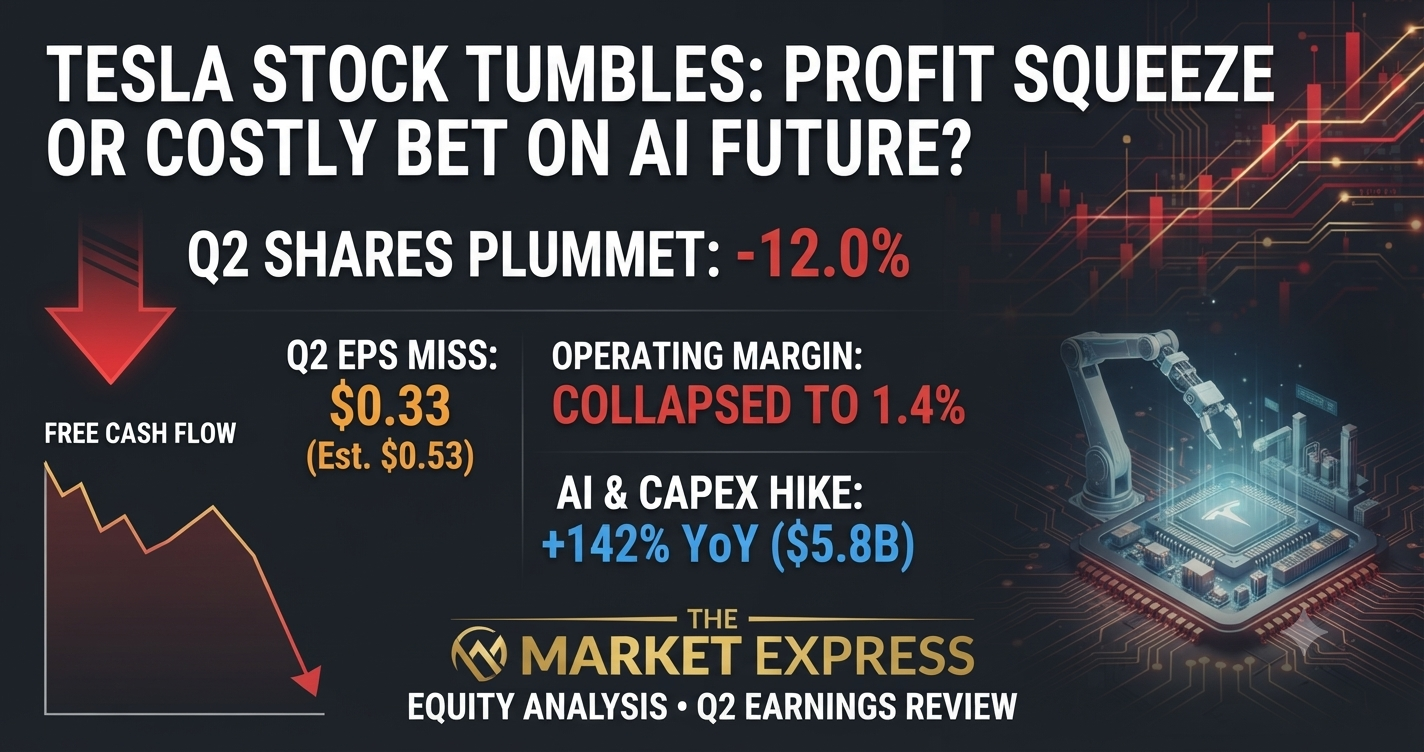
Tesla’s stock just had one of its roughest sessions in years. On July 23, shares plummeted roughly 12%, wiping out more than $140 billion in market value in a single day. The trigger: a Q2 earnings report that looked strong on the surface but revealed serious cracks underneath — a steep profit miss, collapsing margins, and the company’s first quarterly cash burn since early 2024.
Tesla’s long-term vision hasn’t changed. But investors just got a much clearer look at what that vision is currently costing.
Revenue Beat, Profit Crisis
Here’s the confusing part for anyone glancing at the headline numbers: Tesla’s revenue actually came in strong. The company posted $28.24 billion in Q2 revenue, up 26% year-over-year and ahead of analyst expectations. Deliveries hit a record 480,000+ vehicles for the quarter.
So why the stock crash? Because everything below the revenue line told a much uglier story.
Wall Street had expected adjusted earnings per share of roughly 52-54 cents. Tesla delivered just $0.33 — a miss of close to 40%. The culprit is margin compression: automotive gross margin came in at 16.8%, well below the roughly 19% analysts were modeling. Operating income fell 57% year-over-year, and operating margin collapsed to just 1.4%, down from 4.1% a year earlier.
In plain terms: Tesla is selling more cars than ever, but making less money meaningfully on each one — a direct consequence of the aggressive price cuts it’s been using to keep volume growing.
The High Cost of the “AI Dream”
Tesla is in the middle of repositioning itself — from a car company to what it hopes will be an AI and robotics leader. That repositioning isn’t cheap.
Capital expenditure jumped 142% year-over-year to roughly $5.8 billion in Q2 alone, funding a wide slate of ambitious projects: the Cybercab robotaxi (now in production at Gigafactory Texas), the Optimus humanoid robot, a dedicated chip manufacturing facility, and continued buildout of the Robotaxi service, which is now live in seven U.S. metro areas.
The bill for all of this showed up directly in Tesla’s cash flow. Free cash flow turned negative at $1.09 billion for the quarter — the company’s first quarterly cash burn since early 2024, and a sharp reversal from the positive free cash flow it posted a year ago.
What Wall Street Is Watching Next
From a technical standpoint, the picture looks shaky. The stock broke below a support level around $368 that had largely held since late 2025. If Tesla can’t reclaim that level, some analysts see the next downside test as low as the mid-$330s.
Reaction from analysts has been mixed rather than uniformly bearish. Several have acknowledged that the AI and robotics spending represents a genuine long-term bet rather than wasteful spending — but that framing hasn’t stopped several firms from trimming their price targets to reflect the deteriorating near-term cash flow picture.
The Investor’s Dilemma
Tesla’s valuation has always leaned heavily on its future rather than its present — but that gap is widening. As a car company, the numbers this quarter were genuinely weak. As a bet on autonomy and robotics, the story is still unproven: Cybercab and Optimus remain early in production, manufacturing at scale is still a work in progress, and a clear timeline to monetization doesn’t yet exist.
Layer on intensifying competition from lower-cost Chinese EV makers and ongoing regulatory scrutiny of Autopilot and Full Self-Driving software, and the picture facing Tesla investors becomes clearer: this isn’t a company in crisis, but it is a company asking shareholders to keep funding an expensive, uncertain future while the core business absorbs real near-term pain.
Whether that trade-off is worth it now depends entirely on how much patience — and conviction in the robotaxi/Optimus vision — investors are willing to bring to the next few quarters.
Editorial Note: This article was researched and drafted with AI assistance, then rigorously fact-checked, edited, and published by Miles. All content is strictly for informational and educational purposes only and does not constitute professional investment advice. Cryptocurrency and global financial markets experience severe volatility, sometimes swinging 50% or more in a single day. Invest only capital you can comfortably afford to lose, and always consult a certified financial advisor before committing funds. Read my full Disclaimer for more details.