Mexico’s central bank unexpectedly adjusted its official Banxico growth forecast on Wednesday, signaling a complex dual-track economic trajectory for the Latin American nation. Policymakers upgraded the near-term economic expansion estimate but simultaneously warned that consumer price pressures are proving far more stubborn than previously modeled. The central bank raised its gross domestic product projection for 2026, yet it forced global markets to digest a significant delay in its long-awaited inflation-convergence timeline.
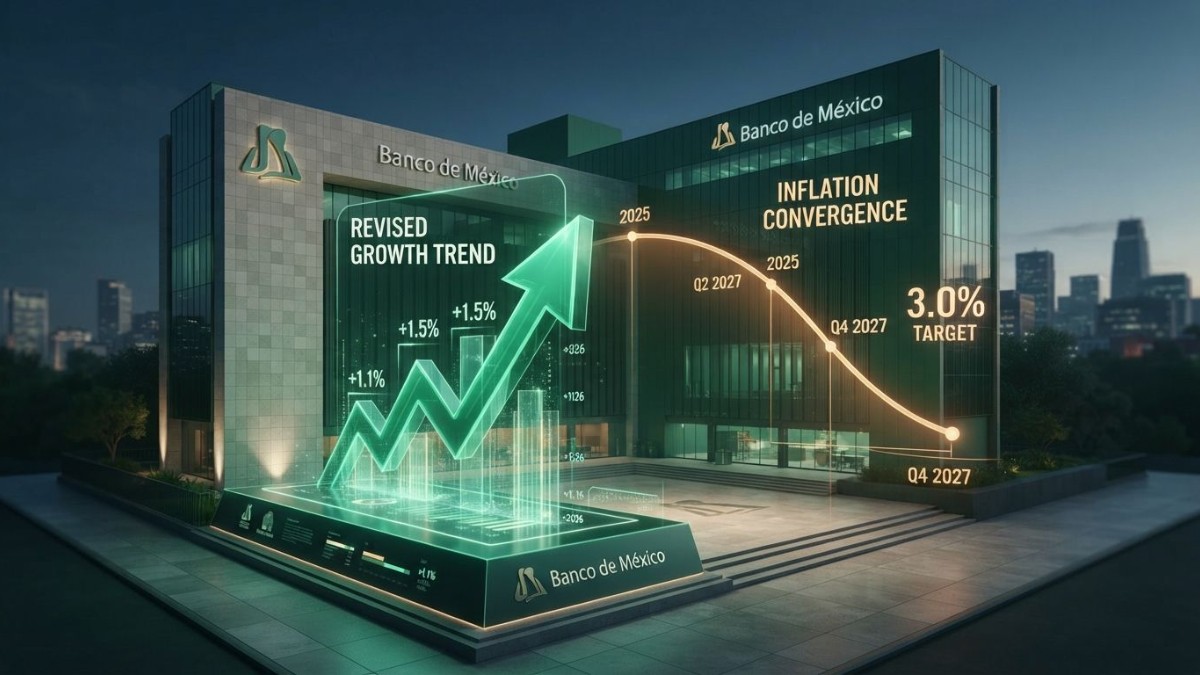
The Bank of Mexico revised its GDP growth expectations upward for 2026, lifting the rate to 1.5%. This expansion projection marks a notable improvement over the central bank’s previous estimate of 1.1%. Near-term domestic demand has shown surprising resilience, prompting analysts to recalculate their immediate models. “The Bank of Mexico raised its economic growth forecast on Wednesday while extending the timeline for inflation to reach its target rate,” said Jaiveer Shekhawat, Editor at Investing.com.
Meanwhile, the growth outlook for the subsequent year did not share the same optimistic revisions. The central bank trimmed its 2027 economic growth projection down to 2.0%. This new projection represents a decline from the 2.1% rate previously estimated by the monetary authority. Policymakers pointed to deep-seated domestic and international structural hurdles that continue to limit the nation’s mid-term productive output.
Trade policy uncertainty remains a dominant weight on the Mexican economic machinery. The central bank noted that economic activity continues to experience a period of weakness. This deceleration coincides with elevated caution among businesses regarding cross-border trade framework stability. “Economic activity continues to experience a period of weakness with uncertainty surrounding the review of the U.S.-Mexico-Canada (USMCA) trade agreement,” said the Governing Board of the Central Bank of Mexico.
This trade uncertainty directly impacts capital expenditure, as domestic and foreign companies delay major investments. The scheduled review of the USMCA represents a significant geopolitical hurdle for North American manufacturing networks. Still, near-term industrial sectors continue to operate, even as long-term planning remains on hold. This creates a volatile operational environment where local suppliers must navigate shifting trade policies.
The most substantial shock to market pricing came from the central bank’s inflation timeline. The monetary authority officially delayed its expected convergence window for headline inflation to reach the 3.0% target. Banxico now estimates that headline consumer price inflation will only hit this target in the fourth quarter of 2027. This adjustment represents a notable postponement from the previously expected convergence date of the second quarter of 2027.
A primary factor behind this delayed timeline is the persistent stickiness of core inflation. The central bank adjusted its core inflation expectation for the fourth quarter of 2026 upward. Policymakers now project core inflation will end this year at 3.5%, up from the previous forecast of 3.4%. This upward adjustment shows that raw consumer price pressures are deeply embedded in the service and retail sectors.
“The latest data showed inflation for the first half of August stood at 3.26%, while core inflation measured 3.93%,” said Reuters News, Syndicated Wire Service at Reuters. These high consumer price prints illustrate the difficult policy decisions ahead for Banxico’s monetary committee. Core inflation remains significantly elevated above the headline rate, signaling that underlying demand continues to outpace sustainable capacity.
Persistent price stickiness restricts the central bank’s ability to lower borrowing costs rapidly. Restrictive monetary policy has been the primary tool used to cool domestic demand. However, holding interest rates at elevated levels for an extended period threatens to exacerbate the economic weakness already noted in the GDP data. This policy dilemma forces policymakers to proceed with extreme caution in subsequent meetings.
Global investors are watching these adjustments closely to determine the future trajectory of Mexican financial assets. High interest rates have historically supported the domestic currency, yet they weigh on industrial activity. If the USMCA review introduces additional trade barriers, the central bank may find it increasingly difficult to support growth while fighting sticky prices. Still, the immediate upgrade to 2026 growth provides a temporary buffer for fiscal authorities.
The domestic services sector remains a primary source of stubborn price pressures across the nation. While global commodity prices have fluctuated, local wages and operational expenses keep core consumer metrics elevated. This domestic momentum helps explain why the near-term Banxico growth forecast improved, even as the mid-term target convergence slipped into late 2027. Central bank officials must remain vigilant to prevent inflation expectations from becoming completely unanchored.
Ultimately, Mexico’s economic path depends on navigating both persistent domestic inflation and international trade negotiations. The raised 2026 growth outlook offers a brief moment of relief, yet the structural decelerations expected in 2027 highlight deep systemic challenges. As monetary authorities balance these competing forces, the delayed convergence timeline reminds markets that the battle against inflation is far from over.
Editorial Note: This article was researched and drafted with AI assistance, then rigorously fact-checked, edited, and published by Miles. All content is strictly for informational and educational purposes only and does not constitute professional investment advice. Cryptocurrency and global financial markets experience severe volatility, sometimes swinging 50% or more in a single day. Invest only capital you can comfortably afford to lose, and always consult a certified financial advisor before committing funds. Read my full Disclaimer for more details.