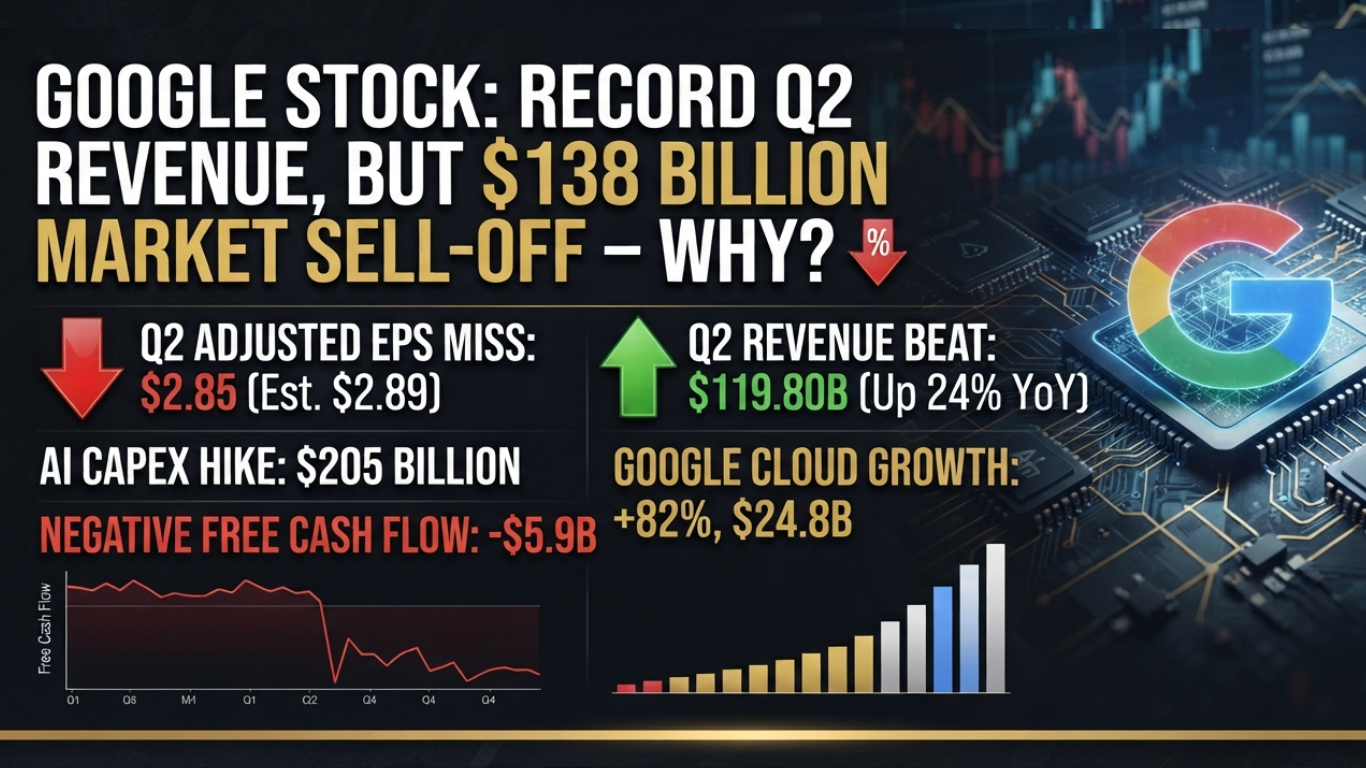
Alphabet (Google’s parent company) recently reported its second-quarter (Q2) earnings for 2026, delivering a report that was both record-breaking and deeply concerning for Wall Street. While the company celebrated a massive revenue beat, the market reacted with a sharp decline. This Google stock analysis dives into why shares plummeted by as much as 5% in after-hours trading, effectively erasing $138 billion in market capitalization despite Alphabet surpassing sales expectations.
The Revenue Beat vs. the Adjusted EPS Reality
At face value, Alphabet’s performance was dominant. Total revenue surged 24% year-over-year to $119.80 billion, comfortably beating the consensus estimate of $116.93 billion. However, savvy investors looking at Google stock noticed a discrepancy in the profit margins.
The reported net income tripled to $112.1 billion, but a staggering $98 billion of that was attributed to one-off, unrealized “paper gains” from equity investments in companies like Anthropic and SpaceX. When these non-operational gains are stripped away, the adjusted Earnings Per Share (EPS) was $2.85, missing the $2.89 target Wall Street had anticipated.
The Soaring Cost of the AI Arms Race
The primary catalyst for the Google stock dip was the company’s revised Capital Expenditure (Capex) guidance. CFO Anat Ashkenazi informed analysts that Alphabet is raising its 2026 Capex forecast for the second time in three months, now targeting a range of $195 billion to $205 billion.
This aggressive spending is required to scale AI infrastructure, such as the Virgo Network, which connects one million AI accelerators into a unified supercomputer. While necessary for long-term dominance, investors are increasingly wary that this “AI race” demands massive upfront costs and a timeline for returns that remains unclear.
Negative Free Cash Flow: A Red Flag for Investors
For the first time in over a decade, Alphabet reported negative free cash flow of $5.9 billion. This indicates that the company is currently spending more on infrastructure and operations than its core business is generating. To bridge this gap, Alphabet had to raise $49.6 billion in new equity and issue $20.3 billion in new debt, causing interest expenses to surge by 390%. For those holding Google stock, this shift from a “cash cow” to a company needing external financing marks a significant structural change.
The “Capex Coverage Ratio” Insight
To assess the health of Google stock, analysts are tracking the Capex Coverage Ratio (operating cash flow divided by Capex). In Q2 2026, this ratio dropped to 0.87x, falling below the critical 1.0x threshold for the first time in recent years. This suggests that Alphabet’s own operations are no longer fully funding its growth spending, a trend that may continue as the company expects Capex to “increase significantly” in 2027.
Google Cloud: The Bright Spot in the Portfolio
Despite the stock volatility, Google Cloud emerged as a massive profit engine. The segment grew 82% to $24.8 billion, with operating margins expanding from 20.7% to 35.6% in just one year. Cloud’s momentum is evidenced by:
- A $514 billion backlog in signed future revenue.
- 90% adoption of the Gemini Enterprise platform by the Fortune 100.
- 22 billion tokens processed per minute by model APIs.
Verdict: Is Google Stock a Strategic Buy?
Despite the current dip, most Wall Street analysts remain bullish. Evercore ISI maintains an “Outperform” rating with a $420 price target, arguing that the core Search and Cloud businesses are healthy enough to justify the current spending.
The summary for Google stock is clear: Alphabet is in a high-stakes transition period. While the core business is performing exceptionally well, the sheer scale of AI infrastructure spending is testing investor patience. For long-term investors, this dip may represent a strategic entry point, provided they believe the company’s $514 billion Cloud backlog will successfully convert into high-margin profits over the coming quarters.