
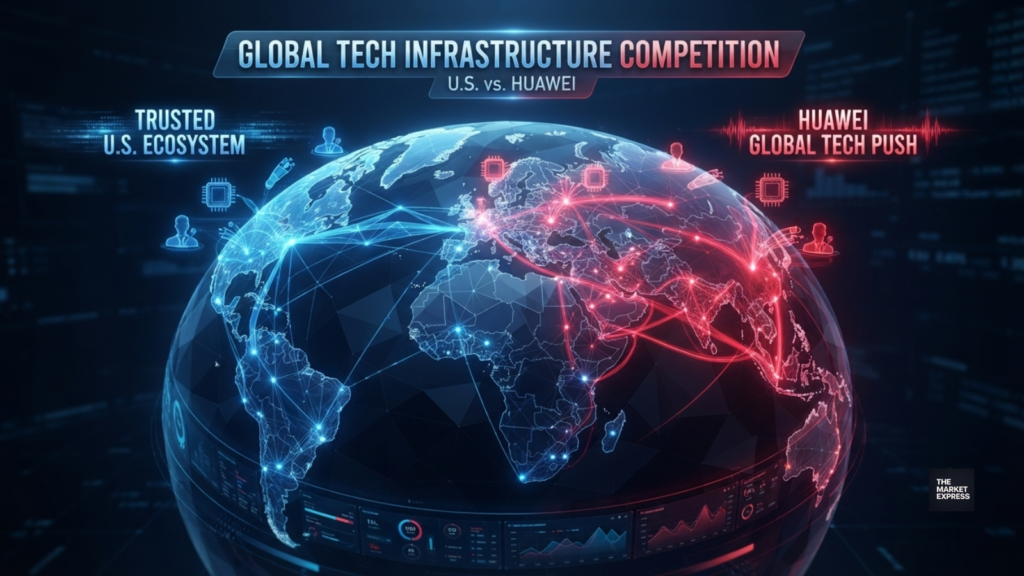
The US-China AI competition has reached a critical pivot point in mid-2026. While the United States maintains a technical lead in large language models, China is rapidly closing the distance by leveraging the global footprint of telecommunications giant Huawei. Former State Department official Keith Krach warned this week that the rivalry has evolved from a software-centric race into a “full-stack” struggle for dominance over the entire technological ecosystem.
Washington now faces an urgent mandate to scale its physical and digital capacity. The battle for artificial intelligence is no longer confined to code; it is being fought across power grids, semiconductor fabrication plants, and data center construction sites. As Beijing accelerates its global technology push, the U.S. lead is under its most significant pressure since the inception of the generative AI boom.
Market Impact: Capital Flows Toward Infrastructure
The financial stakes of the US China AI competition are reflected in the staggering earnings of hardware providers. Nvidia recently reported a blockbuster Q1 FY27, with revenue hitting $81.6 billion—an 85% year-over-year increase. Non-GAAP earnings per share (EPS) surged 140%, signaling that demand for AI hardware remains insatiable.
Investors are increasingly looking beyond software applications toward the industrial backbone of AI. Nvidia’s diversification into industrial and enterprise sectors, which now account for $37 billion of its revenue, underscores a market shift toward the physical infrastructure required to run these models. This capital migration is a direct response to the massive projected growth in AI consumption. OpenAI CEO Sam Altman recently predicted that by 2033, individual token use could skyrocket to 500 billion per month. To meet this demand, the infrastructure must grow by orders of magnitude, a challenge that lies at the heart of the current geopolitical rivalry.
Key Details: The “Full-Stack” Battleground
Keith Krach, the former Under Secretary of State, argues that the US-China AI competition is now a contest of entire ecosystems. This “full-stack” rivalry includes several critical pillars:
- Energy Production: AI models require unprecedented levels of electricity.
- Semiconductors: The essential hardware layer remains a key bottleneck.
- Data Centers: Physical processing capacity is becoming a sovereign asset.
- Technical Standards: The rules governing how AI interacts globally.
Huawei leads China’s approach, which focuses on combining these components into a unified solution for global markets. By bundling telecommunications, cloud services, and AI hardware, Beijing is creating a dependency loop that complicates U.S. efforts to maintain a “trusted” global network. Krach emphasizes that for the U.S. to win, it must not only innovate but also offer a comprehensive alternative that supports its allies’ independence.
Why It Matters: Strategic Independence of Allies
The expansion of Huawei’s global technology influence is not merely a commercial threat; it is a strategic one. As China narrows the gap in the US China AI competition, allied nations face a difficult choice between Chinese-backed infrastructure and U.S. technology.
Huawei’s ability to offer easier financing and rapid deployment has made it an attractive partner for developing nations and even some Western allies. If the U.S. fails to offer competitive financing and deployment options, it risks being sidelined in the global rollout of AI-integrated infrastructure. Krach notes that a “trusted, full-stack technology ecosystem” is the only viable way to ensure that allies do not become tethered to Beijing’s technical standards and surveillance capabilities.
Expert Analysis: The Krach and Altman Perspectives
Analysts point to two divergent but related pressures on U.S. leadership. From a geopolitical lens, Keith Krach views the current landscape as a race for trust. He argues that the U.S. must leverage its reputation for transparency and the rule of law to build international coalitions. However, this reputation must be backed by industrial might.
From a technical and economic lens, Sam Altman’s projections provide a roadmap of the sheer scale required. The jump from 100,000 tokens per person in 2019 to a predicted 500 billion by 2033 suggests that current U.S. capacity is a mere fraction of what will be needed. This scale-up requires a workforce that does not yet exist in sufficient numbers. Krach explicitly identified a “skilled workforce” as one of the critical components the U.S. must boost to maintain its edge.
Related Info: The Semiconductor Chokepoint
While AI models get the headlines, the semiconductor industry remains the most volatile front in the US China AI competition. The U.S. push to domesticate chip production is a direct response to the vulnerability of global supply chains. According to recent analyst insights, companies like Nvidia are seen as “undervalued” despite massive stock runs because they hold the keys to this hardware kingdom.
However, the hardware race is also being influenced by security scares in related sectors. For instance, a recent security vulnerability in Coldcard hardware wallets led to the creation of 2.27 million new Bitcoin wallets in a single week as users scrambled for safety. This highlights a broader trend: as the digital world becomes more complex and integrated with AI, the demand for secure, trusted hardware—from wallets to AI chips—will only intensify.
Conclusion: A Strategic Crossroads
The United States remains the leader in the US-China AI competition, but the era of easy dominance is over. The narrowing gap, fueled by Huawei’s aggressive global expansion and China’s focus on “full-stack” infrastructure, requires a fundamental shift in American policy.
To prevail, Washington must treat energy, semiconductors, and data centers as vital components of national security. It must foster a skilled workforce and provide the financial mechanisms necessary to export its “trusted” ecosystem to the world. As token consumption heads toward the trillions, the nation that builds the most robust and reliable infrastructure will likely dictate the future of the global economy.
Editorial Note: This article was researched and drafted with AI assistance, then rigorously fact-checked, edited, and published by Miles. All content is strictly for informational and educational purposes only and does not constitute professional investment advice. Cryptocurrency and global financial markets experience severe volatility, sometimes swinging 50% or more in a single day. Invest only capital you can comfortably afford to lose, and always consult a certified financial advisor before committing funds. Read my full Disclaimer for more details.
