
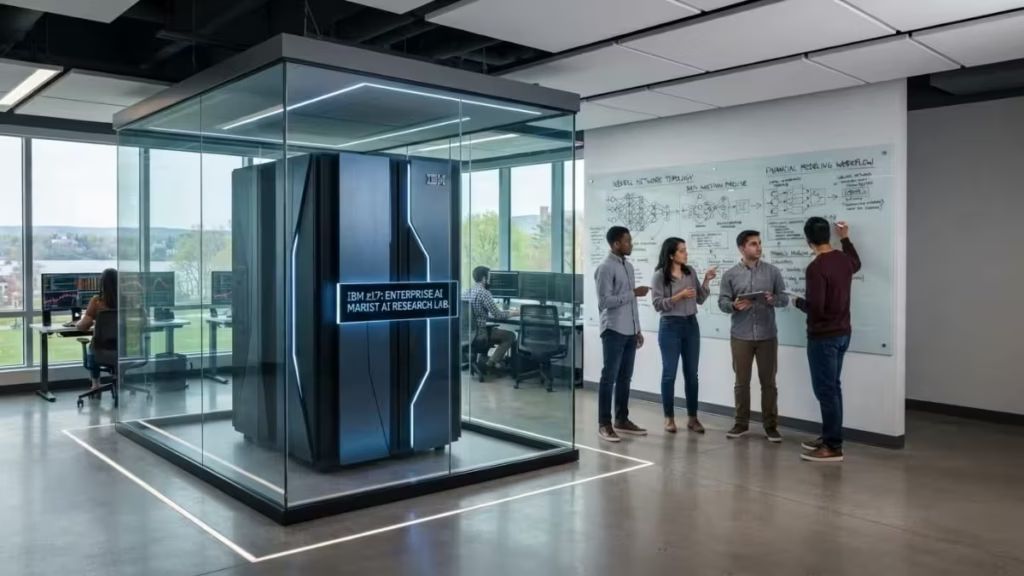
IBM stock gains as z17 momentum during Friday trading as shares of the hybrid cloud and mainframe provider climbed 0.4% to $227.97 by 11:19 a.m. Eastern Time. The modest uptick coincided with the deployment of an enterprise z17 system to Marist University’s newly established Innovation Incubator. Trading at a 6.14% discount to its estimated GF Value of $242.88, the stock reflected cautious optimism among market participants evaluating the long-term payoff of institutional hardware placements. While the immediate price movement remains incremental, the placement underscores IBM’s ongoing strategy of integrating high-performance computing hardware into educational settings. Investors closely watched the market action to determine whether campus infrastructure installations can eventually translate into high-margin enterprise commercial contracts.
The university deployment deepens a historical technology relationship that spans more than 50 years between IBM and Marist University. Over five decades, the two institutions have collaborated on mainframe architecture, enterprise software testing, and computer science curriculum development. The arrival of energy-efficient systems at the Innovation Incubator marks the latest evolution in this strategic alignment, shifting focus toward advanced artificial intelligence research. By granting academic researchers direct physical and programmatic access to mainframe computing power, the partnership aims to bridge theoretical machine learning and the realities of enterprise hardware. The multi-decade longevity of the partnership provides IBM with a stable environment for testing mainframe capabilities outside commercial data centers.
Under the terms of the academic initiative, faculty members and undergraduate students will utilize the z17 mainframe to investigate specialized artificial intelligence applications. Primary research tracks include the development of autonomous AI marketing agents designed to process complex consumer datasets. Additionally, finance and data science teams plan to leverage the system’s processing capabilities to construct quantitative portfolio allocation models. Researchers will also explore modern algorithmic polling methods to analyze large-scale opinion datasets in real time. These diverse academic projects demonstrate the versatile workload capabilities of modern z17 architecture across financial engineering, data analytics, and digital marketing workflows.
Despite the high-profile nature of the hardware installation, project leaders have not disclosed specific financial targets or formal research budgets for the proposed initiatives. Market observers note that academic hardware grants often operate without immediate revenue expectations or strict commercial timelines. The absence of public funding metrics makes it difficult for equity analysts to model direct financial returns from the Marist University installation. Consequently, Wall Street continues to treat the z17 deployment primarily as an educational initiative rather than an immediate top-line catalyst. Still, the lack of disclosed project budgets does not diminish the strategic value of establishing early-stage hardware familiarity among emerging technologists.
For institutional market participants, distinguishing between academic goodwill and near-term revenue generation remains critical. Equity analysts emphasize that placing a mainframe system on a college campus is not proof of a new commercial sales stream. The immediate financial impact on IBM’s quarterly earnings remains negligible until university research generates proprietary enterprise tools or commercial spinoffs. Wall Street routinely scrutinizes enterprise tech grants to separate promotional academic partnerships from binding corporate procurement orders. However, market pricing reflects an understanding that early access to hardware often shapes the technical preferences of future corporate decision-makers.
By embedding its z17 infrastructure within higher education, IBM secures early exposure among students and researchers who will soon enter the technology workforce. Engineers and software developers who build applications on z17 mainframes during their academic tenure are statistically more likely to recommend IBM hardware in future corporate roles. This talent pipeline strategy allows IBM to defend its dominant mainframe market share against cloud-native competitors. As these graduates advance into enterprise IT departments, their familiarity with z17 architecture creates organic demand for hybrid cloud systems. Over a multi-year horizon, this educational seeding strategy strengthens customer retention and expands software licensing opportunities.
Equity valuation models highlight an ongoing gap between IBM’s market trading price and its intrinsic value estimates. At $227.97 per share, IBM trades 6.14% below its calculated GF Value benchmark of $242.88. Analysts note that this valuation gap reflects broader market debate surrounding enterprise mainframe upgrade cycles and hybrid cloud revenue acceleration. The 0.4% share price gain on Friday indicates steady investor support, though market participants recognize that single-day university announcements rarely close valuation gaps on their own. Instead, sustained share price appreciation will depend on broader enterprise adoption of z17 systems across commercial banking, healthcare, and government sectors.
Financial analysts maintain that the bull case for IBM grows significantly stronger when university research translates into tangible software applications and commercial demand. If student projects surrounding AI marketing agents or portfolio allocation yield patentable software, IBM could capture new enterprise licensing streams. Additionally, corporate enterprise clients seeking pre-tested AI algorithms may turn to IBM as a primary technology partner. Until academic projects convert into measurable customer purchasing orders, the financial benefits of campus mainframes remain theoretical. Investors continue to monitor whether research outputs from Marist University can spark broader enterprise demand for z17 hardware installations.
Industry executives and financial analysts offered measured perspectives on the strategic implications of the university deployment. “Deploying our z17 infrastructure to academic environments allows researchers to push the boundaries of enterprise computing,” said a spokesperson at IBM. University administrators echoed the strategic value of the long-standing academic relationship. “Our 50-year collaboration continues to provide students direct access to institutional-grade technology,” said an administrator at Marist University’s Innovation Incubator. Meanwhile, market analysts stressed the distinction between educational placements and commercial earnings catalysts. “A mainframe placement on a university campus builds future mindshare, though investors need to see converting enterprise sales streams,” said an analyst at GuruFocus.
As trading concluded on Friday, IBM demonstrated resilience within the technology sector as investors weighed immediate financial metrics against long-term ecosystem positioning. The placement of the z17 system at Marist University reinforces IBM’s commitment to sustaining mainframe relevance in an artificial intelligence era. While the stock’s 6.14% discount to its GF Value of $242.88 presents an intriguing valuation entry point, institutional buyers remain focused on measurable revenue conversion. The ultimate commercial value of the z17 AI classroom will be measured not by Friday’s 0.4% stock gain, but by the enterprise software, client contracts, and industry adoption that emerge from the Hudson Valley incubator in the years ahead.
Editorial Note: This article was researched and drafted with AI assistance, then rigorously fact-checked, edited, and published by Miles. All content is strictly for informational and educational purposes only and does not constitute professional investment advice. Cryptocurrency and global financial markets experience severe volatility, sometimes swinging 50% or more in a single day. Invest only capital you can comfortably afford to lose, and always consult a certified financial advisor before committing funds. Read my full Disclaimer for more details.
