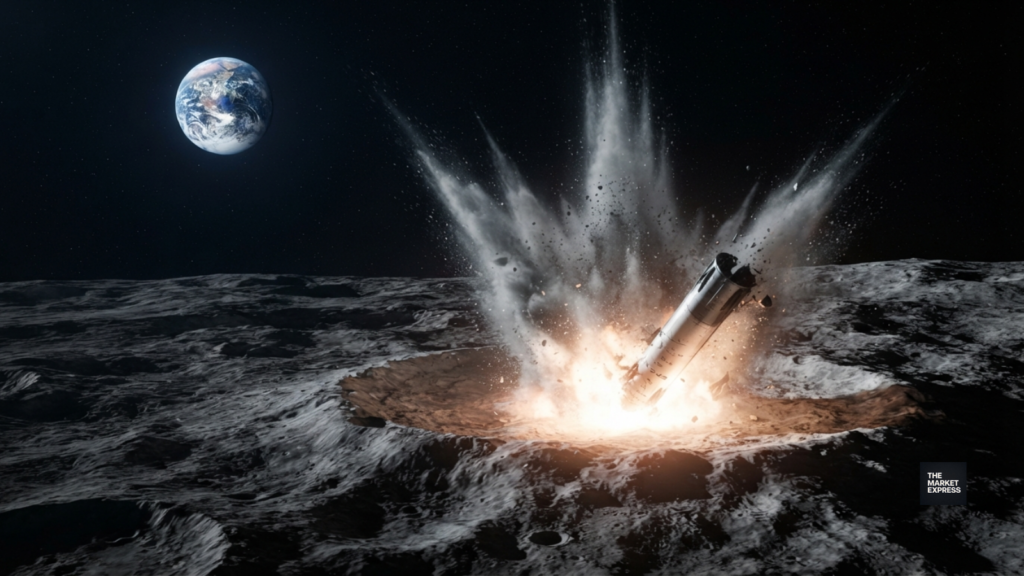
HOUSTON — A spent 4-tonne SpaceX Falcon 9 upper stage collided with the lunar surface early Wednesday, marking a significant and unintentional SpaceX moon impact that has transitioned from a tracking challenge into a rare scientific opportunity. The impact, which occurred at approximately 07:35 BST on August 5, 2026, concludes an 18-month orbital drift across cislunar space. While NASA confirmed the event posed zero threat to terrestrial safety, the collision near the Einstein and Bell craters has reignited a global debate over the management of cislunar space debris as commercial lunar activity accelerates.
The high-velocity collision occurred as SpaceX released its first quarterly earnings report as a public company, revealing a complex financial picture of surging revenue weighed down by aggressive capital expenditures in artificial intelligence and the Starlink satellite constellation.
Impact Physics and Lunar Crater Formation
The physics governing the SpaceX moon impact involved extreme kinetic energy transfers. Because the Moon lacks an atmosphere to provide aerodynamic drag, the 4,000-kilogram Falcon 9 stage—roughly 14 meters (45 feet) long—struck the surface at its full orbital velocity of approximately 5,400 mph (8,690 km/h).
Initial projections from NASA and independent astronomers suggest the energy release was equivalent to approximately three tonnes of TNT. This force was sufficient to initiate new lunar crater formation, with scientists estimating a fresh scar measuring between 18 and 30 meters wide and roughly 4 meters deep. The collision likely generated a massive ejecta plume of lunar dust and pulverized rock that rose as high as 100 kilometers (62 miles) above the surface.
For geological context, NASA officials noted that natural meteoroids with equivalent energy strike the Moon approximately every six days. However, this artificial impact is distinct in that the mass, composition, and velocity of the projectile were known variables, allowing researchers to calibrate seismic tracking models with a level of precision that would be impossible with random meteoroid events.
Trajectory Drift: From Deployment to Unintentional Collision
The hardware involved in the impact originated from a mission launched on January 15, 2025, from Florida’s Cape Canaveral Space Force Station. The Falcon 9 was tasked with deploying commercial lunar landers—Firefly Aerospace’s Blue Ghost 1 and a Japanese ispace Hakuto-R lander—under NASA’s Commercial Lunar Payload Services (CLPS) initiative.
While the payloads were successfully deployed, the high-thrust requirements of the cislunar trajectory left the second stage in a highly elliptical “long, looping orbit” rather than the standard disposal path into Earth’s atmosphere. Over the subsequent 18 months, the discarded stage drifted aimlessly, influenced by the “gentle push and pull” of solar radiation pressure and complex gravitational perturbations from the Earth and Moon.
Julianna Scheiman, SpaceX Director of NASA Science and Dragon Programs, confirmed that the company adhered to standard cislunar disposal protocols. Scheiman noted that the eventual impact was the result of a “mixture of solar activity and gravity forces” that pushed the uncontrollably floating hardware onto its final collision course.
Scientific Response: Monitoring Vaporized Lunar Plumes
Despite the accidental nature of the Falcon 9 lunar impact, international research organizations mobilized to treat the Einstein crater region as a natural laboratory. Ground-based telescopes in the Americas, positioned in the dark hours before sunrise, were trained on the lunar horizon to capture the brief flash and subsequent dust plume.
Rodrigo Palominos, a telescope operator at the Paranal Observatory in Chile, reported “encouraging preliminary results” shortly after the predicted impact window. Palominos detected changes in emission lines—bright flashes of light—which indicated the presence of vaporized material released by the collision.
By analyzing the light reflected from this material, scientists can identify the chemical composition of the impact site. Preliminary spectroscopic data suggest the detection of sodium and lithium gas plumes, helping researchers understand the Moon’s geological evolution. NASA’s Lunar Reconnaissance Orbiter (LRO) and South Korea’s Danuri (KPLO) probe are currently being repositioned to capture before-and-after imagery of the site.
Cislunar Space Debris: A Growing Regulatory Red Flag
The SpaceX moon impact has amplified concerns regarding the “lunar junkyard”. With this collision, the Moon is now home to roughly 3,000 human-made objects, weighing a combined 190 tonnes. This inventory dates back to the Soviet Union’s Luna 2 mission in 1959 and includes 796 items from NASA’s Apollo program alone.
Experts warn that the lack of stringent end-of-life regulations for commercial spacecraft poses a long-term risk. Hannah Sargeant, a researcher at the University of Leicester, characterized the event as a “red flag” for lunar preservation. Sargeant noted that while NASA and the European Space Agency (ESA) are required to have deorbiting plans and fuel reserves for safe disposal, commercial entities often lack similar mandates.
“It is not a good thing to be randomly sending debris into the moon,” Sargeant said, highlighting the risk of future hardware damaging sites of special interest or historical Apollo landers. Astronomer Jennifer Millard of Fifth Star Labs warned that as the Artemis program moves toward permanent habitation, “out-of-control rocket bodies” could threaten crewed lunar bases, sensitive scientific equipment, or undisturbed lunar soil containing billions of years of geological history.
Corporate Context: Revenue Surges Amid Heavy Strategic Spending
The lunar collision coincides with a period of high financial volatility for SpaceX. In its first quarterly report since going public, the company announced that revenue nearly doubled year-over-year to $7.8 billion. However, these gains were offset by a massive surge in spending, which ballooned to $18.3 billion—more than six times the previous year’s figure.
The bulk of this expenditure was directed toward artificial intelligence development and the continued expansion of the Starlink internet constellation. Consequently, SpaceX reported a net loss of $143 million for the quarter and a total loss of $2 billion for the first half of the year.
Despite the stock tumbling nearly 9% in after-hours trading, CEO Elon Musk remains bullish on the company’s long-term dominance. During an investor call, Musk argued that markets are “underestimating” the firm, predicting that Starlink—the only currently profitable segment of the company with $1.6 billion in Q2 revenue—will eventually “operate most of the world’s internet”.
Conclusion: A Turning Point for Lunar Traffic Management
As NASA prepares for upcoming Artemis missions, the SpaceX moon impact serves as both a scientific windfall and a procedural warning. The data gathered from the Einstein crater plumes will provide essential insights into the Moon’s composition and the behavior of ejecta in a vacuum, helping engineers plan future landing zones and habitation pods.
However, the event underscores the need to harmonize commercial operations with international preservation efforts. Whether the Moon remains a pristine record of planetary evolution or becomes a sprawling field of industrial scrap depends on the regulatory frameworks established in this new decade of deep-space exploration.
“A billion years from now, the only proof we ever existed will probably be on the moon,” one observer remarked on social media. Ensuring that proof reflects discovery rather than debris remains the primary challenge for the Second Space Age.
Editorial Note: This article was researched and drafted with AI assistance, then rigorously fact-checked, edited, and published by Miles. All content is strictly for informational and educational purposes only and does not constitute professional investment advice. Cryptocurrency and global financial markets experience severe volatility, sometimes swinging 50% or more in a single day. Invest only capital you can comfortably afford to lose, and always consult a certified financial advisor before committing funds. Read my full Disclaimer for more details.
Ready to Start Trading Cryptocurrency?
Open your account at a trusted exchange and begin trading today.
Sponsored & Disclosure: This box contains affiliate links. We earn a commission when you sign up through these links at no extra cost to you.