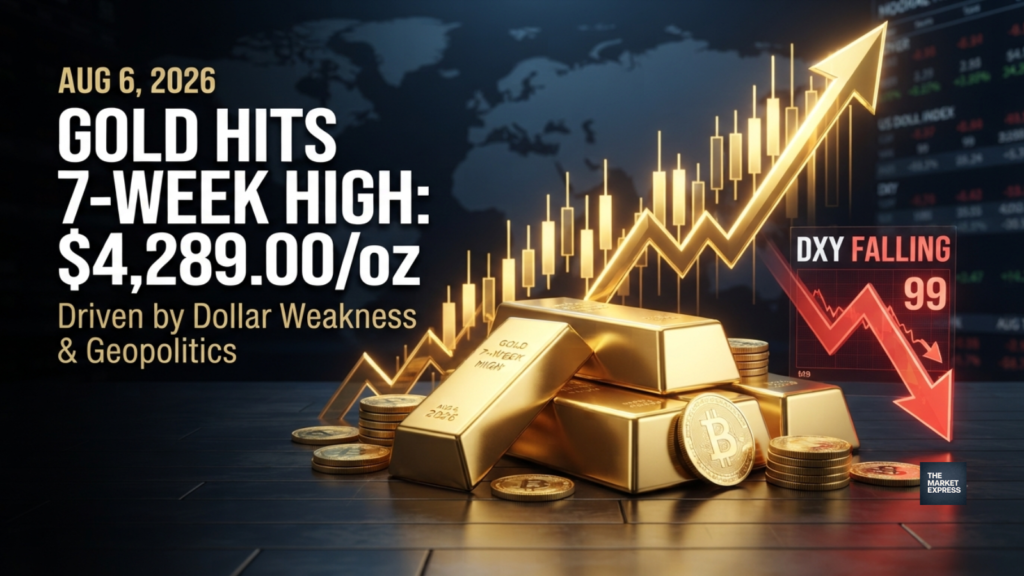
World Gold Price Fluctuations reached a critical turning point on August 6, 2026, as spot gold surged to a seven-week high, trading at $4,289.00 per ounce. This rally, marking the fourth consecutive session of gains, stems from a unique convergence of a weakening US dollar, declining Treasury yields, and significant geopolitical shifts in the Middle East. As traders digest reports of a potential diplomatic breakthrough regarding the Strait of Hormuz, the bullion market is witnessing a massive influx of capital. In domestic markets like India, MCX gold futures mirrored this global trend, climbing past the Rs 1.45 lakh mark per 10 grams, reflecting a broader shift in investor sentiment toward safe-haven assets amidst cooling inflation expectations.
Market Impact: Bullion and Equities React to Shifting Yields
The immediate impact of the current World Gold Price Fluctuations is visible across global exchanges. Spot gold’s climb to $4,289.00 represents its highest valuation since mid-June, while US gold futures have reached $4,345.50. This upward trajectory is largely fueled by the US dollar index falling to the 99 level, down from its recent peak of 101. Simultaneously, the yield on the benchmark 10-year US Treasury note has retreated, enhancing the appeal of non-yielding assets like gold.
In Asia, the equity markets presented a mixed response to these fluctuations. While the Shanghai Composite Index managed a 0.6% gain, the blue-chip CSI300 edged down by 0.2%. Gold-related shares provided a necessary cushion for the Chinese market, offsetting significant losses in the technology sector. Conversely, Hong Kong’s Hang Seng Index fell 1.5%, weighed down by a 6% slump in AIA Group and a 4.6% drop in Prudential shares following reports that Chinese tax authorities are beginning to levy taxes on offshore insurance income.
The silver market has seen even more aggressive volatility. Spot silver surged toward $61-$62 per ounce, with MCX silver prices in India skyrocketing by Rs 4,500 to trade above Rs 2.26 lakh per kilogram. Other precious metals followed suit, with platinum trading at $1,750.15 and rhodium hitting $8,525 per ounce.
Key Details: The Hormuz Factor and Oil Price Deflation
A primary catalyst for the recent World Gold Price Fluctuations is the reported progress in negotiations to reopen the Strait of Hormuz. Diplomats from the US, Iran, and Oman are reportedly nearing a deal to establish a navigable channel, a move that could resume stable crude oil shipping and drastically reduce oil-driven inflation.
This geopolitical development has sent Brent crude oil prices tumbling below $79 per barrel. While gold typically serves as a hedge against the chaos of war, the current price rise is paradoxical. Usually, peace talks would pressure gold prices downward; however, the resulting decline in oil prices has altered Federal Reserve interest rate expectations.
Investors believe that a reopened Strait will ease global supply chain pressures, leading to a “softer” inflation outlook. Consequently, the probability of a September Federal Reserve rate hike has dropped from 67% to approximately 54.8%. Because gold does not pay interest, it becomes significantly more attractive when the market perceives that central banks may pause or slow their tightening cycles.
Why It Matters: Central Bank Strategy and Reserve Diversification
Beyond short-term trading, the World Gold Price Fluctuations reflect big structural changes in global central bank reserves. The People’s Bank of China (PBoC) added 40.12 tons of gold to its reserves recently, marking its 20th consecutive month of buying. This persistent accumulation is a clear signal of “de-dollarization,” as major economies move their reserves away from US dollar-denominated assets.
In India, the Reserve Bank of India (RBI) recently opted for a status quo move, keeping the repo rate unchanged at 5.25%. This decision supported domestic bullion prices, as it signaled a stable interest rate environment. Furthermore, gold has overtaken coal to become Australia’s second-largest export, trailing only iron ore, with June shipments reaching A$7.13 billion.
The formalization of the gold trade is also becoming a priority for emerging economies. Bangladesh has recently moved to revise its national “Gold Policy 2018,” aiming to transform the sector into a transparent, regulated industry. The goal is to encourage legal trade, boost exports of gold jewelry, and align domestic prices more closely with international benchmarks like those in Dubai to discourage smuggling.
Expert Analysis: Technical Thresholds and Economic Divergence
Financial analysts suggest that the current World Gold Price Fluctuations may lead to further gains if specific technical resistance levels are breached. Prithviraj Kothari, Managing Director at RiddiSiddhi Bullions Ltd, notes that if gold sustains its position above $4,200 (approximately Rs 1,46,000 in the Indian market), it could fuel a rally toward the $4,500 mark. For silver, Kothari identifies $63 as the decisive push point that could drive prices toward $70 per ounce.
However, Jateen Trivedi, VP Research Analyst at LKP Securities, warns that the recovery remains modest and highly dependent on upcoming macroeconomic data. Market participants are now focused on the US Non-Farm Payrolls and Unemployment Rate reports for further clues on the Fed’s path.
In China, the economy is showing signs of a “two-speed” phenomenon. Larry Hu, chief China economist at Macquarie, suggests that policymakers are providing “just enough” stimulus to meet growth targets while restraining support for consumption and property. This economic environment has shifted Chinese consumer behavior; while jewelry sales fell 33.88% due to high prices, the demand for gold bars and coins jumped 28.42% in the first half of 2026, as investors seek tangible wealth preservation.
Related Info: Mining Sector Developments and Base Metals
While gold dominates the headlines, the broader commodities market is experiencing its own set of upheavals. Copper hit new highs of $14,060 per ton as the market anticipates new US tariffs and import restrictions. Conversely, nickel fell 2.1% to $16,605 per ton following reports that the Indonesian government may allow a massive increase in mining quotas.
In the mining sector, several companies are capitalizing on the high-price environment:
- Galantas Gold has received permit approvals to restart mining at the Andacollo project in Chile, with a pathway to producing 130,000 ounces of gold per year.
- Thor Explorations reports continued high-grade intersections beneath its Segilola pit in Nigeria, with a resource update expected by the end of 2026.
- American Tungsten & Antimony (AT4) is planning a September restart for its antimony plant in Nevada, aiming to secure US Government funding for further expansion.
Market Outlook
The current World Gold Price Fluctuations signal a complex interplay between geopolitical de-escalation and monetary policy uncertainty. While the potential reopening of the Strait of Hormuz offers hope for global trade stability, it has paradoxically strengthened gold by lowering the necessity for aggressive interest rate hikes. As central banks like the PBoC continue their 20-month buying streak and emerging markets like Bangladesh formalize their bullion sectors, gold’s role as a strategic reserve asset remains undisputed. Investors should remain focused on upcoming US labor data and the finalization of the Hormuz agreement, as these factors will dictate whether gold can maintain its momentum toward the $4,500 threshold.
Editorial Note: This article was researched and drafted with AI assistance, then rigorously fact-checked, edited, and published by Miles. All content is strictly for informational and educational purposes only and does not constitute professional investment advice. Cryptocurrency and global financial markets experience severe volatility, sometimes swinging 50% or more in a single day. Invest only capital you can comfortably afford to lose, and always consult a certified financial advisor before committing funds. Read my full Disclaimer for more details.
Ready to Start Trading Cryptocurrency?
Open your account at a trusted exchange and begin trading today.
Sponsored & Disclosure: This box contains affiliate links. We earn a commission when you sign up through these links at no extra cost to you.