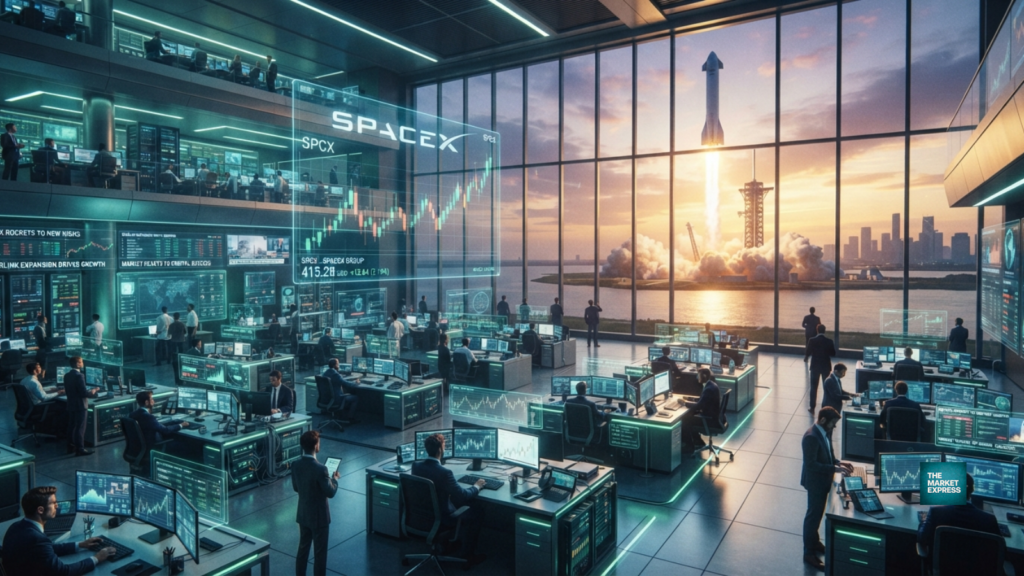
SpaceX shares climbed 10% on Tuesday as the reusable rocket maker prepared to report its first set of quarterly financial results as a public company. The SpaceX stock surge follows a volatile period since its June 12 initial public offering (IPO), which saw the company debut at $150 per share before sliding 24% to approximately $114. This market retreat has erased nearly $500 billion in market capitalization, placing significant pressure on the fiscal second-quarter 2026 report to justify the company’s $2 trillion valuation.
Wall Street analysts surveyed by LSEG expect SpaceX to report revenue of $6.93 billion for the quarter ending June 30. The consensus estimate points to a loss of 26 cents per share, though initial reporting adjustments often complicate year-over-year comparisons for newly public entities. Investors are currently navigating an environment of extreme volatility, with SpaceX’s implied volatility reaching 133, a level surpassed in the S&P 500 only by SanDisk.
Starlink Profitability Anchors Connectivity Segment
The primary driver of the SpaceX stock valuation remains the Starlink satellite internet constellation. Analysts at StreetAccount forecast revenue for the connectivity segment at $3.83 billion for the second quarter. Starlink is currently the company’s only profitable business unit, having generated $4.42 billion in income on $11.39 billion in revenue during the 2025 fiscal year.
Subscriber growth continues to accelerate, with the company confirming in June that its user base has surpassed 12 million. To optimize margins, SpaceX recently implemented price adjustments, including a $10 monthly kit fee for rented terminals. James Ratzer, a senior analyst at New Street Research, identifies a three-part success story for Starlink: expanding broadband capacity, developing a direct-to-cell business, and eventually deploying orbital data centers. While Ratzer remains conservative on the timeline for orbital data, he views the segment as a “huge opportunity” looking into the next decade.
Aggressive Pivot to SpaceX AI Infrastructure
A central pillar of the current SpaceX stock thesis is the company’s rapid expansion into artificial intelligence and compute services. In February, SpaceX merged with xAI in a transaction valuing the combined entity at $1.25 trillion. This strategic shift aims to build data centers in space, leveraging the company’s orbital launch capabilities.
The scale of this pivot is reflected in the company’s capital expenditures. In the first three months of 2026, SpaceX reported $10.1 billion in total capex, with $7.7 billion dedicated specifically to SpaceX AI infrastructure. Analysts expect capex to soar to $13.2 billion for the second quarter. A major component of this buildout is “Terafab,” a massive AI chip manufacturing facility planned for East Texas in partnership with Tesla and Intel. The facility is projected to cost up to $119 billion and is intended to alleviate future chip shortages while optimizing compute performance.
SpaceX has already begun monetizing these investments through significant cloud capacity deals. In June, the company announced an agreement with Google expected to bring in $920 million per month. Additionally, SpaceX secured a $150 million monthly deal with Reflection AI to provide top-tier Nvidia chips. Despite these contracts, investors remain focused on whether this infrastructure spending will generate sustainable long-term cash flow.
Starship Progress and Space Segment Losses
The space segment, encompassing the Falcon 9 and Starship programs, is forecasted to generate $835 million in quarterly revenue. Unlike the connectivity segment, this division continues to record operational losses. Last year, SpaceX spent $3 billion on research and development specifically for the Starship launch vehicle.
Bank of America’s Ron Epstein describes Starship as the “key enabler” for the company’s growth, potentially unlocking commercial space tourism and high-mass orbital missions. However, technical challenges persist. During a 13th test flight in July, the company encountered difficulties reigniting Raptor engines during the landing phase, raising concerns about potential damage to launch pad infrastructure in future attempts. Analysts are also monitoring whether Starship delays will force the company to open more slots for external customers on its legacy Falcon 9 fleet, which currently prioritizes Starlink deployments.
Financial Risks and the Lockup Expiration Catalyst
Despite a cash pile that swelled beyond $90 billion post-IPO, the SpaceX balance sheet carries significant liabilities. At the end of the first quarter, the company reported total liabilities of $60.5 billion, with debt and finance leases totaling $28.7 billion. Phillip Capital analysts, who maintain a rare “Sell” rating and a $75 price target on SpaceX stock, project that debt and finance leases will swell by 150% as capex increases. They anticipate the company will remain in a net debt position through 2030.
A critical near-term risk for SPCX earnings and share price stability is the upcoming lockup expiration on Thursday. Approximately 912 million shares held by employees and insiders will become eligible for public trading. This volume represents more than double the current floating supply, creating a potential “deluge” of shares that could further depress the stock price. Short sellers have already positioned themselves for this event, accumulating approximately $8.3 billion in paper profits as of early August.
Elon Musk has criticized these market participants, stating on social media that the survival probability for firms maintaining significant short positions in SpaceX is “very low”. However, the high implied volatility and heavy options activity—including 90,000 call options at a $330 strike price sold on Monday—suggest that professional traders are bracing for extreme price swings.
Strategic Integration and Ecosystem Risks
The performance of SpaceX stock is increasingly tethered to Musk’s broader corporate ecosystem. Tesla shares have declined approximately 20% since the SpaceX IPO, contributing to a reduction in Musk’s net worth to roughly $750 billion. Tesla’s own second-quarter results failed to impress Wall Street, with free cash flow turning negative and expenses rising.
There is ongoing speculation regarding a potential merger between Tesla and SpaceX. Gwynne Shotwell, SpaceX COO, did not dismiss the possibility, noting it might simplify corporate oversight. SpaceX already shares engineering resources with Musk’s other ventures and has seen Tesla invest $2 billion into xAI, which later converted into SpaceX equity. This interconnectedness presents both a synergy opportunity and a concentrated risk for investors.
Looking Ahead
The inaugural public SPCX earnings report serves as a credibility test for the company’s pivot to AI and its multi-trillion-dollar valuation. While Starlink provides a stable foundation of revenue and profit, the capital-intensive nature of Starship and the $119 billion Terafab project require consistent execution to avoid further share price erosion. Thursday’s lockup expiration remains the most immediate hurdle for shareholders, as the market prepares to absorb nearly a billion new shares.
Editorial Note: This article was researched and drafted with AI assistance, then rigorously fact-checked, edited, and published by Miles. All content is strictly for informational and educational purposes only and does not constitute professional investment advice. Cryptocurrency and global financial markets experience severe volatility, sometimes swinging 50% or more in a single day. Invest only capital you can comfortably afford to lose, and always consult a certified financial advisor before committing funds. Read my full Disclaimer for more details.

Ready to Start Trading Cryptocurrency?
Open your account at a trusted exchange and begin trading today.
Sponsored & Disclosure: This box contains affiliate links. We earn a commission when you sign up through these links at no extra cost to you.