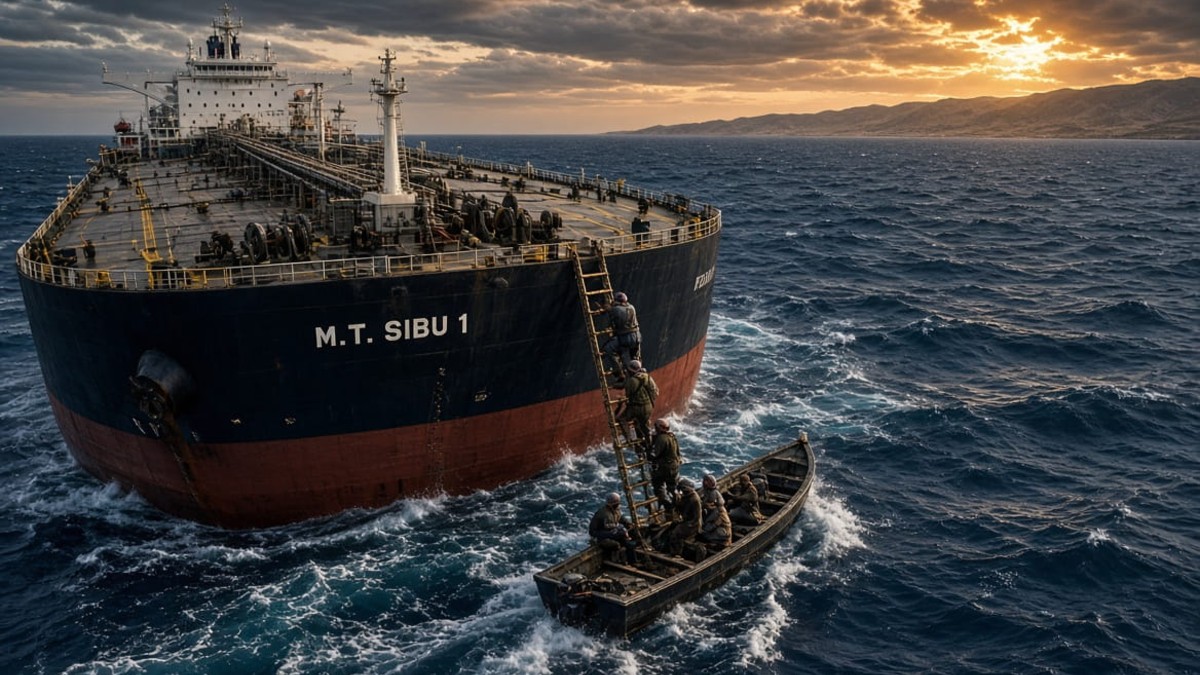
A volatile Somali piracy resurgence is disrupting critical global trade lanes after armed maritime raiders hijacked a sanctioned oil products tanker off the coast of Yemen. Six armed pirates boarded the Eritrean-flagged M.T. Sibu 1 on Thursday, approximately 136 nautical miles east of al-Mukalla. The attackers quickly seized control of the vessel and forced it toward Somalia’s Puntland coast. This incident marks the sixth commercial vessel seized in the region since April, signaling a sharp escalation in maritime security risks across the Gulf of Aden.
Meanwhile, the M.T. Sibu 1 is managed by the UAE-based Qatrat Alnada Almasi Ship Management. The U.S. Treasury Department sanctioned this specific operator last year. However, federal investigators alleged the vessel belongs to an Iranian shadow fleet used to transport petroleum products to evade international economic sanctions. Still, the hijacked tanker remains at sea with 20 crew members held hostage, including 16 Indians, one Syrian, one Sudanese, and one Iraqi. The nationality of the final crew member is unknown, while the ship’s departure and destination remain unclear.
“Six armed pirates hijacked the Eritrean-flagged M.T. Sibu 1 on Thursday and took it toward Somalia’s Puntland coast,” said a Somali maritime security official, speaking on condition of anonymity to discuss the active security threat.
Yet, this dramatic capture is part of a broader threat developing in the western Indian Ocean. Just three days prior, pirates boarded the Lutuf, a Cameroon-flagged general cargo vessel, right off the coast of Somalia. That ship carried 10 crew members, including six Indians, a Turkish national, a Georgian national, and two Serbian security guards. The rapid succession of attacks reveals a coordinated effort by pirate networks to re-establish dominance over these critical shipping channels.
The chronological timeline of seizures highlights the widening reach of these modern pirate networks. The current wave began on April 21 when attackers captured the Palau-flagged tanker Honor 25 off the Somali coast. Five days later, on April 26, pirates successfully hijacked the Sward. They followed this by seizing the Eureka on May 2 while it sat anchored off Yemen, and the Asana on July 17. Security analysts note that these attacks occur increasingly far from the Somali coastline. For example, the Asana was taken 65 nautical miles southwest of Al-Mukalla.
“Somali pirates accounted for 94% of crew members taken hostage during that period,” said a spokesperson at the International Maritime Bureau, referencing 38 global piracy and armed robbery incidents recorded in the first half of 2026.
Local authorities in Somalia are struggling to contain the crisis. Puntland’s Security Ministry has deployed armed security forces along its extensive coastline to counter the gangs. However, the ministry’s investigators claim that forces beyond Puntland’s control are driving the renewed piracy. This internal struggle is complicated by outside military interventions. Regional officials recently condemned unidentified airstrikes that struck local fishing vessels and property near coastal communities on August 18 and August 20. These strikes hit near Garacad, where pirates are currently holding several hijacked commercial ships.
“Investigations indicated that forces beyond Puntland’s control were behind the renewed piracy,” said an official at Puntland’s Security Ministry, who demanded an international explanation for recent coastal airstrikes.
The sudden escalation in the Gulf of Aden threatens to drive up maritime insurance premiums and disrupt global trade routes. With 94% of global maritime hostages currently held by Somali groups, shipping firms face a perilous choice between costly detours and armed escorts. Meanwhile, the fate of the M.T. Sibu 1 and its 20 crew members hangs in the balance as regional tensions mount.