
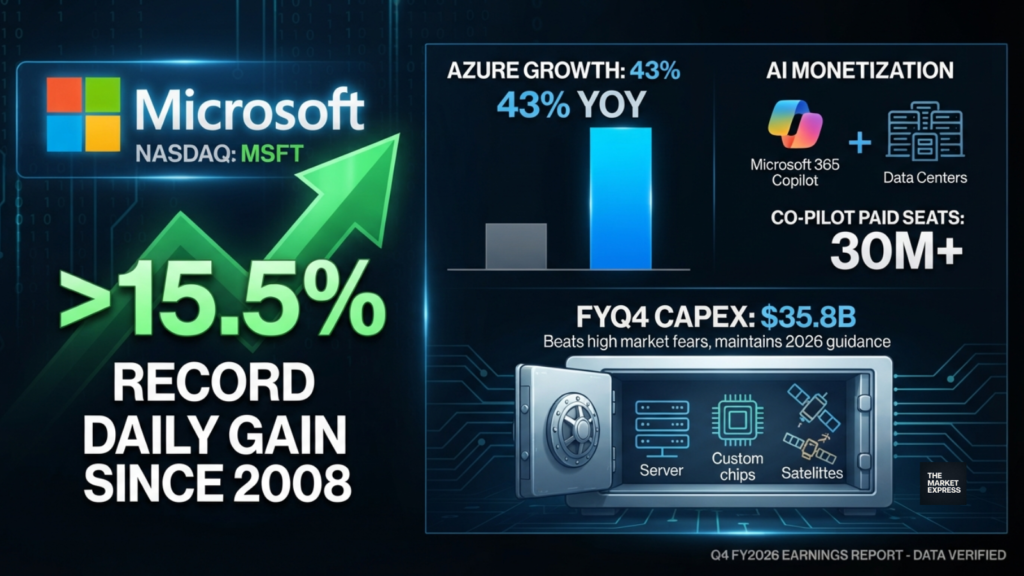
Microsoft Corp. (NASDAQ: MSFT) shares staged a historic rally on July 30, surging 15.5% in their most significant single-day gain since the 2008 financial crisis. The record-breaking session was fueled by a fiscal fourth-quarter earnings report that not only blew past Wall Street estimates but also provided a masterclass in balancing aggressive AI expansion with fiscally conservative discipline.
Azure Outperformance and Direct AI Monetization
The tech giant’s cloud-computing powerhouse, Azure, remains the primary engine of growth. Azure revenue climbed 43% during the quarter, comfortably exceeding the 40% growth rate projected by analysts. Total Microsoft Cloud revenue reached a staggering $59.3 billion, marking a 27% year-over-year increase.
Critically, CEO Satya Nadella provided a concrete update on the commercial viability of generative AI. Microsoft 365 Copilot now counts over 30 million paid subscribers, a massive 50% increase from the 20 million users reported just three months prior. This rapid adoption within the Productivity and Business Processes segment—which generated $37.85 billion in revenue—demonstrates that Microsoft is successfully moving past the “AI hype” phase into a cycle of high-margin monetization.
The “Goldilocks” Capex: Spending Without the Squeeze
While the broader market has grown wary of the massive infrastructure costs associated with the AI arms race, Microsoft’s capital management has provided much-needed relief. Capital expenditures for the June quarter totaled $35.8 billion, coming in lower than the $36.14 billion the market had feared.
Crucially, Chief Financial Officer Amy Hood confirmed that Microsoft’s capex forecast for calendar year 2026 remains unchanged after accounting adjustments. This stability acted as a “relief valve” for investors, especially as competitors like Meta Platforms saw their stocks stumble after signaling narrower, higher spending ranges for their AI infrastructure.
Key Financial Metrics at a Glance
- Total Revenue: $90 billion (up 18% YoY), beating the $87.7 billion consensus.
- Adjusted EPS: $4.81, significantly outperforming the $4.24 estimate.
- Azure Revenue Growth: 43% vs. 40% expected.
- Microsoft 365 Copilot Users: 30 million+ paid seats.
- Quarterly Capex: $35.8 billion, underperforming (positive for margins) the $36.14 billion forecast.
Personal Thought / Editorial Insight: The “Enterprise Moat” Advantage
From a senior analyst’s perspective, this quarter represents a decoupling of Microsoft from other “hyperscalers.” Unlike Meta, which is largely funding AI through digital advertising to improve engagement, Microsoft is selling AI as a utility to the enterprise. The 30 million Copilot seats aren’t just a revenue stream; they are a lock-in mechanism. As long as Microsoft can keep its 2026 capex guidance stable while Azure continues to grow in the 40% range, the company effectively proves that it can absorb the costs of the AI transition without sacrificing its best-in-class operating margins.
Broad Market Impact
The Microsoft-led surge revitalized the technology sector, helping the S&P 500 gain 1.7% and the Nasdaq Composite jump 2.8%. The positive sentiment cascaded into the semiconductor space, with companies like Micron Technology (+18.4%) and Lam Research (+18%) recording massive gains as fears of an AI spending bubble momentarily receded.