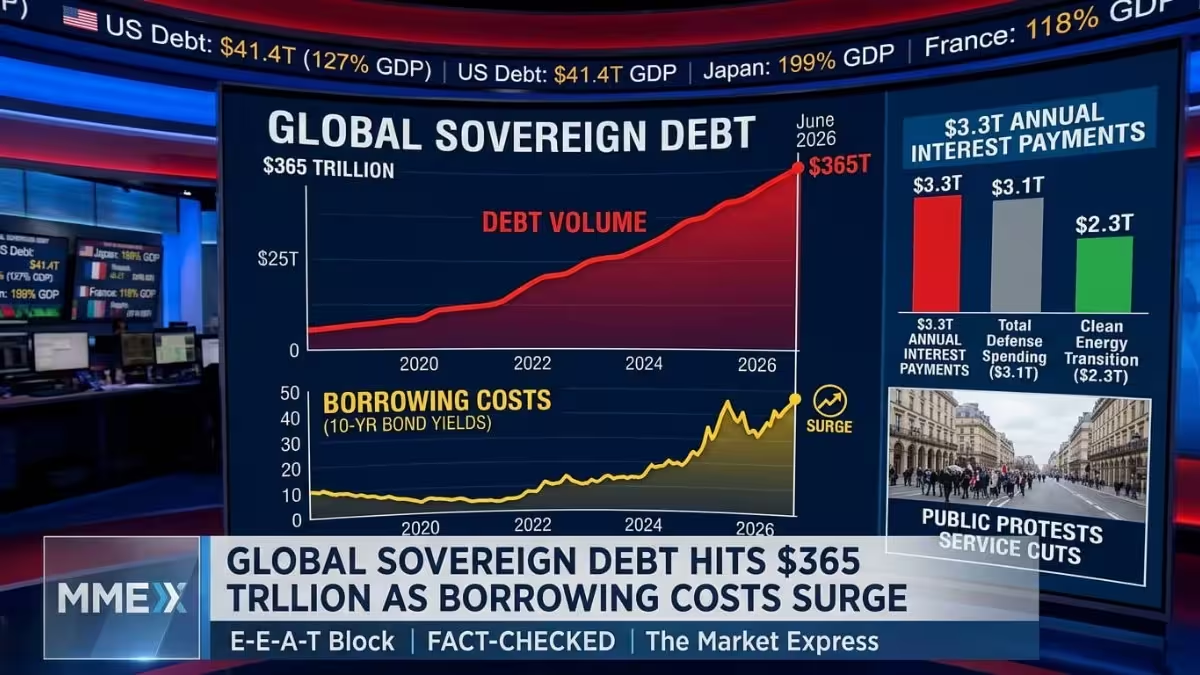
Global sovereign debt reached a record $365 trillion at the end of June 2026, driven by a massive borrowing surge across advanced and developing economies. Governments, households, and non-financial corporations accumulated $10 trillion in new liabilities during the first six months of 2026 alone. This sharp rise pushes the average global debt burden to roughly $44,000 for every individual on Earth. Much of the recent expansion stems from emerging market nations taking on fresh commitments to cover expanding budget gaps.
Rising debt levels coincide with elevated interest rates, sharply increasing the price governments pay to service their obligations. Advanced economies spent more than $3.3 trillion over the past year solely on sovereign bond interest payments. This annual debt servicing expenditure now outpaces several major categories of global investment. For comparison, the $3.3 trillion interest tab exceeds total worldwide defense spending of $3.1 trillion. It also eclipses the $2.6 trillion spent globally on artificial intelligence development. Additionally, it surpasses the $2.3 trillion directed toward clean energy transition projects.
Higher sovereign debt servicing costs directly reduce available capital for essential public services. When governments divert larger shares of revenue toward bond yields, spending on healthcare, infrastructure, and education faces severe pressure. The broader economic impact extends beyond state treasuries into private household budgets. Surging government borrowing costs push up commercial interest benchmarks, lifting consumer mortgage rates, auto financing costs, and credit card charges.
Data from the International Monetary Fund reveals that the United States maintains the largest government debt burden in the world. Washington owes $41.4 trillion in public debt, which equals 127 percent of its gross domestic product (GDP). The United States benefits from issuing debt in the US dollar, the primary global reserve currency. Persistent global demand for the U.S. dollar continues to sustain strong investor interest in U.S. Treasury securities. Still, market analysts emphasize that even American borrowing capacity faces structural boundaries.
China holds the second-largest volume of public debt globally. Beijing’s government debt stands at $22.50 trillion, representing 104 percent of its GDP. Japan ranks third in total volume with $8.7 trillion in public debt. Among major industrialized economies, Japan carries the highest sovereign debt-to-GDP ratio at 199 percent.
European nations occupy several top positions on the global debt scoreboard. The United Kingdom ranks fourth worldwide with $4.4 trillion in government debt, amounting to 102 percent of its national output. France holds fifth place with $4.2 trillion in sovereign debt, representing 118 percent of its GDP. International Monetary Fund projections indicate that French public debt could rise to 121.8 percent of GDP by 2030. Such growth complicates Paris’s efforts to restore fiscal stability and balance state spending.
Italy holds $3.7 trillion in sovereign debt, generating a heavy fiscal load equivalent to 138 percent of its GDP. Germany carries $3.5 trillion in public debt, maintaining a lower debt-to-GDP ratio of 65 percent. In Asia, India ranks seventh globally with $3.4 trillion in government debt, equal to 83 percent of its economic output.
Further down the international debt rankings, Bangladesh holds the 45th position. Bangladesh’s total debt reached $204.9 billion, representing 40 percent of its GDP. Back in 2010, the South Asian nation carried $40.9 billion in total obligations. Over the past decade and a half, Bangladesh’s national debt expanded nearly fivefold. However, its overall debt-to-GDP ratio remains considerably lower than levels recorded across major developed economies.
Sovereign debt markets operate through bond issuances rather than traditional bank credit lines. Governments sell fixed-income securities to institutional investors, promising periodic coupon payments and full principal repayment at maturity. Ten-year sovereign bonds serve as a primary benchmark for state financial health. Yields on these bonds reflect market confidence in a nation’s fiscal administration. When bond prices fall, yields increase, making fresh borrowing significantly costlier for treasuries.
Bond yields in France recently reached near 5 percent for 10-year debt, marking their highest borrowing cost since 2002. By contrast, Germany pays a 3.41 percent yield on its 10-year sovereign bonds. France now pays higher debt servicing rates than southern European peers, including Italy and Greece. Across Western Europe, only the United Kingdom faces higher 10-year sovereign borrowing yields than France.
Current market conditions mirror past periods of intense European fiscal strain. During the Eurozone sovereign debt crisis between 2010 and 2012, borrowing yields above 5 percent affected distressed nations like Greece, Italy, and Spain. When yields breached 7 percent during that crisis, countries including Ireland and Portugal required international bailout packages.
Escalating debt interest costs now spill over into social and political instability across Europe. Rising living costs, stagnant wages, housing shortages, and education budget cuts generated widespread public protest. Demonstrations spread across France, Belgium, Italy, and Portugal, leading to civil friction, property damage, and street clashes in several major cities.
France stands as the focal point of the current unrest. The French Ministry of Interior reported that over 550,000 citizens joined nationwide protests last Saturday. Student groups and labor unions organized marches to oppose rising living costs and public sector spending reductions. Demonstrators argue that elevated government interest payments strip funding away from public hospitals, schools, and national pension systems.
Explore in-depth global economic analysis, central bank policies, and inflation reporting at The Market Express Economy Hub.