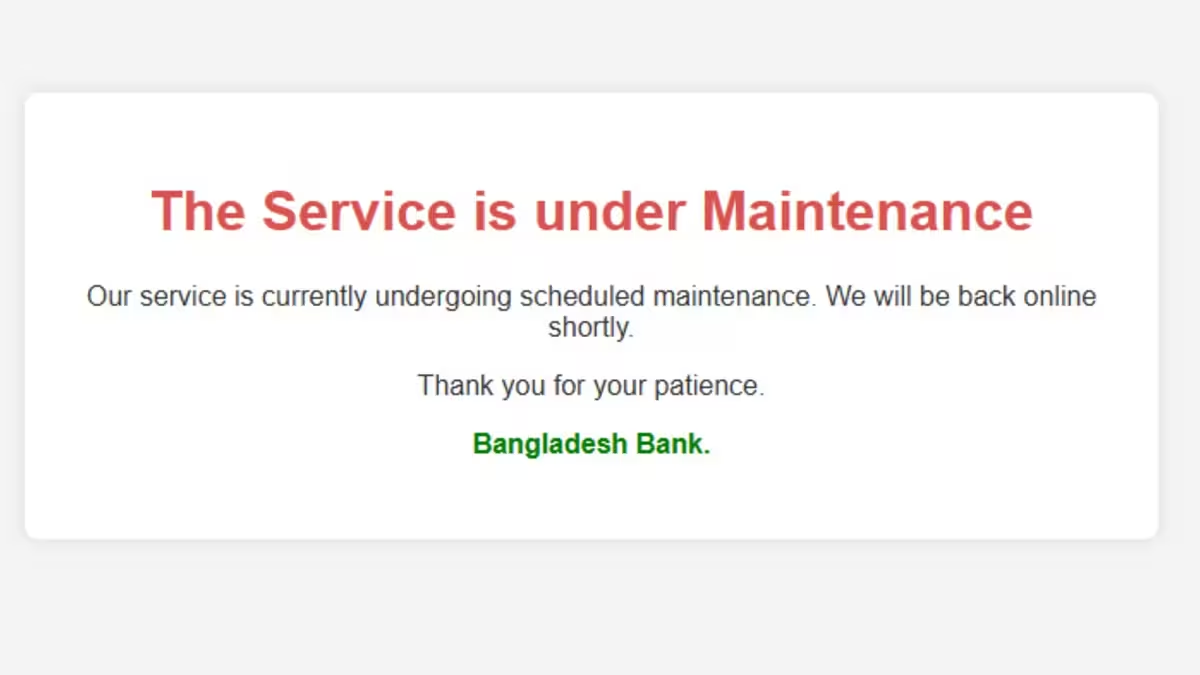
The sudden Bangladesh Bank website shutdown has sent ripples through regional financial markets after the central bank pulled its primary web portal offline following an escalating global security alert. General users attempting to navigate to the official domain found access completely blocked, encountering a standardized digital notice indicating that systems were undergoing scheduled maintenance. Officials confirmed that the precautionary blackout was executed directly to shield monetary infrastructure against sophisticated international cyberthreats targeting financial authorities. While digital access to the main institutional site remains severed, core clearing networks, commercial settlement systems, and mobile banking operations continue to function without interruption.
Senior officials at the central bank emphasized that the decision reflected proactive risk mitigation rather than an active system compromise. The financial authority acted swiftly upon receiving intelligence regarding coordinated attacks aimed at central monetary institutions worldwide. Cybersecurity teams inside the facility immediately launched comprehensive system inspections and technical enhancements to fortify internal perimeters. “Our IT department is working on it,” said Arief Hossain Khan, Executive Director and Spokesperson at Bangladesh Bank. The spokesperson noted that technical teams were executing mandatory security upgrades and thorough inspections before attempting to restore public domain access. “The website was shut down temporarily to protect critical systems from potential cyber threats and as part of an advanced precautionary step,” said Arief Hossain Khan, Executive Director and Spokesperson at Bangladesh Bank.
The sudden offline movement stems from a severe structural vulnerability within PHP, the open-source server-side scripting engine that powers nearly 70 percent of all active websites across the globe. Cybersecurity research teams at Calif and Wiz initially uncovered the critical code defects utilizing specialized artificial intelligence tools. Although software patches were rapidly authored to address the underlying flaws, technical details regarding the exploit vector were published publicly before institutional web administrators could deploy necessary security updates. The premature exposure created an immediate global window of vulnerability, allowing malicious threat actors to scan and target unpatched enterprise servers at unprecedented scale.
Global threat intelligence networks recorded an explosive surge in hostile network activity immediately following the vulnerability disclosure. Network security giant Cloudflare reported automated hacking attempts spiking from thousands of baseline requests into millions within hours of the public briefing. Global attack telemetry gathered by Censys revealed that approximately 1.5 million servers out of 2.6 million public-facing instances worldwide lacked the essential security patch. The massive vulnerability gap forced sovereign cybersecurity agencies and multinational corporate entities to execute emergency containment protocols. “This is an unprecedented situation where IT teams have been scrambling to protect their organisations from a highly serious cyber attack risk,” said Joe Tidy, Cyber Affairs Correspondent at the BBC.
The preemptive shutdown in Dhaka mirrors emergency defensive measures deployed across major international capital markets and sovereign state infrastructures. Sovereign government portals across the Netherlands, France, Denmark, and Finland were forcefully taken offline as national security centers rushed to insulate public networks. In Europe, telecom titan Orange suspended digital customer services to mitigate exposure risks. Meanwhile, major Japanese financial conglomerates, including Nomura and Mitsubishi UFJ Financial Group, restricted online operations while engineering teams verified server integrity. Municipal portals such as the Edinburgh Council website and entertainment verticals like the BBC’s Doctor Who platform were similarly shuttered to prevent potential systemic intrusion.
For Bangladesh Bank, the severe defensive response is deeply informed by historical institutional trauma from prior high-stakes cyber incidents. In 2016, sophisticated cyber criminals compromised the central bank’s SWIFT credentials to fraudulently divert $101 million from its official reserve account held at the Federal Reserve Bank of New York. That historic heist sent shockwaves through the international banking sector and ultimately led to the high-profile resignation of then-Governor Atiur Rahman. Institutional caution flared again in 2023, when central bank leadership preemptively shut down internal web-based services for 36 hours to neutralize an imminent hacking threat. As a result, top bank officials enforce strict zero-day patch protocols across all sovereign digital infrastructure.
Despite the temporary suspension of its public portal, Bangladesh Bank’s macroeconomic balance sheet and operational liquidity remain exceptionally robust. Official financial statistics confirm that foreign exchange reserves currently stand at $31.5 billion, providing a substantial economic cushion capable of covering more than five months of national import bills. Commercial banking channels across the country report that electronic fund transfers, point-of-sale transactions, and consumer mobile financial services are operating cleanly. Retail bank customers continue to execute routine financial transactions without delay, isolating the disruption entirely to the public-facing informational website. Central bank IT leadership confirmed that public portal operations will resume only after comprehensive threat sweeping and verified security patching are complete.
As central banks navigate an increasingly hostile cyber threat ecosystem, the incident highlights the expanding perimeter of vulnerability facing sovereign financial stewards. Emerging market central banks remain primary targets for threat groups seeking to exploit software supply chain vulnerabilities before systemic patches can be fully distributed. The rapid isolation of Bangladesh Bank’s web infrastructure underscores a decisive shift toward hyper-vigilant defense, prioritizing operational containment over public domain availability. Financial institutions worldwide continue to monitor the PHP patch rollout closely as security operations centers work around the clock to audit software stacks. Until full integrity verification is achieved, central monetary authorities remain on high alert, balancing continuous digital banking operations against the reality of global cyber threats.
Editorial Note: This article was researched and drafted with AI assistance, then rigorously fact-checked, edited, and published by Miles. All content is strictly for informational and educational purposes only and does not constitute professional investment advice. Cryptocurrency and global financial markets experience severe volatility, sometimes swinging 50% or more in a single day. Invest only capital you can comfortably afford to lose, and always consult a certified financial advisor before committing funds. Read my full Disclaimer for more details.
Firoz Ahmed is a Senior Financial & Digital Asset Analyst at The Market Express, where he covers real-time market trends, cryptocurrency price action, and macroeconomic updates. With a background in software engineering and digital publishing, he focuses on technical market structures, derivatives data, and on-chain intelligence.