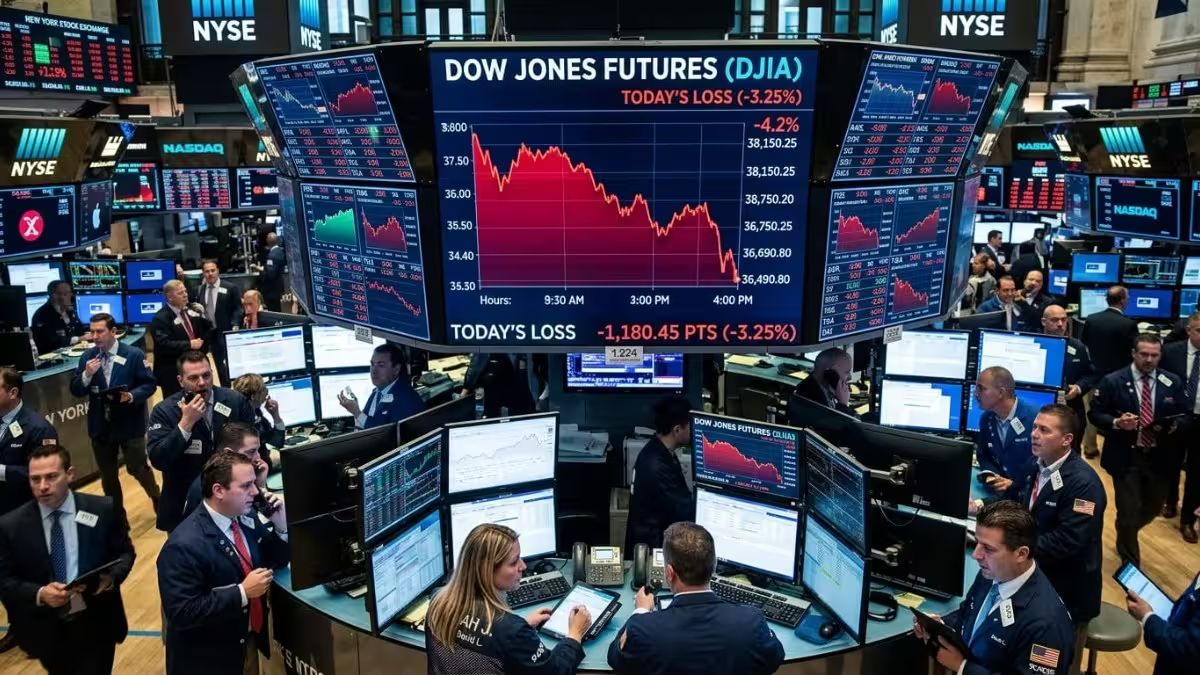
Institutional equity traders monitoring market sentiment noted Dow Jones futures falling early this morning as Wall Street processed fresh macroeconomic releases and rising interest rate expectations. Futures contracts tied to the 30-stock benchmark slipped 124 points, or 0.28%, signaling a cautious opening bell across U.S. trading floors. Simultaneously, institutional asset allocators recalibrated holdings in response to persistent inflation figures and elevated fixed-income yields.
The early dip in Dow Jones futures shows growing uncertainty on Wall Street, as investors carefully weigh future Federal Reserve interest rate moves ahead of key corporate earnings reports. While high-growth technology shares showed temporary resilience, rate-sensitive manufacturing and industrial stocks faced immediate selling pressure. Consequently, benchmark 10-year Treasury yields advanced toward 4.90%, creating persistent valuation headwinds for traditional dividend-paying equities.
Analyzing the core drivers impacting Dow Jones futures, market strategists emphasized that sustained capital costs continue to restrict index-level momentum. S&P 500 futures fell 0.22% while Nasdaq 100 futures managed a small 0.12% gain, highlighting a clear split between tech stocks and traditional sectors. “Equity valuations are confronting a structural hurdle as long-term borrowing rates remain near multi-year highs,” said Jonathan Miller, Chief Market Strategist at Apex Global Management. “Investors are exercising caution until clear monetary easing signals emerge from monetary authorities.”
Trading desks reported heightened activity in options contracts tied to major enterprise earnings scheduled for release later this week. Market participants are closely watching quarterly performance reports from leading industrials, consumer brands, and technology leaders to assess whether consumer demand remains steady under current credit conditions. Meanwhile, borrowing costs across corporate debt channels remain elevated, tightening financial conditions for capital-intensive enterprises.
Cross-asset volatility also influenced international liquidity flows during pre-market trading hours. WTI Crude futures hovered near $83.50 per barrel as supply disruption risks interacted with global demand projections. Spot gold edged higher by 0.30% to $2,735.00 per ounce, reflecting ongoing institutional demand for inflation-hedging instruments. The U.S. Dollar Index held firm at 104.10, confirming persistent global demand for dollar-denominated reserves.
“Elevated Treasury yields continue to limit valuation multiples across traditional blue-chip equities that anchor institutional portfolios,” said Catherine Reynolds, Senior Portfolio Manager at Meridian Wealth. “Until macroeconomic data reveals a sustained cooling trend in baseline inflation, equity index upside will remain constrained.”
The Federal Reserve’s monetary stance remains the primary focus for institutional portfolio construction entering the final calendar quarter. Federal Open Market Committee officials reiterated their commitment to maintaining borrowing constraints until labor market metrics and consumer price indices converge toward the central bank’s explicit target objectives. The Labor Department’s recent economic indicators showed persistent headline inflation, reinforcing expectations of extended interest rate tightness.
Institutional order flow data reveals that portfolio managers are prioritizing cash-rich mega-cap technology firms while reducing exposure to debt-laden manufacturing conglomerates. Small-cap domestic equity benchmarks also retreated in pre-market action, reflecting tight credit conditions for regional businesses. Yet, balance-sheet-healthy enterprise software leaders continue to attract defensive liquidity inflows.
Looking ahead, market liquidity will depend heavily on upcoming labor force disclosures and official policy commentary. Financial analysts stress that a sustainable recovery across industrial equities requires stabilization in fixed-income markets alongside margin expansion across cyclical sectors. Until those conditions materialize, Wall Street trading will likely maintain a defensive posture defined by index divergence.
Editorial Note: This article was researched and drafted with AI assistance, then rigorously fact-checked, edited, and published by Miles. All content is strictly for informational and educational purposes only and does not constitute professional investment advice. Cryptocurrency and global financial markets experience severe volatility, sometimes swinging 50% or more in a single day. Invest only capital you can comfortably afford to lose, and always consult a certified financial advisor before committing funds. Read my full Disclaimer for more details.
Firoz Ahmed is a Senior Financial & Digital Asset Analyst at The Market Express, where he covers real-time market trends, cryptocurrency price action, and macroeconomic updates. With a background in software engineering and digital publishing, he focuses on technical market structures, derivatives data, and on-chain intelligence.