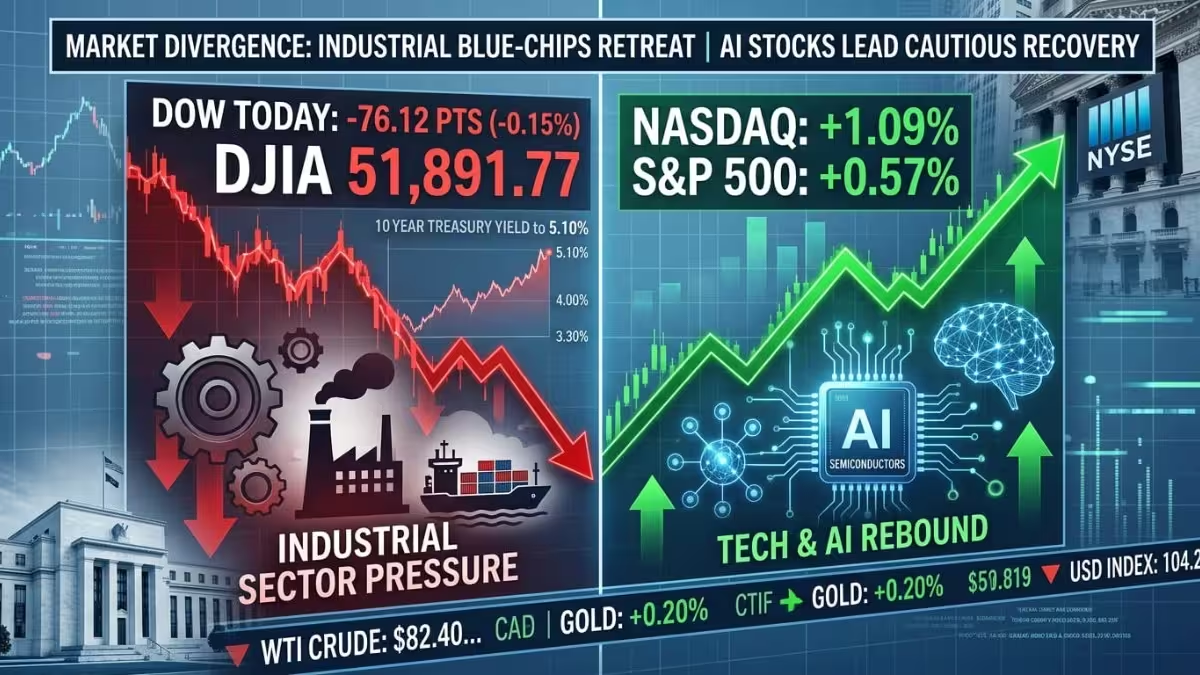
Investors parsing market movements around the Dow today witnessed a sharp divergence across Wall Street trading desks as blue-chip industrial equities retreated while technology shares attempted a cautious recovery. The Dow Jones Industrial Average fell 76.12 points, or 0.15%, slipping to 51,891.77 points shortly after the opening bell. Meanwhile, institutional traders recalibrated portfolios in response to rising bond yields and an impending wave of quarterly corporate earnings reports.
The broader reaction across the Dow today underscores how microeconomic pressure on traditional manufacturing and consumer staples continues to weigh down industrial benchmarks. While tech-heavy indices gained ground, blue-chip equities faced headwind pressure as the 10-year Treasury yield edged upward to 5.10%. This shift forced asset managers to trim exposures in rate-sensitive industrial sectors.
Analyzing the underlying sentiment driving the Dow today, energy and capital goods components struggled to hold ground amid lingering concerns over elevated capital expenditures. While the S&P 500 gained 0.57% and the Nasdaq Composite rallied 1.09%, the 30-stock Dow Jones index lagged behind, weighed down by weakness in healthcare and heavy manufacturing equities. “The equity market is navigating a complex split where mega-cap artificial intelligence names are decoupling from broader industrial fundamentals,” said Marcus Vance, Chief Market Strategist at Vanguard Capital. “Investors are demanding clear earnings visibility before committing fresh liquidity to legacy industrial equities.”
Trading desks reported heavy volume in options contracts tied to major corporate earnings scheduled for release later this week. Market participants are closely watching reports from key leaders including Tesla, Meta Platforms, IBM, and Netflix to evaluate whether enterprise software spending remains resilient. However, industrial conglomerates within the Dow average face mounting input costs driven by sustained borrowing rates. The benchmark 10-year Treasury note yield touched intraday highs near 5.30% earlier this month, marking its highest level since 2002 and imposing strict discount rates on long-duration corporate liabilities.
Cross-asset volatility also reflected heightened geopolitical frictions and shifting energy prices. WTI Crude futures fluctuated near $82.40 per barrel as supply chain adjustments absorbed recent international trade developments. In precious metals, gold contracts advanced 0.20% to $4,189.60 per ounce, highlighting ongoing institutional demand for inflation hedges. The U.S. Dollar Index held firm at 104.25, reflecting persistent global demand for dollar-denominated liquidity.
“Higher bond yields create a structural hurdle for dividend-yielding industrial stocks that historically anchor traditional equity portfolios,” said Helena Rostova, Head of Global Asset Allocation at Zurich Investment Management. Until the Federal Reserve offers clear guidance on its rate trajectory, industrial equities are likely to face capped upside potential.
Indeed, the central bank’s monetary policy path remains the primary driver of stock valuations heading into the fourth quarter. Federal Open Market Committee officials maintained the federal funds rate target range at 5.25% to 5.50% during their recent policy meeting, citing steady employment metrics and persistent core inflation figures. The Labor Department’s latest consumer price index reading showed year-over-year headline inflation holding at 3.2%, slightly above the central bank’s long-term 2.0% objective.
Institutional order flow indicates that fund managers are actively rebalancing portfolios toward high-margin technology leaders while reducing exposure to cyclical capital goods. Semiconductor equity benchmarks gained 1.90% during early trading hours, fueled by sustained infrastructure demand for enterprise hardware platforms. Yet, the drag from legacy industrial transport and manufacturing entities continues to suppress the Dow’s short-term momentum.
Looking ahead, market liquidity will depend heavily on corporate forward guidance and macroeconomic disclosures due later in the month. Analysts emphasize that sustainable upside across industrial equities requires both a stabilization in fixed-income yields and broader margin expansion beyond high-growth technology hardware. Until those conditions materialize, Wall Street remains locked in a selective trading environment where index-level divergence defines daily price discovery.
Editorial Note: This article was researched and drafted with AI assistance, then rigorously fact-checked, edited, and published by Miles. All content is strictly for informational and educational purposes only and does not constitute professional investment advice. Cryptocurrency and global financial markets experience severe volatility, sometimes swinging 50% or more in a single day. Invest only capital you can comfortably afford to lose, and always consult a certified financial advisor before committing funds. Read my full Disclaimer for more details.
Firoz Ahmed is a Senior Financial & Digital Asset Analyst at The Market Express, where he covers real-time market trends, cryptocurrency price action, and macroeconomic updates. With a background in software engineering and digital publishing, he focuses on technical market structures, derivatives data, and on-chain intelligence.
1 thought on “Dow Today Slips 76 Points as Wall Street AI Stocks Rebound”
Comments are closed.