
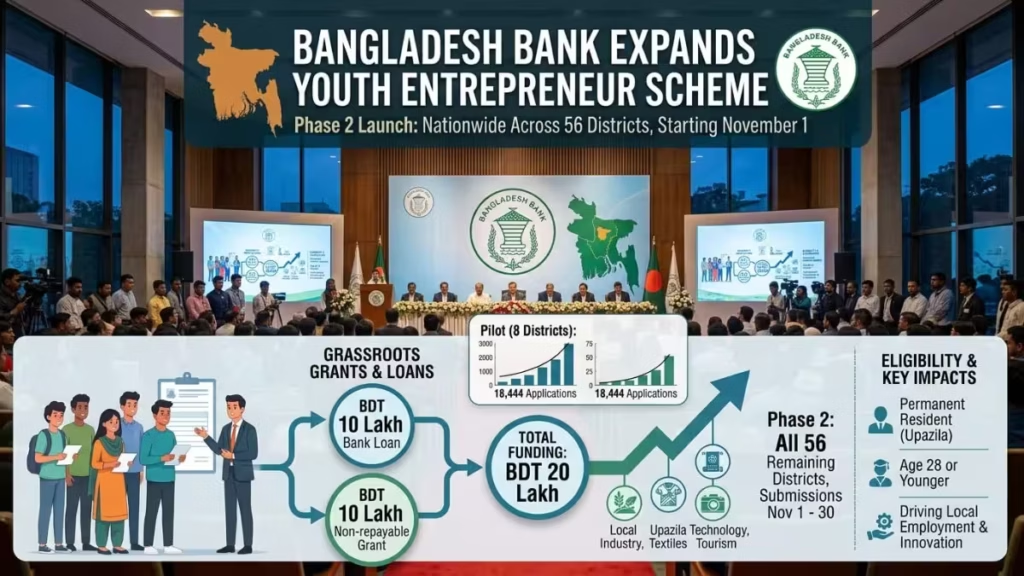
Bangladesh Bank youth entrepreneur scheme, named ‘Uddyog,’ will scale across 56 districts starting November 1 to broaden capital access for young business owners. Under the official central bank framework, eligible young entrepreneurs can secure up to BDT 20 lakh in total financial assistance, structured evenly as a BDT 10 lakh bank loan alongside a BDT 10 lakh non-repayable grant. The nationwide expansion follows a pilot phase conducted across eight districts from September 16 to October 15, during which 18,444 applications were submitted by aspiring business owners seeking startup capital. Central bank officials confirmed in a formal press release that the program aims to identify grassroots entrepreneurial talent at the upazila level, verify genuine business models, and provide structured liquidity to drive local employment and innovation.
Demand recorded during the pilot phase demonstrated strong grassroots participation across regional sub-districts. Operating through scheduled bank branches across 64 upazilas in eight representative divisions—specifically Netrokona, Rangpur, Naogaon, Jhenaidah, Habiganj, Bhola, Manikganj, and Feni—the initiative logged its highest concentration of filings in Netrokona, where 5,351 prospective entrepreneurs submitted capital requests. Rangpur registered the second-highest tally with 2,745 submissions, followed by Naogaon with 2,456, Jhenaidah with 2,191, Habiganj with 1,552, Bhola with 1,545, Manikganj with 1,343, and Feni with 1,261 applications. Central bank assessments indicate that the initial volume highlights significant underlying demand for micro-capital outside major municipal centers.
The second phase of the Bangladesh Bank youth entrepreneur scheme will accept submissions from November 1 through November 30 across all upazilas in the remaining 56 districts. Applicants must complete standardized forms available on the central bank website, the official SME portal, and participating scheduled banks’ web portals. Completed application dossiers must be submitted directly to scheduled bank branches within the applicant’s resident upazila. The operational directives governing the scheme were established under SMESPD Circular No. 05, released by Bangladesh Bank on September 13. This regulatory framework aims to eliminate early-stage funding bottlenecks for emerging entrepreneurs by removing conventional collateral constraints.
To qualify under the official guidelines, applicants must be 28 years of age or younger and hold permanent residency in the specific upazila where their application is registered. Crucially, prior business ownership or formal operating history is not mandatory; candidates need only submit a viable commercial concept or structured business plan. However, strict disqualification criteria are enforced: individuals who have previously accessed commercial business credit from banks or non-bank financial institutions, defaulted borrowers recorded on central registries, and active personnel employed by government, semi-government, or autonomous public bodies are barred from receiving funds.
The enterprise drive aligns with broader national fiscal priorities aimed at decentralizing commercial credit and raising domestic productive capacity. Addressing national economic policy targets, senior public sector leadership emphasized the structural necessity of expanding micro-capital access. Md. Ismail Zabiullah, Public Administration Advisor, highlighted that economic democratization fundamentally relies on mobilizing the productive potential of all citizens. “The primary economic goal under the leadership of Prime Minister Tarique Rahman is to transform Bangladesh into a $1 trillion economy by 2034,” said Zabiullah, noting that hitting the milestone requires sustained industrialization, export diversification, and targeted SME growth across upazila administrative units.
Expanding local enterprise formation aligns directly with pressing tax administration reforms intended to widen the national revenue base. Bangladesh currently maintains a tax-to-GDP ratio of approximately 6.7%, lagging regional economies like India at nearly 12% and China at 20%. Public Administration Advisor Zabiullah noted that raising tax revenues requires expanding the pool of commercial entities rather than increasing the tax burden on existing businesses. “To achieve economic democratization, the number of taxpayers must increase,” said Zabiullah, stressing that long-term fiscal stability requires fostering voluntary compliance, digital tax reporting, and transparent public asset allocation.
As domestic financial institutions gear up to distribute capital to young entrepreneurs, international development partners and foreign investors are executing parallel funding commitments in Bangladesh. Highlighting bilateral support, Canadian diplomatic channels confirmed a CAD 45 million grant (approximately BDT 390 crore) across four initiatives focused on agricultural development, commercial reform, and private sector growth. Concurrently, Germany and the European Union signed a EUR 20 million grant agreement (roughly BDT 277.38 crore) targeting sustainable, eco-friendly construction standards. Meanwhile, a consortium of Japanese private investors pledged $1.2 billion for developing Bangladesh’s tourism sector, driving foreign capital into both rural and metropolitan economies.
Editorial Note: This article was researched and drafted with AI assistance, then rigorously fact-checked, edited, and published by Miles. All content is strictly for informational and educational purposes only and does not constitute professional investment advice. Cryptocurrency and global financial markets experience severe volatility, sometimes swinging 50% or more in a single day. Invest only capital you can comfortably afford to lose, and always consult a certified financial advisor before committing funds. Read my full Disclaimer for more details.
Firoz Ahmed is a Senior Financial & Digital Asset Analyst at The Market Express, where he covers real-time market trends, cryptocurrency price action, and macroeconomic updates. With a background in software engineering and digital publishing, he focuses on technical market structures, derivatives data, and on-chain intelligence.