
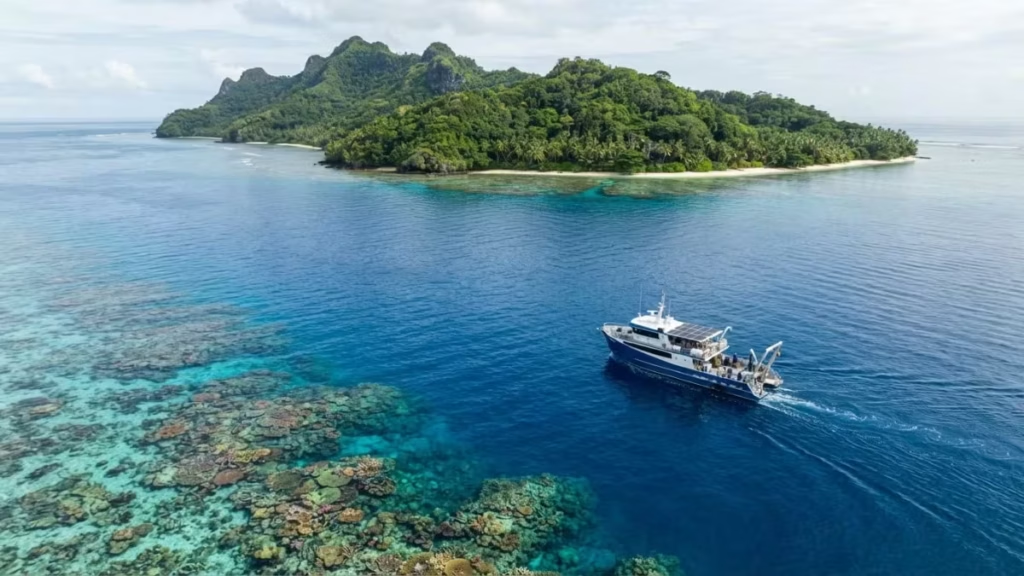
The Bezos Earth Fund Pacific Ocean conservation initiative expanded its financial footprint today with the announcement of more than $25 million in new grants directed across five island nations in the Southwest Pacific. This latest capital deployment delivers targeted funding to the Cook Islands, Kiribati, Papua New Guinea, Tonga, and Vanuatu to support marine protection and sustainable ocean management across more than 625,000 square miles of territory. Designated as Unlocking Blue Pacific Prosperity, the program represents the second round of a dedicated $100 million regional pledge structured to protect at least 30% of the region’s waters by 2030. Following an initial $37.5 million tranche awarded in 2025, the total capital committed under this Pacific framework now reaches $63.3 million.
This funding injection represents an integral slice of Jeff Bezos’ overarching $10 billion climate commitment established in 2020 through the Earth Fund. Under the original deployment schedule, the $10 billion portfolio was targeted for full distribution by the end of 2030. Almost seven years into that ten-year mandate, the organization has awarded approximately $2.4 billion in cumulative grants, leaving roughly $7.6 billion in remaining capital to be allocated over the next four years. Grantmaking velocity has accelerated notably in 2026, rising to at least $400 million after dropping to $183 million during 2025. Kelly Levin, Chief of Science, Data and Systems Change at the Bezos Earth Fund, noted that the organization carefully evaluates a region’s specific needs before allocating financial resources. Still, foundation executives maintain that the organization remains fully committed to meeting its 2030 distribution deadline.
On the ground across the South-West Pacific, the incoming capital translates directly into national marine governance and infrastructure projects. Papua New Guinea will deploy its funding allocation to establish its first large offshore marine protected area. Tonga is channeling its capital toward expanding existing marine sanctuaries, while the Cook Islands will bolster operations at the Marae Moana ocean park. In Kiribati and Vanuatu, the grants prioritize comprehensive habitat protection planning. These designated marine protected areas establish binding regulatory boundaries where commercial activities, including industrial fishing, seabed mining, and extractive operations, can be prohibited entirely in tightly protected zones. Following these latest awards, 17 out of the Pacific’s 22 countries and territories are actively executing water protection or ocean management initiatives supported by Earth Fund capital. French Polynesia established the world’s largest network of fully protected marine areas spanning almost 625,000 square miles earlier this year, while Niue has legally protected 40% of its national territorial waters.
Beyond sovereign territorial waters, the Earth Fund’s deployment extends into international marine governance. A dedicated grant awarded to the global conservation organization Rare supports regional governments in drafting initial protection proposals for biodiversity in international waters under the UN High Seas Treaty, which officially entered into force in January. Vice Chair Lauren Sánchez Bezos leads this latest Pacific grant tranche. Since marrying Bezos in June 2025, she has assumed an increasingly prominent public position across the organization’s philanthropic operations after heading the debut Pacific grant rollout last year.
The capital injection comes at a critical juncture as South-West Pacific economies face severe environmental and commercial disruptions driven by ocean warming and acidification. A July report published by the World Meteorological Organization highlighted that escalating sea surface temperatures severely disrupted marine ecosystems and commercial fisheries across the region, which recorded its second-warmest year on record in 2025. “Across Asia and the Pacific, heat is intensifying multi-hazard risks, intersecting with food systems, public health, infrastructure and oceans, and placing new pressures on health and livelihoods,” said Armida Salsiah Alisjahbana, Executive Secretary of the UN Economic and Social Commission for Asia and the Pacific. “Early warning and early action save lives when alerts are timely, messages are trusted and last-mile delivery reaches the vulnerable,” said Alisjahbana.
The $25 million Pacific grant package is part of a broader capital deployment push by the Earth Fund in 2026. Since April, the foundation has announced $34 million for sustainable fabric innovation, $26 million for advanced wildfire detection and prevention technology, and $100 million to convert vacant urban land into public parks across eight American cities. An additional $100 million commitment was structured through a joint partnership with Leonardo DiCaprio’s organization Re to protect threatened global species. Meanwhile, the fund disbursed $30 million through its AI Grand Challenge to support environmental technology applications, including AI models designed to identify plant species and analyze endangered bird vocalizations.
Against Jeff Bezos’ personal net worth—valued at approximately $273 billion on the Bloomberg Billionaires Index as of October 1, 2026, placing him third globally—the $10 billion environmental commitment underscores the operational complexities of private philanthropic capital. Bezos has previously drawn explicit comparisons between managing large-scale philanthropic distribution and scaling global enterprise operations. “The hard part is figuring out how to do it in a levered way,” said Jeff Bezos, Founder of the Bezos Earth Fund. “It’s not easy. Building Amazon was not easy. Reflecting on his philanthropic efforts, Bezos drew parallels between scaling a global enterprise and managing large-scale charitable investments, noting that building Amazon required intense dedication and talented teams, a challenge he and Lauren Sánchez are finding remarkably similar in the non-profit sector.
Editorial Note: This article was researched and drafted with AI assistance, then rigorously fact-checked, edited, and published by Miles. All content is strictly for informational and educational purposes only and does not constitute professional investment advice. Cryptocurrency and global financial markets experience severe volatility, sometimes swinging 50% or more in a single day. Invest only capital you can comfortably afford to lose, and always consult a certified financial advisor before committing funds. Read my full Disclaimer for more details.
