
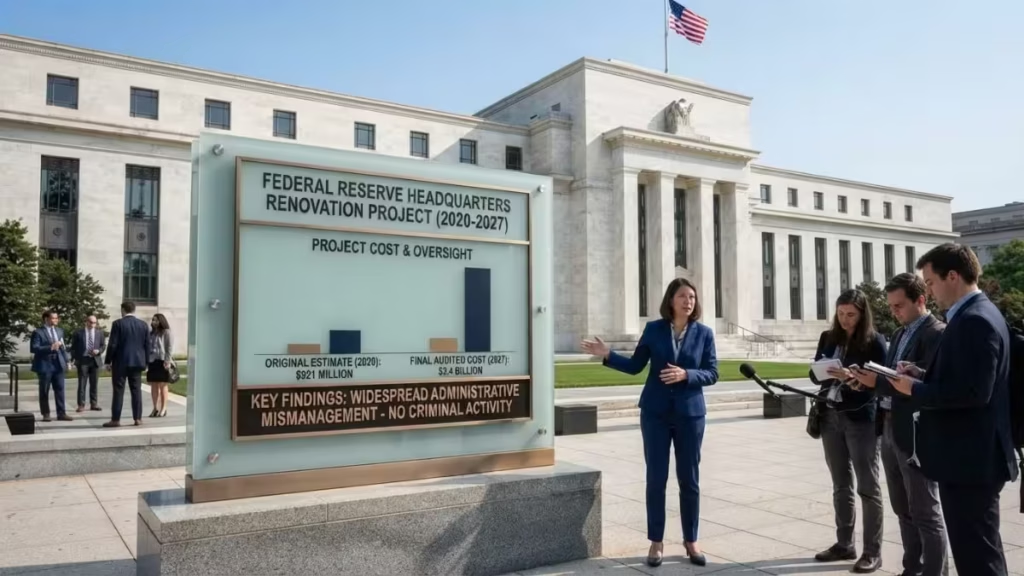
The Federal Reserve Building Renovation suffered from widespread administrative mismanagement and weak contract execution, but involved zero criminal activity, according to a federal watchdog report released Wednesday. Inspectors faulted the central bank’s Board of Governors for failing to establish cost controls as expenses escalated across the multi-year project.
The official findings capped a chaotic 14-month federal investigation that intertwined central bank policy with intense political warfare. Total projected construction expenses ballooned to $2.4 billion across two historic buildings on the Washington campus, more than double original budget figures. Initial estimates stood at $921 million in February 2020 before awarded construction contracts reached $2.018 billion by December 2024. Final completion now faces delays extending through December 2027.
A comprehensive 120-page evaluation from the Office of Inspector General cited fundamental governance failures. Central bank leadership never established a guaranteed maximum price before construction began in 2022. Consequently, building contractors operated under a pay-as-you-go reimbursement structure that passed market price hikes directly to the institution.
“At no point during our evaluation did we find reasonable grounds to believe that a violation of federal criminal law had occurred,” said Michael Horowitz, Inspector General for the Board of Governors of the Federal Reserve System.
The investigation thoroughly debunked claims that luxury additions drove cost overruns. Political critics previously alleged the central bank installed lavish rooftop terraces, custom elevators opening into VIP dining rooms, and a private art collection. Inspector General auditors confirmed those specific features did not materially contribute to financial overruns. Removing proposed water features would save negligible money due to replacement landscaping requirements.
Instead, internal governance flaws and major design shifts created expensive delays. The full seven-member board originally approved the project back in 2017. However, central bank officials abruptly altered interior building plans in 2023, abandoning open floor plans to construct individual private offices. That single decision stalled construction, forcing the project into periods of severe economic inflation. External review boards and historic preservation panels also mandated expensive design modifications, including classical exterior marble pushed by presidential appointees. Unforeseen site complications, including extensive environmental asbestos remediation, further compounded price spikes.
“Inflation does not change the Fed’s responsibility to manage its resources prudently and be accountable to Congress,” said Tim Scott, Chairman of the Senate Banking Committee.
The physical renovation became a primary flashpoint in a broader campaign against central bank independence. White House officials repeatedly cited building costs while pressuring monetary policymakers to cut benchmark interest rates. During a tense Senate Banking Committee hearing in June 2025, congressional leaders accused central bank leadership of lavish spending. Central bank leadership forcefully rejected those allegations during public testimony, noting workers were simply reinstalling original historic marble removed during structural upgrades.
Shortly after that hearing, Office of Management and Budget Director Russell Vought sent a sharp letter to the central bank. Vought claimed comparable federal renovations cost orders of magnitude less, likening the headquarters project to a palace.
President Donald Trump escalated pressure by making an unprecedented personal visit to the construction site in July 2025. Standing alongside central bank officials in hard hats before television cameras, Trump brandished a cost sheet and suggested price tags had exploded further. Central bank leadership immediately corrected Trump on camera, pointing out that his higher numbers incorrectly included a previously completed building project. The central bank subsequently launched a public web portal detailing inflation drivers and material costs.
Tensions reached a breaking point in January when federal prosecutors launched a criminal probe against central bank leadership. Justice Department officials served grand jury subpoenas regarding congressional testimony about the renovation. Prosecutors even attempted to send investigative aides to inspect the construction site directly. A federal judge quashed those subpoenas in April, ruling prosecutors produced essentially zero evidence of criminal conduct. Justice Department spokesperson Tim Lauer noted that prosecutors are currently reviewing the watchdog report.
“This is about whether the Fed will be able to continue to set interest rates based on evidence and economic conditions,” said Jerome Powell, former Chairman of the Federal Reserve.
Jerome Powell stepped down as chairman in May 2026, handing central bank leadership to incoming Chair Kevin Warsh. However, Powell took the extraordinary step of remaining on the board as a governor to safeguard administrative autonomy during ongoing inquiries. By retaining his seat, Powell denied political authorities an open vacancy on the seven-member board. His statutory term as a governor runs through January 2028.
“The report confirmed that Trump lapdogs U.S. Attorney Jeanine Pirro and Attorney General Todd Blanche have no basis to restart the President’s witch hunt,” said Elizabeth Warren, senior Democrat on the Senate Banking Committee.
In response to watchdog critiques, newly installed central bank leadership announced immediate administrative overhauls. Chair Kevin Warsh transferred executive project oversight directly to the General Services Administration, the federal government’s primary real estate agency. Officials also commissioned an independent external auditor to evaluate all historical project expenses. The central bank plans to review every existing vendor contract and pursue clawback reimbursements for any work paid for but not performed.
“The American people are owed a prudent and conscientious use of public funds,” said Kevin Warsh, Chairman of the Federal Reserve Board.
Unlike standard executive departments, the central bank operates without direct taxpayer appropriations. The system self-funds operations through payment processing service fees and interest yields earned on its vast bond portfolio. Still, congressional oversight committees pledged continued scrutiny as the General Services Administration assumes daily site execution.
Work across the Washington campus continues under revised federal management. Meanwhile, central bank governors remain focused on macroeconomic stability, having already raised benchmark interest rates once under Warsh despite external pressure for rate cuts.
Editorial Note: This article was researched and drafted with AI assistance, then rigorously fact-checked, edited, and published by Miles. All content is strictly for informational and educational purposes only and does not constitute professional investment advice. Cryptocurrency and global financial markets experience severe volatility, sometimes swinging 50% or more in a single day. Invest only capital you can comfortably afford to lose, and always consult a certified financial advisor before committing funds. Read my full Disclaimer for more details.
