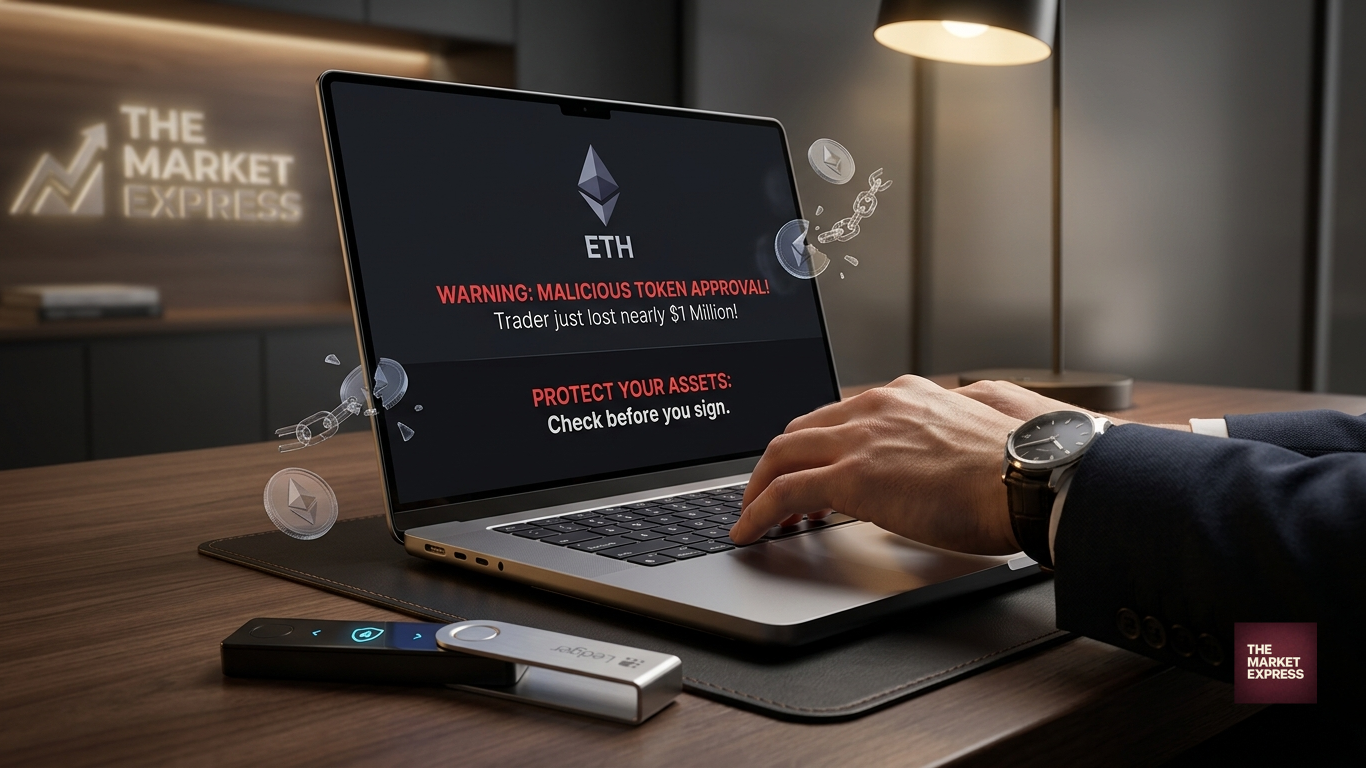
A single approval click. Nearly $1 million in USDT gone in seconds. This isn’t a hypothetical warning — it’s what happened to one Ethereum trader this week, and it’s a pattern our team tracks closely because it keeps repeating with almost identical mechanics.
What Actually Happened
The trader had unknowingly signed a malicious token approval — a permission that, once granted, lets an attacker move tokens out of a wallet without needing the private key or any further confirmation. According to a report from Scam Sniffer, the attacker’s first withdrawal attempt failed, but a second attempt seconds later succeeded, draining close to 999,999 USDT (~$1 million) from the wallet.
That detail — a failed first attempt followed by an immediate successful second one — is worth pausing on. It’s consistent with how these drainer scripts are built: they’re designed to auto-retry with slightly different call parameters the instant one method is rejected by the wallet or blocked by a security extension. The victim often has no window to react between the two attempts.
This Is Infrastructure, Not a One-Off
It’s tempting to read this as an isolated case of one person clicking the wrong link. The data says otherwise. CertiK’s mid-year report recorded roughly $366 million lost to phishing in just the first six months of 2025 — and importantly, that figure represents a small number of underlying toolkits and wallet-draining services being reused across thousands of victims, not thousands of independent scams.
In practice, this means:
- The same drainer contracts and front-end kits show up across unrelated victim wallets, reused by different affiliate scammers renting the same infrastructure
- Attackers increasingly target approval requests disguised as routine actions — NFT mints, airdrop claims, wallet “verification” — rather than obvious fake giveaways
- Success doesn’t require a smart contract exploit or coding skill; it requires one convincing message and one rushed signature
That last point is the real shift worth understanding: this attack class doesn’t exploit Ethereum’s code; it exploits the interface between humans and their wallets. No protocol upgrade fixes that.
How to Protect Yourself
- Audit your active approvals now, not after an incident. Use Etherscan’s Token Approval Checker to see every contract with standing permission to move your tokens, and revoke anything unfamiliar or unused.
- Treat every signature request as a withdrawal, not a formality. Wallets rarely need a fresh “verification” signature — that framing is almost always the scam, not a legitimate step.
- Watch for address poisoning. Attackers send dust transactions from lookalike addresses that mimic ones you’ve paid before, hoping you copy the wrong one from your history. Always verify the full string, not just the first and last few characters.
- Slow down around urgency. Every phishing kit in this category relies on the victim acting fast. A five-second pause to actually read what a signature grants blocks most of these attacks outright.
The Practical Takeaway
Phishing losses aren’t declining because the underlying tooling has gotten cheap and easy to deploy — anyone can rent a drainer kit with no coding background. For traders, this means self-custody security has become an active, ongoing habit rather than a one-time setup: checking approvals periodically matters as much as choosing a secure wallet in the first place.
The uncomfortable reality is that once funds move through one of these approvals, recovery is close to impossible — there’s no chargeback in a smart contract. The defense has to happen before the signature, not after.