
Summary
- SpaceX is preparing for its monumental SpaceX Starship orbital launch, marking a pivotal transition from developmental flight testing to commercial satellite deployment.
- The 14th test flight serves a crucial commercial mandate by delivering 26 next-generation Starlink Version 3 satellites directly into low Earth orbit.
- Achieving full and rapid reusability across both stages remains what SpaceX describes as the holy grail of rocketry to drastically reduce capital expenditure.
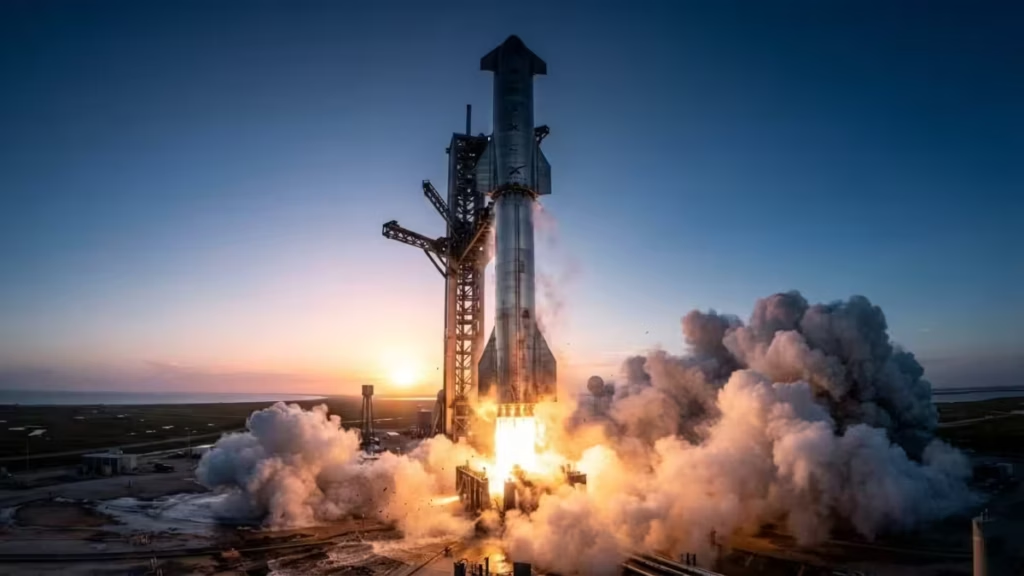
SpaceX is preparing for its monumental SpaceX Starship orbital launch on September 28, 2026, marking a pivotal transition from developmental flight testing to commercial satellite deployment. The 75-minute launch window gets underway at 7:15 a.m. CT (8:15 a.m. EDT), with liftoff targeted from SpaceX’s Starbase facility located in South Texas, where the company will attempt to place its upper-stage vehicle into Earth orbit for the first time. Beyond proving orbital capability, the 14th test flight serves a crucial commercial mandate by delivering 26 next-generation Starlink Version 3 satellites directly into low Earth orbit. This single payload will inject 26 terabits per second of capacity into SpaceX’s orbital network, representing a tenfold capacity expansion over standard Falcon 9 satellite deployments. “The upcoming flight is planned to be the first to send Starship into orbit around Earth,” stated SpaceX in its official Flight 14 briefing.
Standing 407 feet (124 meters) tall when fully stacked, the two-stage Starship represents the largest and most powerful launch system in aviation and aerospace history. The 171-foot upper stage sits atop a Super Heavy booster powered by 33 methane-fueled Raptor engines designed to produce millions of pounds of thrust. Achieving full and rapid reusability across both stages remains what SpaceX describes as the “holy grail of rocketry,” a breakthrough intended to drastically reduce capital expenditure per kilogram launched. Previous developmental testing relied on 13 suborbital flights lasting no more than 65 minutes, but Flight 14 expands operational parameters to a nearly 10-hour orbital trajectory. Following six full circuits around the globe at an altitude of roughly 275 kilometers, the upper stage is scheduled to conclude its flight with a splashdown in the Pacific Ocean west of Chile.
The financial implications of Flight 14 center heavily on SpaceX’s global satellite internet unit, Starlink. SpaceX currently operates approximately 11,000 active Starlink satellites in low Earth orbit, serving millions of commercial and residential customers worldwide. Chief Executive Officer Elon Musk has outlined long-term ambitions to scale this orbital architecture to 100,000 spacecraft. Each Starlink V3 unit deployed during Flight 14 contributes an individual bandwidth capacity of 1 Tbps. Upon release from the Starship payload bay between T+34 minutes and T+1 hour, the 26 units will unfold their solar arrays, establish high-speed laser links, and activate onboard thrusters to raise their orbits toward operational service within weeks.
To ensure structural and operational reliability during ascent, SpaceX engineers implemented targeted hardware and software upgrades following Flight 13. In the prior mission attempt, the Super Heavy booster fired all 33 Raptor engines for the boostback burn; however, ice buildup in the trio of center engines caused a premature shutdown during the final maneuvers. As a direct result, just 8 out of the 13 designated engines relit for the terminal landing sequence, culminating in a forceful touchdown in the Gulf of Mexico. For Flight 14, SpaceX modified engine propellant filtration systems and updated flight control algorithms to improve relight reliability prior to a planned offshore booster landing burn seven minutes after liftoff.
The mission timeline establishes rigorous benchmarks across its 10-hour duration. Following stage separation at T+2:22 and a brief coast phase, Starship’s upper stage will execute its primary orbital insertion burn at T+25:17, firing its Raptor engines for 19 seconds to reach orbit. The vehicle is scheduled to complete six orbits around Earth while mission controllers evaluate hardware redundancy before granting authorization for the deorbit burn at T+8 hours and 52 minutes. Mission documentation from SpaceX specifies that Starship will proceed with its orbital insertion burn strictly after flight controllers verify that critical systems possess adequate redundancy to safely execute the final deorbit maneuver.
Thermal protection management represents another crucial technical milestone being evaluated during Flight 14. Engineers fitted three of the Starlink V3 satellites with specialized camera suites tasked with scanning Starship’s exterior tiles and transmitting real-time imagery during orbital coast. In tandem, the vehicle features curved tile geometries designed to mitigate plasma flow between gaps, alongside enhanced tile retention mechanisms in high-stress zones. Marking a historic milestone for reusable heatshield materials, Ship 41 will fly two reconditioned tiles recovered directly from Ship 40 following its splashdown in the Indian Ocean.
Beyond immediate Starlink network expansion, Starship’s orbital validation carries massive commercial weight for government launch contracts. NASA previously selected Starship as the human landing system for its Artemis IV lunar mission targeted for 2028. Future mission strategies involve intricate orbital refueling procedures, utilizing specialized tanker spacecraft to transfer cryogenic propellants in space before undertaking long-duration deep-space journeys. “Starship is the biggest and most powerful rocket ever built, standing a towering 407 feet tall when fully stacked,” noted Mike Wall, Spaceflight and Tech Editor at Space.com. As liftoff approaches at Starbase, financial markets and aerospace analysts alike are closely watching whether Flight 14 can turn Starship’s massive structural potential into a fully operational orbital engine.
Editorial Note: This article was researched and drafted with AI assistance, then rigorously fact-checked, edited, and published by Miles. All content is strictly for informational and educational purposes only and does not constitute professional investment advice. Cryptocurrency and global financial markets experience severe volatility, sometimes swinging 50% or more in a single day. Invest only capital you can comfortably afford to lose, and always consult a certified financial advisor before committing funds. Read my full Disclaimer for more details.
