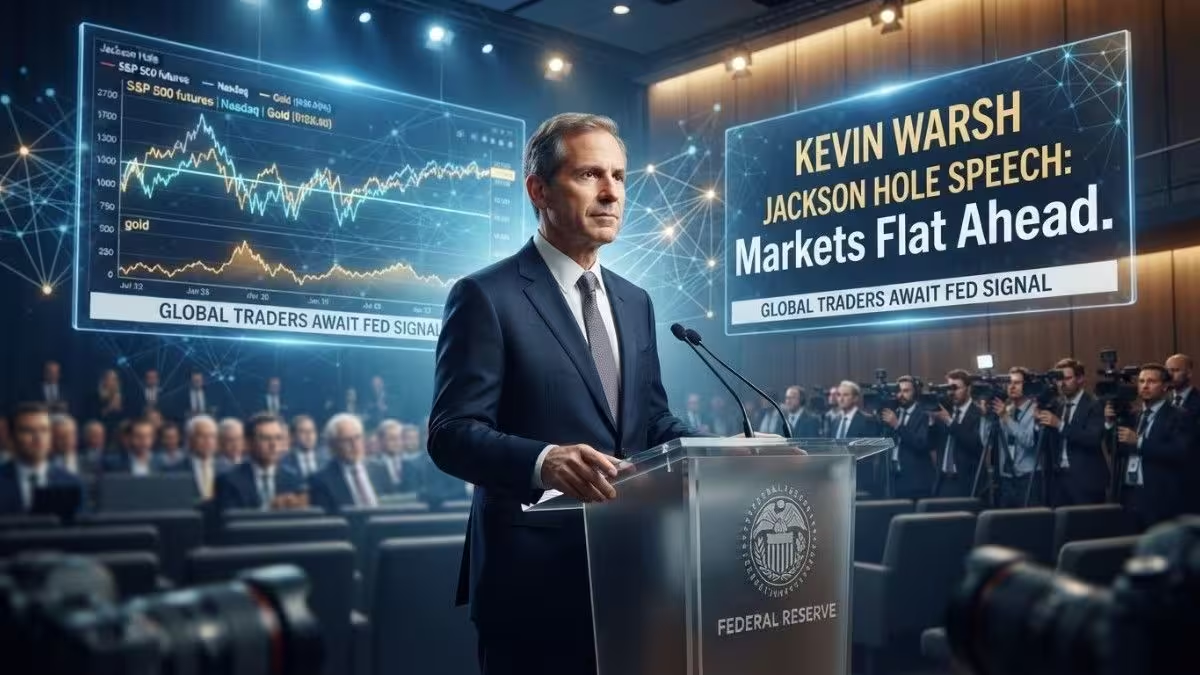
United States stock index futures are flatlining as the financial world holds its collective breath ahead of the highly anticipated Kevin Warsh Jackson Hole speech. Traders across global desks are maintaining tight, cautious positions before the Federal Reserve chair takes the podium at 10:00 a.m. Eastern time in Wyoming. While Dow Jones futures experienced a marginal lift and Nasdaq contracts dipped 0.1%, S&P 500 futures remained largely unchanged. This quiet trading follows a major technology-driven session on Wall Street, which saw the headline benchmarks approach record highs before hitting this temporary pause.
The calm market response highlights a deep internal divergence that is currently masking broader underlying anxieties. On Thursday, the S&P 500 climbed 0.7% to finish at 7,730.99, while the tech-heavy Nasdaq composite gained 1.6% to reach 26,541.35 and the Dow added 0.2% to close at 53,569.44. However, the equal-weighted version of the S&P 500 actually fell 0.2%, with only 171 of its constituents advancing during the session. Technology stocks almost entirely carried the benchmark index on their shoulders, driven by a blockbuster performance from semiconductor giant Nvidia. The company saw its stock rocket 8.7% after beating consensus estimates and forecasting a bold 70% revenue growth for the next fiscal year.
Nvidia single-handedly generated $456 billion in market value during the rally, nearly matching the entire S&P 500 index’s total capitalization increase of $482 billion. Salesforce added another $37 billion in value, soaring 22.6% on the back of strong Agentforce adoption numbers that calmed concerns over artificial intelligence software displacement. “Investor sentiment steadied following solid performances from tech giants like Nvidia, Salesforce, and CrowdStrike, alongside subtle indications of cooling tensions across the Middle East,” said Dan Coatsworth, head of markets at AJ Bell. Yet the narrowness of this market advance means that any hawkish shift in monetary rhetoric could quickly threaten these expensive technology leaders.
The macroeconomic backdrop remains highly charged as July headline Personal Consumption Expenditures inflation accelerated to 3.7%, landing above the 3.6% forecast. This stubborn price acceleration has forced traders to price in a 35% probability of a rate hike at the September Federal Reserve meeting, with those odds climbing to 75% by December. Meanwhile, the ten-year US Treasury yield is holding firm near 4.67%, and the dollar index is trading around 99.10, which sits near a one-week high. Commodity and cryptocurrency markets are also locked in a holding pattern, as gold prices fell 0.5% toward $4,575 and Bitcoin hovered near the $80,000 threshold.
This environment places immense pressure on the Federal Reserve chair, whose Kevin Warsh Jackson Hole speech marks his official symposium debut. Warsh is attempting to reshape the central bank’s communication strategy by advocating for less forward guidance, arguing that the markets should do the heavy lifting of tightening financial conditions. This hands-off approach has created friction with the US Treasury Department, where Treasury Secretary Scott Bessent has taken the opposite path. Bessent has actively increased longer-term bond buybacks to tame rising borrowing costs, a move that critics argue could spice up the economy and directly undermine the Fed’s inflation battle.
“The stakes are high because Kevin Warsh is trying to change the way the Fed functions and communicates its policy to the market,” said Ipek Ozkardeskaya, senior analyst at Swissquote. This potential collision between fiscal and monetary authorities has left investors wondering how the central bank will respond to Treasury interventions that might interfere with policy transmission. Warsh has previously indicated he wants his remarks to center on long-term structural changes, including artificial intelligence, productivity, and global economic responses to geopolitical shocks. Still, market participants are demanding immediate clarity on how the Federal Reserve plans to coordinate with the Treasury or if it will choose to act independently.
“This speech could focus on bigger issues, such as how he plans to run the world’s most important central bank, and also what changes he will make and when,” said Kathleen Brooks, research director at trading firm XTB. Investors are dissecting every potential scenario, knowing that Warsh’s previous communications have occasionally sent mixed signals to Wall Street. During his first press conference in July, the chair was criticized for pledging to control inflation without offering a concrete roadmap of actions. That lack of specificity has elevated the importance of today’s address, as the market looks for a coherent reconciliation between Fed actions and its hawkish goals.
European equity markets are also exhibiting cautious optimism, with London’s FTSE 100 trading 0.22% higher at 10,815 points, DAX up 0.54% at 26,510, and CAC 40 up 0.97% at 8,400. In France, revised economic data showed that the eurozone’s second-largest economy narrowly dodged a recession, with GDP shrinking 0.2% in the first quarter and remaining flat in the second quarter. The French government is vocal about keeping its deficit below 5% of GDP next year, yet weak growth will make balancing defense and technology spending incredibly difficult. Globally, sovereign debt burdens are rising, forcing a historic debate over fiscal dominance and the exact boundary between independent monetary policy and government spending.
As morning trading unfolded, investors steered clear of heavy risk-taking, keeping S&P 500 futures anchored right around the flatline. Whether the Fed chief delivers a grand conceptual thesis on productivity or a traditional policy cleanup, his words will inevitably set the tone for global capital flows. The mountain air of Wyoming may be calm, but the financial architecture below is preparing for a storm of volatility if monetary and fiscal policies continue on their current collision course.