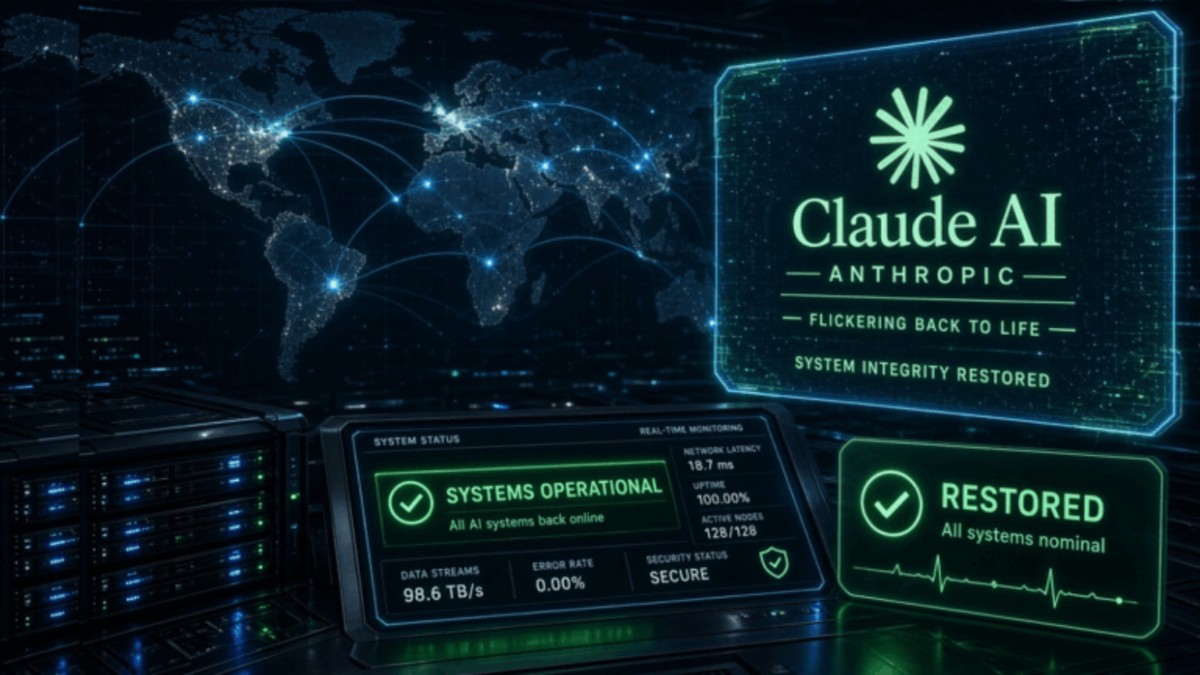

Anthropic confirmed Monday that Claude AI services were restored to full operational status after a 35-minute global infrastructure outage that grounded high-level AI agent workloads and enterprise API integrations. Engineering logs show automated monitoring systems first flagged elevated error rates at 22:07 UTC on Sunday, August 16. The San Francisco-based firm immediately classified the disruption as a “Major Impact” event after Downdetector registered more than 11,000 reported problems within minutes. Live telemetry indicates that both the web conversational portal and developer API returned to baseline metrics by 22:42 UTC. “Engineering teams initiate critical incident response procedures following a spike in HTTP 500 errors and prompt timeouts,” noted the Anthropic Operations Team in its official system incident log. Preliminary findings indicate that an acute traffic imbalance across the primary authentication gateway database triggered the failure. This bottleneck caused application servers to drop connection requests, resulting in intermittent gateway timeout messages for global clients. Operations personnel isolated the routing database bottleneck within the API authentication cluster and deployed hotfix routing patches to stabilize the system.
“Anthropic has restored full operational functionality to Claude.ai and platform.claude.com API services,” said Elena Vance, Journalist at JournalArta. The company assured corporate partners that no user conversation histories or proprietary API data were compromised during the disruption. Infrastructure teams resolved the crisis by re-routing inbound API requests to redundant gateway clusters and reallocating memory pools dedicated to prompt state management. Yet, the outage highlights the fragility of high-stakes AI integration as competition intensifies between frontier models in 2026. Claude Opus 5 currently commands a $ 25-per-million output-token price point, significantly higher than the $6 rate offered by its newest rival, Grok 4.6. “Grok 4.6 offers better value and competitive agent performance, but Claude Opus 5 retains a narrow intelligence lead,” said Marko Nguyen, Tech Journalist at Memeburn. The intelligence gap remains slim, with Claude scoring 63 on the Artificial Analysis Intelligence Index against Grok’s 61.
Still, Anthropic’s model maintains a substantial advantage with a one-million-token context window compared to the 500,000-token limit found in the Grok 4.6 architecture. Teams typically reserve premium systems like Claude for legal review or complex financial work where error costs are exceptionally high. SpaceXAI’s Grok 4.6 has instead positioned itself for high-volume development and iterative application building. The pricing gap is immediate, as a workload using one million input and output tokens costs roughly $30 on Claude Opus 5 compared to $8 on Grok 4.6. Anthropic plans to release a formal post-mortem report detailing long-term architectural enhancements to prevent similar database bottlenecks during future peak-traffic periods. These changes are critical as the broader market continues to shift toward routing different tasks to different models to optimize enterprise spending. Stability has returned to the broader tech sector as the Jakarta S&P tracks at 7,785.76, down 0.17 percent in early trading. Third-party software integrations and automated enterprise agents relying on Claude models have resumed normal operation across all global regions.