
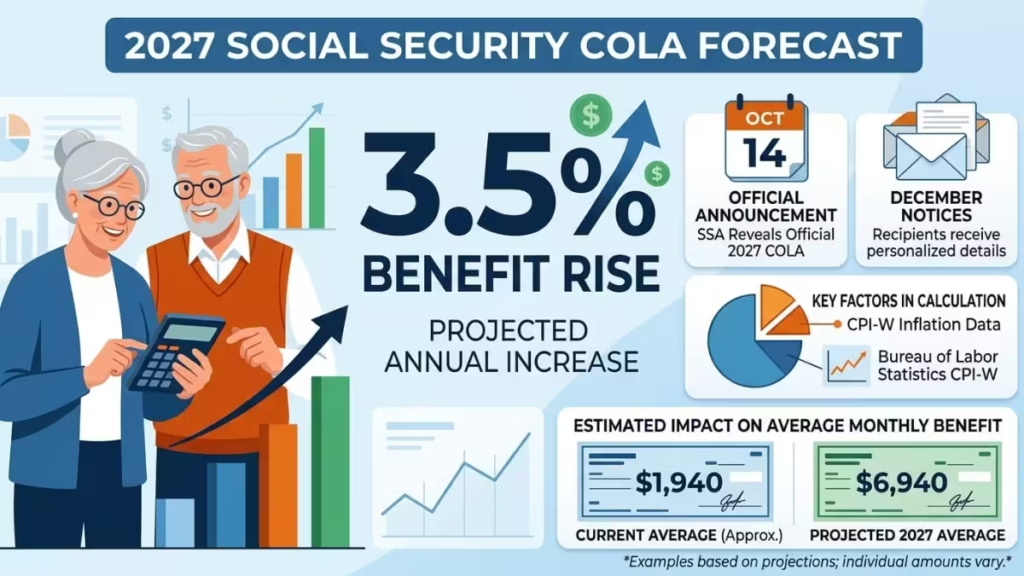
Millions of retirees could receive a 3.5% boost to their monthly payouts, according to the latest 2027 Social Security COLA projections. The Social Security Administration will officially announce the annual cost-of-living adjustment on Wednesday, October 14, following the Bureau of Labor Statistics’ release of September inflation data. Social Security recipients will receive personalized notices detailing their updated benefit amounts in December.
According to projections from nonpartisan senior advocacy group The Senior Citizens League, the adjustment is projected to reach 3.5% in 2027. That figure reflects a modest 0.1 percentage point revision down from last month’s forecast of 3.6%. Independent Social Security and Medicare policy analyst Mary Johnson told CNBC that the Social Security COLA for 2027 could indeed reach 3.5%. However, Johnson cautioned that the final figure remains subject to change due to volatile oil prices. If the 3.5% projection holds, it will mark the largest annual benefit increase in four years.
According to Shannon Benton, Executive Director at The Senior Citizens League, two of the three CPI-W metrics needed for the calculation have already been finalized. However, Benton noted that upcoming short-term economic disruptions over the next 30 days could still push inflation figures sharply in either direction before the final adjustment is announced.
The mechanics of the annual benefit calculation depend entirely on official price metrics collected by federal statistical agencies. Annual adjustments stem directly from changes in the Consumer Price Index for Urban Wage Earners and Clerical Workers. The Bureau of Labor Statistics calculates these figures on a monthly basis. The explicit purpose of these statutory adjustments is to ensure Social Security benefits keep up with broader consumer inflation.
For the average retiree, a 3.5% cost-of-living adjustment delivers meaningful dollar gains to monthly household cash flow. Current statistical baselines show the average retiree monthly check standing at $1,940.08. Under the projected 3.5% bump, that average monthly benefit will rise by $67.90 to $2,007.98. Beneficiaries receiving higher monthly checks will see proportionally larger dollar increases. For instance, a retiree receiving $2,071 per month—the current average retiree benefit cited by the Social Security Administration—will gain roughly $72 per month, raising their total check to $2,143.48.
Energy market movements remain the primary wild card in the upcoming administrative announcement. August Consumer Price Index data showed a 3.4% year-over-year increase in overall consumer prices. Ongoing geopolitical tensions involving the United States and Iran drove a 3.9% surge in retail gasoline costs over the preceding month. Meanwhile, core inflation, which strips out volatile food and energy costs, rose 0.3% month-over-month.
Federal statutory regulations dictate the exact mathematical formula behind the cost-of-living increase. A COLA effective for December of the current year equals the percentage increase in the Consumer Price Index for Urban Wage Earners and Clerical Workers from the third-quarter average of the current year to the third-quarter average of the last year in which an adjustment became effective. Federal rules mandate that any resulting percentage increase must be rounded to the nearest tenth of one percent. If the measured index shows zero increase or a decline, no benefit adjustment is made for the year.
Beneficiaries can track and estimate their prospective payment changes through official digital tools. Individual retirees can check their specific benefit increases by setting up an online account. Once verified online, beneficiaries can view personalized estimates of their retirement benefits and observe how monthly payments shift across different retirement ages. Alternatively, retirees can calculate their updated checks manually by multiplying the estimated percentage increase by their current monthly distribution.
Despite marking a four-year high, financial analysts and elder advocacy organizations warn that the projected increase could ultimately prove disappointing for seniors. Older households allocate their monthly budgets quite differently than younger workforce members, spending a larger proportion on healthcare and housing.
“No matter if the COLA announcement comes in slightly higher or slightly lower than our prediction, seniors will probably end up disappointed in the long run,” said Shannon Benton, Executive Director at The Senior Citizens League. Shannon Benton, Executive Director at The Senior Citizens League, emphasized that inflation impacts retirees disproportionately because senior households distribute their spending far differently than active members of the labor force. “The CPI-W captures the experience of urban wage earners, which doesn’t represent the average senior’s budget,” said Shannon Benton, Executive Director at The Senior Citizens League.
“Recipients will receive their personalized notices detailing their new benefit amounts in December,” said Ivana Pino, Senior Writer at Yahoo Finance.
“The Social Security COLA for 2027 could be 3.5%, though the final figure could change due to volatile oil prices,” said Mary Johnson, Independent Policy Analyst at CNBC.
This structural discrepancy between official price indices and actual senior expenditures poses a persistent challenge for fixed-income retirees. Because the Consumer Price Index for Urban Wage Earners and Clerical Workers measures active urban workers, it places greater weight on transportation and general consumer goods rather than medical care. Consequently, even a robust four-year high adjustment may leave retirees struggling to keep pace with elder-specific price pressures.
Still, beneficiaries will obtain complete clarity in a matter of days when the Social Security Administration publishes the official 2027 figure on October 14. With two of the three third-quarter inflation readings already finalized, the ultimate adjustment rests on the upcoming September price report. Detailed notices will subsequently reach beneficiaries via mail and online accounts in December, well ahead of the updated benefit distributions.
Editorial Note: This article was researched and drafted with AI assistance, then rigorously fact-checked, edited, and published by Miles. All content is strictly for informational and educational purposes only and does not constitute professional investment advice. Cryptocurrency and global financial markets experience severe volatility, sometimes swinging 50% or more in a single day. Invest only capital you can comfortably afford to lose, and always consult a certified financial advisor before committing funds. Read my full Disclaimer for more details.
