
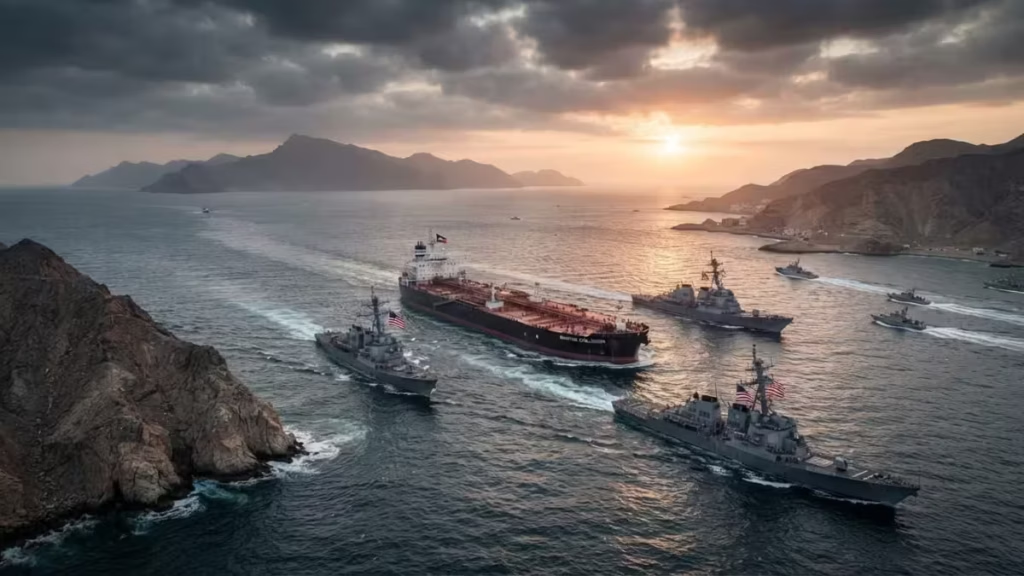
Strait of Hormuz oil shipments reached an average of 13.1 million barrels per day last week, marking a dramatic rebound to nearly 80 percent of prewar volumes despite persistent military conflict in the Persian Gulf. Supported by heavy U.S. Navy escorts, Gulf producers are successfully moving crude through the critical waterway right under Tehran’s watch. Total Middle Eastern crude flows—combining strait transits and pipeline bypasses—have recovered to 98 percent of prewar benchmarks, according to analytics from JPMorgan. The robust volume of shipments transiting the strait clearly indicates that Tehran’s leverage over the vital waterway is diminishing, according to Matt Smith, director of commodity research at Kpler.
This logistical recovery relies on a complex, high-risk naval operation involving military-escorted shuttle convoys and surreptitious “dark” transits designed to evade targeted strikes. Saudi Arabia recently restored significant volumes through Hormuz after Iranian-aligned Houthi militants bombed the Saudi East-West pipeline, temporarily disrupting roughly 7 million barrels per day of Red Sea diversions. Yet, maintaining this military convoy system requires immense defense resources while global commercial inventories shrink toward operational thresholds. Meanwhile, crude prices remain elevated, keeping refined fuel costs near historic highs for industrial transport and everyday consumers.
Energy markets have adapted to history’s largest supply shock through structural workarounds, increased non-Gulf output, and forced reductions in global energy demand. Global oil inventories dropped by approximately 2 billion barrels during the war, acting as a vital buffer against immediate global shortfalls. “The crude oil market has demonstrated unlimited tricks to keep physical product moving to customers despite history’s largest supply shock,” said David Goldman, senior market analyst. However, commercial inventories cannot absorb supply deficits indefinitely as physical drawdowns erode remaining buffer capacity.
Wall Street analysts struggle to forecast the eventual market clearing point as physical inventories approach critical minimums. According to Natasha Kaneva, head of global commodities strategy at JPMorgan, market analysts are navigating uncharted territory without a foundational framework for the first time since the conflict began. “We simply don’t know how to model the endgame,” said Kaneva. Oil prices hovered above $90 per barrel throughout the month and spent most of September above $100, spiking near $110 following the East-West pipeline attack. Speculation surrounding potential diplomatic agreements continues to drive short-term price volatility more than physical tanker movements.
While crude oil flows near prewar levels, refined petroleum shipments from Middle Eastern refineries remain severely constrained at just 58 percent of prewar volume. Consequently, global downstream markets face severe shortages of finished fuels like diesel and gasoline. Truck drivers in Texas and California face record diesel prices exceeding $6 per gallon, with single commercial pump fill-ups reaching $175. High fuel surcharges continue to inflate global supply chain costs, offsetting broader economic stabilization efforts.
Saudi Arabia has demonstrated exceptional operational agility by rapidly shifting export routes between the Persian Gulf and western Red Sea ports. Recent satellite imagery revealed all seven berths operating at full capacity across the Yanbu and Al Muajjiz port terminals on the Saudi West Coast. This reactivation indicates that repairs on the damaged East-West pipeline successfully restored critical transport capacity. Still, market experts caution against turning a blind eye to structural risks despite higher transit numbers.
“Higher crossings should not be mistaken for improved safety – rather, they reflect the industry’s increasing ability to operate under sustained risk,” said Natasha Kaneva, head of global commodities strategy at JPMorgan. Maritime war-risk insurance premiums have surged to unprecedented levels, skewing capital asset valuations across global shipping fleets. Marine underwriters currently value 5-to-10-year-old oil tankers at $150 million, significantly exceeding the $135 million required to build a brand-new vessel.
Unable to export its own crude due to an enforceable U.S. naval blockade, Iran is escalating asymmetric attacks against commercial shipping to regain tactical leverage. “Not surprisingly, attacks on tankers have become more common as Iran looks to deter transits,” said Matt Smith, director of commodity research at Kpler. Tehran’s aggressive posture creates an unsustainable standoff between military escort operations and targeted maritime harassment. Without a permanent diplomatic resolution, global energy security remains dangerously dependent on dwindling physical inventories.
Editorial Note: This article was researched and drafted with AI assistance, then rigorously fact-checked, edited, and published by Miles. All content is strictly for informational and educational purposes only and does not constitute professional investment advice. Cryptocurrency and global financial markets experience severe volatility, sometimes swinging 50% or more in a single day. Invest only capital you can comfortably afford to lose, and always consult a certified financial advisor before committing funds. Read my full Disclaimer for more details.
