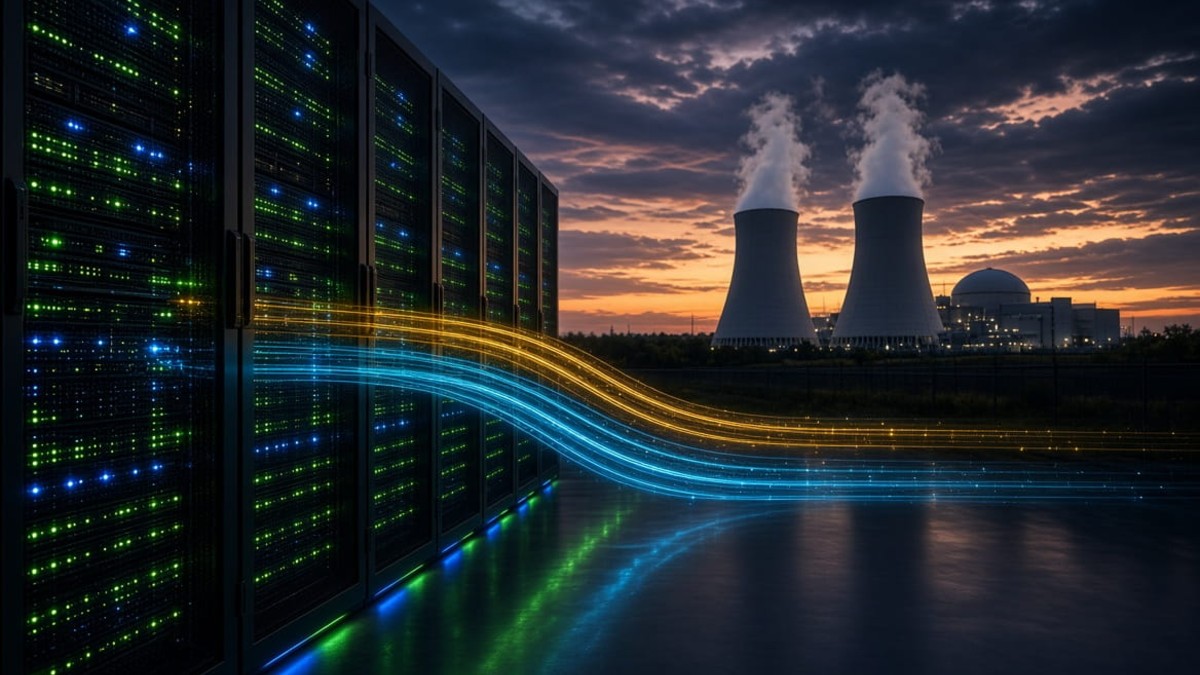
How data center power demand sparks a U.S. clean energy stock surge is now the defining narrative on Wall Street. Big Tech is deploying hundreds of billions of dollars into artificial intelligence infrastructure, but these advanced systems are only useful if they have electricity. As a result, massive data center power demand has outstripped the available local power supply. This structural bottleneck has forced technology giants to search for continuous, carbon-free energy sources to mitigate rising data center power demand. Nuclear energy providers have emerged as the primary beneficiaries of this modern electricity gold rush driven by data center power demand.
How Data Center Power Demand Drives Nuclear Reboots
Securing reliable electricity to satisfy data center power demand has led hyperscalers to sign historic, multi-decade commercial contracts. Microsoft recently finalized a landmark 20-year power purchase agreement with Constellation Energy to satisfy its long-term data center power demand. This unprecedented commercial agreement supports the restart of the retired Three Mile Island nuclear facility, now renamed the Crane Clean Energy Center, to feed data center power demand. This single contract illustrates how severe the pressure from data center power demand has become for top cloud operators trying to manage data center power demand.
Constellation Energy holds the distinction of owning the largest nuclear power fleet across the United States. While fossil fuels like natural gas release significant carbon dioxide and solar or wind cannot deliver stable 24/7 baseload power, nuclear reactors offer continuous, zero-emission generation to support this data center power demand. “These companies operate in two different phases of the power supply chain and complement each other,” said Stefon Walters, contributing analyst at The Motley Fool.
This functional division of labor allows utility generators to lock in long-term revenues while tech firms satisfy their escalating data center power demand. Still, public equity markets have exhibited significant near-term volatility despite these solid secular trends. Constellation Energy stock is down over 25% year to date through August 20, 2026, creating what several analysts view as an attractive entry point for long-term equity investors watching data center power demand trends.
Market Capital Floods Firms Tackling Data Center Power Demand
According to recent SEC regulatory filings, Constellation Energy currently boasts a market capitalization of $97 billion. The company maintains a highly robust gross margin of 17.37% on its generation services, helping it fund growth driven by data center power demand. Its shares recently traded at $272.88, within a wide 52-week trading range of $228.63 to $412.70. Daily trading volume reached 2 million shares, compared to an average volume of 3.5 million shares, demonstrating active institutional participation as capital tracks data center power demand.
“Constellation Energy remains a frontrunner in the race to lock in lucrative AI power revenue,” said Neha Chamaria, energy analyst at The Motley Fool. The company also distributes a modest dividend yield of 0.61% to shareholders, providing yield support. Tech firms are willing to pay a premium for nuclear power because the alternative is letting expensive server farms sit idle. Consequently, the relentless rise in data center power demand has created a highly favorable pricing environment for carbon-free generators capable of handling data center power demand.
On the other hand, the physical electrical grid itself requires a massive physical overhaul to handle this localized load. This grid congestion means generating clean electricity is only half the battle when resolving data center power demand. Utility companies must also secure heavy industrial hardware to distribute this power to remote server installations. This physical reality has directed significant investor attention toward specialized heavy equipment manufacturers to solve data center power demand.
Equipment Backlogs Grow Alongside Data Center Power Demand
This secondary phase of the power supply chain has sparked a massive stock rally for grid equipment providers. GE Vernova does not generate electricity itself but produces the critical transmission infrastructure needed to satisfy data center power demand. The firm manufactures heavy-duty turbines, grid software, and transmission hardware designed specifically to handle high-voltage data center power demand. “GE Vernova represents a highly secure way to capture the physical infrastructure build-out of the AI boom,” said Daniel Sparks, stock market analyst at The Motley Fool.
GE Vernova currently trades at $956.85 per share, commanding a massive market capitalization of $255 billion. The hardware manufacturer boasts a high-quality gross margin of 20.16% and pays a dividend yield of 0.18%. Its shares have surged over 42% this year and a spectacular 194% since the beginning of 2025. This stock outperformance reflects immense demand, with GE Vernova accumulating an unprecedented backlog of $176 billion in confirmed orders tied directly to global data center power demand.
Separately, this backlog acts as a highly reliable revenue floor for the industrial manufacturer over the coming decade. During the first half of this year alone, GE Vernova’s data center power equipment segment generated $5 billion. This impressive six-month figure more than doubles the division’s total revenue from the entirety of the previous fiscal year.
In contrast to pure-play utility companies, hardware manufacturers face different supply chain challenges, including long lead times for heavy electrical transformers. Yet, the ongoing surge in data center power demand ensures that both equipment suppliers and zero-carbon generators will see sustained capital inflows. Tech companies simply cannot afford to wait for the grid to update itself slowly. As a result, the race to secure energy assets and manage data center power demand will continue to reshape both the utility sector and the broader financial markets.