
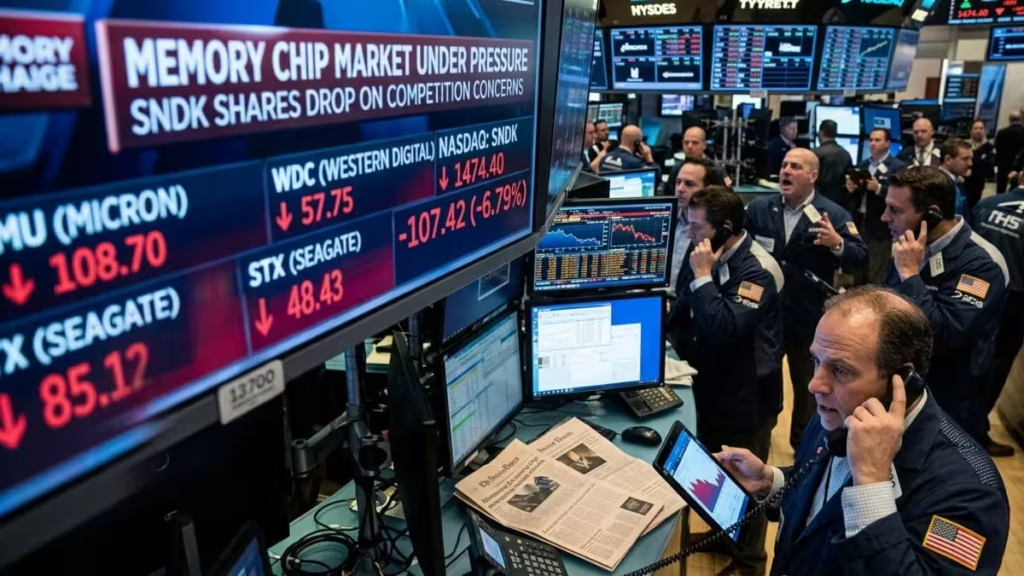
SanDisk stock pressure accelerated during Monday trading as institutional investors evaluated emerging technological advances from Chinese semiconductor rivals alongside broader memory-chip sector profit-taking. Shares of SanDisk Corporation dropped sharply by 6.79%, shedding $107.42 to trade at $1,474.40 by 10:54 a.m. ET on October 12, 2026. The steep decline erased Friday’s closing mark of $1,581.82. Heavy selling materialized almost immediately following the opening bell, with SNDK stock opening at $1,538.12 before pushing down toward an intraday low of $1,464.43. The session’s downward swing reflected growing anxiety across equity trading desks regarding future pricing power, global market share, and enterprise memory margins.
The immediate catalyst triggering Monday’s sell-off stemmed from technical progress announced by major Chinese memory-chip maker ChangXin Memory Technologies. Headquartered in Hefei, China, CXMT revealed breakthroughs in next-generation dynamic random-access memory architecture. Most notably, the manufacturer successfully advanced a 4F² memory-cell design explicitly engineered to maximize spatial storage density and production efficiency. “The Chinese manufacturer is advancing a 4F² memory-cell architecture designed to increase memory density,” said Shubhi Kumar, Market Reporter at Sunday Guardian Live. In tandem with cell-level density achievements, CXMT expanded development of high-capacity server-memory modules tailored for commercial computing platforms.
CXMT’s rapid technological push unsettled global technology desks, sparking widespread risk reduction across the semiconductor supply chain. Equity analysts quickly warned that aggressive production scaling from Chinese fabricators could eventually dilute global memory pricing power. The resulting market fallout extended far beyond SanDisk, dragging down peer memory manufacturers and hardware providers across global exchanges. Idaho-based Micron Technology and South Korean semiconductor giant SK Hynix both experienced heavy selling pressure throughout the session. Meanwhile, data storage specialists Western Digital and Seagate Technology faced similar declines as institutional investors reassessed hardware valuations. “Investors are concerned that increased competition could eventually affect pricing and profit margins across the industry,” said Market Analysts at Sunday Guardian Live Business Desk.
SanDisk maintains direct exposure to flash-memory pricing cycles through its extensive portfolio of digital storage solutions. The company manufactures solid-state drives, high-speed flash memory cards, and universal serial bus drives utilized across consumer hardware, mobile platforms, and gaming electronics. Crucially, SanDisk’s financial trajectory relies heavily on global demand for non-volatile NAND flash memory. Rapid buildouts of artificial intelligence infrastructure and enterprise data centers fueled robust revenue growth in recent quarters. Yet, commodity memory markets remain notoriously cyclical. If state-subsidized Chinese manufacturers expand fabrication capacity faster than enterprise server deployment schedules, overall market supply could outstrip demand, forcing widespread price cuts.
“SanDisk’s performance remains closely tied to demand for NAND flash memory, pricing conditions, and competition from other storage manufacturers,” said Senior Industry Analysts at Market Updates Reports. Global cloud computing providers continue allocating capital toward artificial intelligence hardware, supporting baseline storage consumption. However, market participants remain wary of potential structural oversupply. New manufacturing nodes entering commercial mass production have historically disrupted memory industry profitability. While demand for high-performance computing components remains strong, substantial new capacity from international entrants alters forward-looking margin expectations. Forward-looking risk factors now weigh heavily on analyst discount models across the hardware sector.
Technical market mechanics further intensified SanDisk’s intraday share collapse. Semiconductor equities logged substantial gains earlier in the trading calendar, driven by enthusiastic institutional inflows into artificial intelligence value chains. When headlines regarding CXMT’s architectural progress surfaced, automated trading models and hedge fund managers executed protective profit-taking orders. The sudden influx of sell orders overwhelmed early bid support, forcing SNDK shares down shortly after market open. Analysts emphasize that profit-taking represents a standard risk management response during periods of technological shift. Still, the swift execution underscored how sensitive memory valuations have become to competitive supply headlines.
Long-term financial outcomes for SanDisk will ultimately depend on actual manufacturing execution, yield curves, and customer qualification schedules. Market observers note that a single trading session’s decline does not determine whether SNDK shares will continue falling or stage a technical recovery. The commercial impact of CXMT’s 4F² architecture hinges on real-world manufacturing yields, production volume scaling, and international customer adoption rates. SanDisk continues strengthening its high-margin enterprise solid-state drive product lines to capture enterprise server spend. Meanwhile, fund managers and institutional research desks will monitor benchmark contract pricing indices for NAND and DRAM components alongside upcoming corporate earnings reports to evaluate long-term sector health.
Editorial Note: This article was researched and drafted with AI assistance, then rigorously fact-checked, edited, and published by Miles. All content is strictly for informational and educational purposes only and does not constitute professional investment advice. Cryptocurrency and global financial markets experience severe volatility, sometimes swinging 50% or more in a single day. Invest only capital you can comfortably afford to lose, and always consult a certified financial advisor before committing funds. Read my full Disclaimer for more details.
