
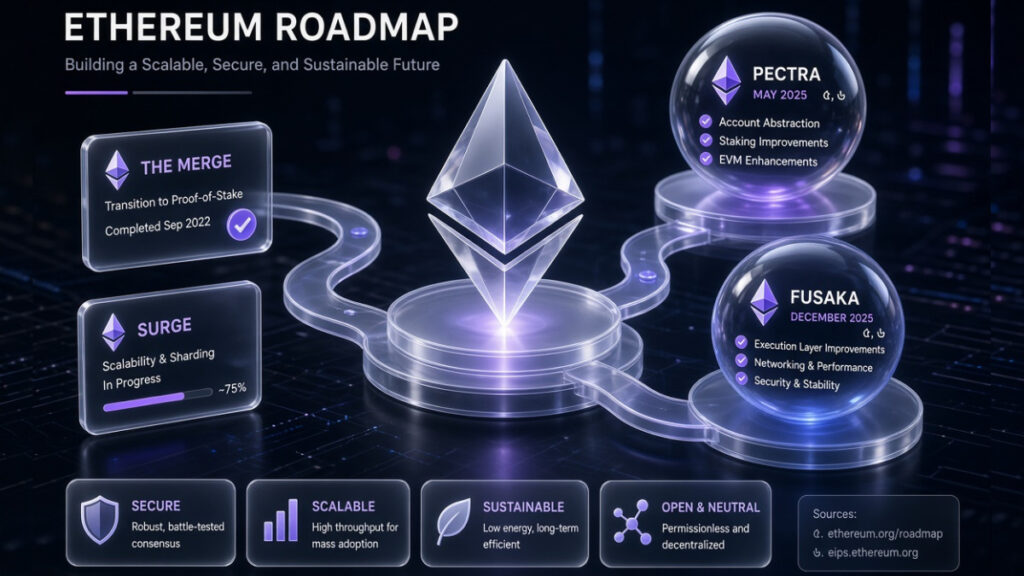
The Ethereum roadmap enters a high-stakes execution phase as developers prepare to deploy the Pectra upgrade on May 7, 2025, to enhance wallet functionality and expand network capacity. This specific update marks a shift toward “smart” accounts and more flexible participation for network validators. Key Pectra features include:
- Smart Wallet Functionality: Users can set Externally Owned Account (EOA) addresses to be represented by smart contract code, enabling transaction batching, fee sponsorship, and advanced recovery mechanisms.
- Staking Flexibility: Stakers can now choose arbitrary ETH amounts to stake and receive rewards on every single ETH above the 32 ETH minimum, rather than being capped at fixed increments.
- Blob Throughput: The network will increase the blob count target from three to six, significantly lowering fees for Ethereum rollups.
This move follows the momentum of the March 13, 2024, Dencun upgrade, which introduced proto-danksharding. By integrating blob transactions, the network successfully reduced transaction costs for layer 2 solutions. “The roadmap is the core researchers’ and developers’ best hypothesis of Ethereum’s most optimal path forward,” said the Official Documentation Team at the Ethereum Foundation.
The Fusaka upgrade follows on December 3, 2025, focusing on data accessibility and network hardening. This fork aims to make node operation more accessible while maintaining strict decentralization. Key Fusaka deliverables include:
- Peer-to-Peer Data Availability Sampling (PeerDAS): This technology enables more efficient data availability for rollups, allowing the network to scale without overtaxing individual nodes.
- Increased Gas Limits: The default network gas limit will rise to approximately 60M from the current 45M mark.
- Security Hardening: A transaction gas limit cap of 16.7M per individual transaction will be implemented to protect the protocol against denial-of-service (DoS) attacks.
Looking toward late 2026, the Glamsterdam upgrade will enshrine proposer-builder separation (ePBS) directly into the protocol. This structural change allows validators to process more data by safely outsourcing complex block assembly to specialized builders. “Adaptability gives Ethereum the flexibility to tackle emerging challenges and keep up with technological breakthroughs,” said the Research Group at ethereum.org.
Glamsterdam also introduces block-level access lists to map dependencies upfront, which facilitates faster syncs and parallel execution. These technical milestones aim to achieve:
- Lower State Costs: Reduced gas fees for state-heavy applications.
- Predictability: Improved gas cost predictability for institutional users.
- Parallelization: Efficient parallel disk reads to boost overall throughput.
Still, the Ethereum roadmap remains an evolving document as new threats and technologies emerge. For instance, post-quantum security is currently a lower priority, with implementation likely five to ten years away. However, a sudden leap in quantum computing performance could accelerate that timeline to protect the network’s cryptographic foundation.
The Hegotá upgrade remains scheduled for 2027, with specific proposals still under active community discussion. The transition toward a fully scaled platform has already seen massive success, notably the September 15, 2022, Paris upgrade, which reduced Ethereum’s energy consumption by 99.95%.
Today, the protocol prioritizes single-slot finality and statelessness to ensure blocks are finalized in seconds rather than minutes. These improvements will eventually allow validators to verify the network without storing massive amounts of data, drastically lowering the cost of entry for node operators.
Regular users do not need to take action to secure their assets during these transitions. Only node operators must update their clients to remain compatible with the mainnet as it evolves. By dropping “shard chains” in favor of layer 2 rollups, the network has chosen a faster, more modular path to global scale. “A network that is able to adapt to new challenges is more likely to succeed than one resistant to change,” said the Development Collective.
Editorial Note: This article was researched and drafted with AI assistance, then rigorously fact-checked, edited, and published by Miles. All content is strictly for informational and educational purposes only and does not constitute professional investment advice. Cryptocurrency and global financial markets experience severe volatility, sometimes swinging 50% or more in a single day. Invest only capital you can comfortably afford to lose, and always consult a certified financial advisor before committing funds. Read my full Disclaimer for more details.
